

For car enthusiasts, it's impossible not to recall the six previous generations of the Mercedes S-Class. As the brand steps into clean energy vehicles (which sell less than combustion engines), this seventh-generation New S-Class facelift recalls past innovations. This car introduced world-first systems and technologies that are now commonplace, such as the anti-lock braking system (ABS) developed in 1978 with the W116 chassis, airbags introduced in 1981 with the W126, and the awe-inspiring double-glazed windows of the massive W140 'whale' model in 1991—known among dealership owners as the S-Class jumbo whale.


Today, the automotive world moves so fast it's hard to keep up. Even automotive influencers known for scrutinizing every model are stunned by the details of the New S-Class. Since China entered the market aggressively, everything has changed rapidly. To maintain its status as the trusted car of heads of state, global leaders, VIPs, prime ministers, and luxury hotel limousines, the S-Class facelift has undergone extensive reengineering—more than half of the vehicle's systems have been rebuilt to upgrade and sharpen its edge.


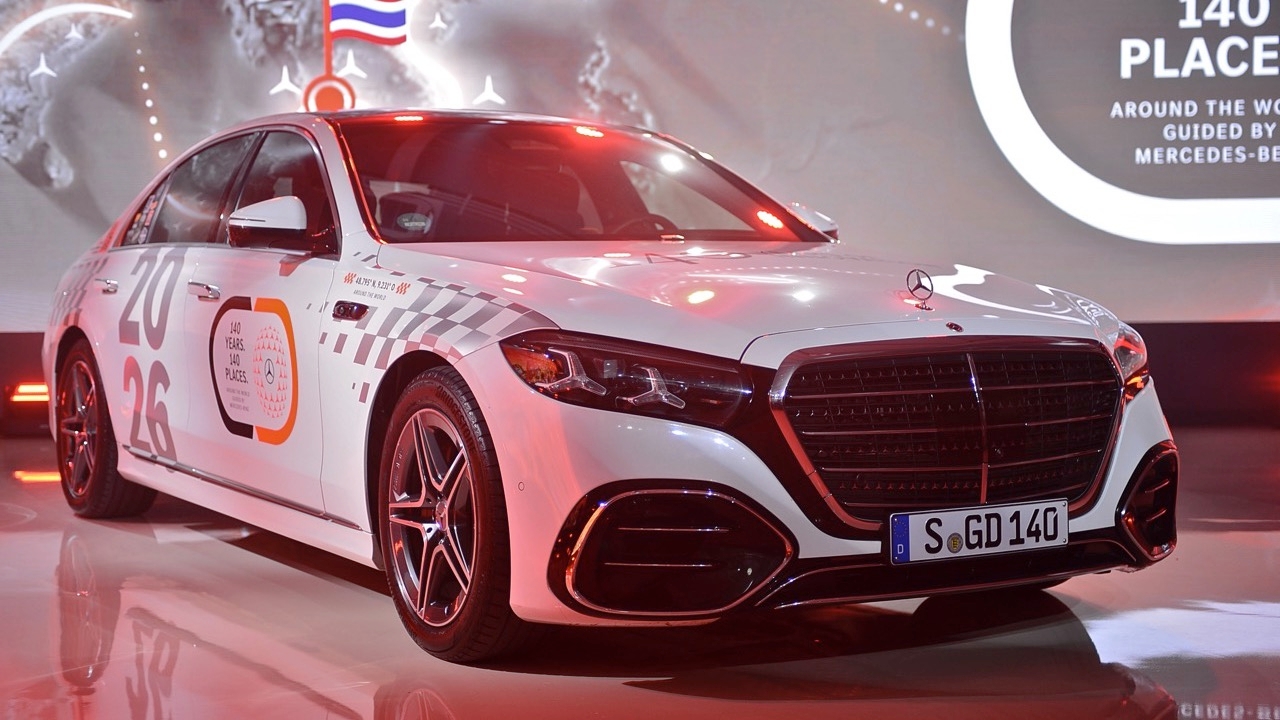
The 2027 S-Class facelift is the most monumental change ever within a single S-Class generation. It features an illuminated grille that's 20 percent larger, accompanied by a strikingly bright three-pointed star emblem reminiscent of Dubai's twilight. It also integrates the latest water-cooled supercomputer MB.OS system, working with the massive Superscreen dashboard display and numerous subtle details hidden beneath the console. Whether this upgrade will be a resounding success remains to be seen. Today, the New S-Class fleet has arrived in Thailand from its German home. After a showcase in the Bangna district, the New S-Class will continue its journey south to Malaysia.


The current challenge lies in technological evolution. Even smaller cars like the CLA Electric are required to include cameras, active driver assistance, and various safety systems, many of which go unused. Family cars now feature automatic parking and voice command systems universally. Moreover, electric vehicles (EVs) from Mercedes and competitors, especially luxury brands from mainland China, have eliminated advantages in power and cabin quietness. Therefore, the S-Class must elevate itself further in an unending battle within the automotive industry.

With the electric vehicle market assigned entirely to the Electric family, discarding the EQ name without hesitation, and vehicle shapes resembling luxury transport seen at hotels or embassies, the question arises: what space remains for traditional limousines like the S-Class? The answer is that the S-Class has become a less controversial model yet remains fully committed to rear seat comfort, matching new entrants trying to compete. Importantly, it demonstrates that vehicles of this type still have vitality and strength, which offers some reassurance to Mercedes sales teams.

This version of the S-Class is more uniquely itself than ever before. While the latest generation originally offered a long list of options, the facelift doubles the advanced technology included. It features the Mercedes-Benz Operating System (MB.OS), developed specifically for this model with superior processing power. It connects various vehicle systems into a single ecosystem and integrates with the intelligent Mercedes-Benz Intelligent Cloud to support over-the-air software updates. It powers the latest MBUX Superscreen spanning the entire dashboard and includes an AI-driven virtual assistant, a Zero-Layer interface displaying everything on the home screen without submenus, and so many functions that even hardcore tech-savvy customers might say, “I don't know.”


The 2027 New S-Class is packed with numerous sensors supporting hands-free autonomous driving from start to finish in countries where it is legally approved (such as China and soon the United States), with plans to expand to other markets later. The car can park itself automatically, features up to 15 airbags, digital air conditioning vents, and heated and cooled seat belts—though the latter might be unnecessary in Thailand's heat, as most people are already very hot before getting in. However, the system can customize cabin air quality and pre-cool the interior on command. Frankly, listing all the performance features and functions would be so lengthy that few would read them all.


This is not a complete overhaul but rather a detailed refinement. The six-cylinder inline engines, including the gasoline plug-in hybrid S580e and the six-cylinder inline diesel in the S350d, are now supplemented by a newly developed M177 4.0-liter V8 gasoline engine with a flat-plane crankshaft, which will soon be used in other Mercedes models as well.
Let's review the current engine options. In Germany, some European countries, and the U.S., the S580 4Matic features a new 4.0-liter twin-turbo V8 engine delivering 535 horsepower and 750 Newton-meters (553 lb-ft) of torque. This powertrain embodies the S-Class's traditional character—smooth, powerful, with a pleasant high-revving engine sound, and a top speed reserved for the Autobahn. Mercedes will not sell this version in the UK or Thailand due to tax rates that deter customers from purchasing such luxury in sufficient numbers to justify import.
The S500 and its sibling the S450 use a 3.0-liter inline six-cylinder turbo gasoline engine producing 443 horsepower and increased torque of 640 Newton-meters. It employs a mild hybrid system to boost fuel efficiency and driving performance. However, compared to the V8 and hybrid versions, the differences are clear.
This leads to some confusion in model naming. The New S-Class offers a plug-in hybrid (PHEV) six-cylinder engine in the S580e model, combining a 28.6 kWh battery with a 3.0-liter inline six gasoline engine. Mercedes claims an electric-only range of about 96 kilometers and a fuel efficiency of approximately 24.78 kilometers per liter. When the battery is nearly depleted, fuel consumption shifts to about 13.5 kilometers per liter, which is still economical for the vehicle's size and weight. This plug-in hybrid delivers a strong 576 horsepower to the road. The naming causes confusion because this PHEV is labeled S580e.
Additionally, diesel engine enthusiasts have two six-cylinder inline clean-running options: the S350d and S450d. Wealthy customers can order only the S350d with 330 horsepower, which claims fuel efficiency of 15.64 kilometers per liter. Although this seems a balanced and cost-effective choice, in the S-Class's large form, the diesel engine runs extremely smoothly at idle and can accelerate impressively.

If you recall, the powerful AMG S63 E Performance debuted at the end of 2022 as a high-performance limousine equipped with a 4.0-liter twin-turbo V8 gasoline engine (a different block than the 2026 M177 Evo in this facelift) combined with a plug-in hybrid system. It produced an astonishing 791 horsepower and 1,430 Newton-meters of torque. However, this model is not part of the current facelift lineup. Thus, the S580e—officially named “S580e with Plug-in Hybrid Technology”—is currently the fastest S-Class in Thailand, accelerating from 0 to 100 km/h in just 4.4 seconds. Interestingly, the pure V8 engine model is not the quickest but still holds a clear and solid role.

The competition remains familiar: the BMW 7 Series, soon to be redesigned under the 'Neue Klasse' name; the top-tier luxury Audi A8L; and the upcoming Hongqi electric vehicle launching in Thailand early next month. Historically, wealthy buyers understand that the S-Class is not a car that adapts quickly to social trends. The W140 double-glazed 'whale' debuted during a global economic downturn with a bulky, unappealing design. Its successor, the W220, adopted a more subdued look during economic recovery periods.


In this latest facelift, Mercedes seems to have shed some modesty. The headlights, named 'DIGITAL LIGHT,' use intelligent Micro-LED technology with a double-star graphic, adjusting the beam according to conditions and expanding illumination area by 40 percent. The front air intakes are larger, and the taillights now feature a three-pointed star pattern. Overall proportions maintain dignified executive car styling, clearly targeting tastes in other markets, especially China and America, rather than focusing solely on traditional European preferences.


With a body length nearing 5.3 meters and width of 1.92 meters, the long wheelbase version extends its wheelbase to 3,216 millimeters, resulting in exceptionally spacious legroom and knee space inside—described as 'vast as a sea.' No matter which seat you recline in, especially the rear cabin, the interior feels airy and roomy beyond what the exterior silhouette suggests. While it may not match the flat, expansive space of some modern electric vehicles, it remains impressively generous.


The four-seat interior layout (separate rear seats) is a best-selling option. It includes a long center console extending from front to rear, now featuring hidden storage, wireless phone charging with fast-charging support, smart USB-C ports for gadgets, a small refrigerator, and cup holders with adjustable hot and cold settings. The new S-Class also offers foldable work tables, two iPhone-style remote controls embedded centrally for executives to operate everything—from sunshade and climate control to dual 13.1-inch entertainment screens. Additionally, upgraded in-car cameras support smooth online meetings via Zoom or Microsoft Teams during travel.


This comprehensive facelift covers the entire vehicle. The exterior styling hasn't dramatically changed, which is Mercedes' deliberate choice to avoid alarming conservative customers. Whether this cosmetic refresh truly enhances the car's elegance is subjective. Yet one undeniable fact is that a major transformation has indeed taken place.


Overall, since the seventh-generation S-Class debuted, competitors and industry standards have advanced significantly. As the acknowledged leader in technology and luxury, Mercedes-Benz had to dismantle and thoroughly upgrade the vehicle. The brand cannot allow junior models or lower segments to surpass its flagship standard-bearer. Whether the addition of massive screens and extensive technology delivers maximum user satisfaction remains debated. It seems the biggest leaps in automotive innovation today are occurring elsewhere.


Ultimately, the S-Class remains one of the most impressive luxury cars ever made. Although part of its charm today stems from a 140-year legacy and established reputation, the S-Class continues as the undisputed leader among luxury vehicles. However, its prestige and aura may no longer shine as radiantly as in past eras.