

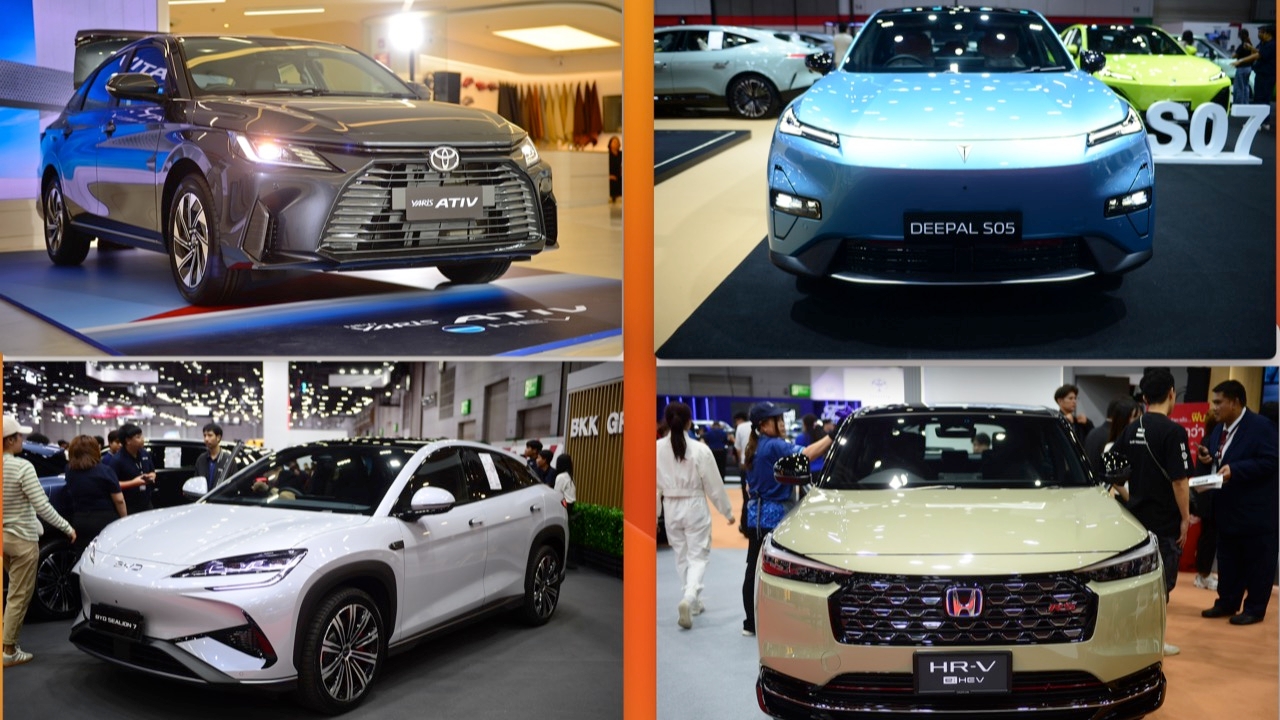
From the perspective of ergonomics and lifestyle, retirees aged 60-65—whether still doing light work or fully retired focusing on health—show a marked change in car preferences compared to their younger years. The time of liking low sedans modified for sportiness in youth has passed. Although the interest in modified cars remains, the body now demands vehicles that allow easy entry and exit without bending or climbing. The former habit of bending repeatedly is replaced by a focus on comfort and ease of use.

If one has substantial savings to spend freely in later years (though this is a small percentage), choosing a premium European car might offer many options. But for those with limited savings buying an ordinary car priced under a million baht, prioritizing economy and ease of entry and exit without crouching or squeezing in, a crossover higher than a sedan is likely more practical than the low cars they've driven all their lives.


Based on studies of senior Thai drivers, cars suitable for people aged 60-65 have features and segments that meet their needs well. Without emphasis on luxury or showing off wealth, choosing a Japanese hybrid (HEV) is economical. For those who see their future as close at hand, traveling short distances to buy groceries, visit friends occasionally, and drive less far than before, and who have space to install a home charging point, selecting a Chinese electric vehicle is not intimidating. Seniors aged 60-65 tend to favor EVs over gasoline cars mainly due to cost savings—no need to buy expensive fuel—and short daily drives under 100 kilometers or infrequent trips make clean-energy vehicles suitable for short trips without charging worries.

Annoyances for those aged 60-65 using EVs include downloading charging station apps and connecting the car to chargers. Initially, confusion and frustration arise when charging fails or when chargers cannot connect to the vehicle. For those concerned about this but still interested in EVs over gasoline cars, home charging without relying on public stations for short trips seems the best solution.

Suitability is key for those over 60 when choosing a car—preferences shift with changing bodies. Most 60-65-year-olds remain strong and mobile, though slower, and have good health. If the current car does not cause ergonomic issues entering or exiting, and is still reliable and well-maintained, there is little reason to replace it unless finances allow indulgence in later life. Most seniors focus on economy, seeing their future more clearly due to life experience. Choosing a vehicle that fits their savings is a personal decision.


For those with knee, joint, or spinal disc problems affecting overall health while driving, using low sedans or traditional sports cars often directly impacts knees and back. The effort of stepping down into a deep seat or struggling to get out can cause significant discomfort or worsen pain.

They prefer a hip-level seat height. Compact crossovers or SUVs with doors that allow sitting down without bending or climbing are ideal. Pickup trucks or high-lift PPV SUVs are too tall, requiring hanging on and throwing oneself inside, which becomes difficult as strength declines with age.
Good visibility is also important. The A-pillar should not be thick, and the windshield broad, as eyesight at 60 starts to decline in distance and night vision. Cars with large front windows, minimal blind spots, and slightly raised height help extend vision and increase driving confidence.
Simple, clear physical controls for basic functions are essential. Separate buttons for adjusting side mirrors, air conditioning, and audio volume are easier to use than navigating menus on a central touchscreen. People in this age group dislike overly technical systems that are hard to operate. Chinese EVs often require touchscreen commands for mirror adjustment, temperature control, panoramic roof shades, and audio settings. Physical buttons that can be felt and pressed without looking improve safety by allowing drivers to keep their eyes on the road.

SUVs and crossovers are popular among retirees because their moderate height allows easy entry and exit without crawling or squeezing. Their wide visibility suits reduced eyesight and avoids the need for dark sunshades that can cause problems in rainy night conditions. Vehicles should be moderate in size, maneuverable in cities and comfortable on long trips, able to carry grandchildren or cargo for charity, social visits, or exercise outings conveniently.

Toyota Corolla Cross and Yaris Cross feature smooth, quiet hybrid systems, easy driving, and reliable long-term service centers, with minimal maintenance hassles.


Honda CR-V and HR-V offer spacious interiors with higher seating than sedans. Rear seats fold flat to comfortably accommodate luggage, plants, or bicycles with the front wheel removed.


Nissan Kicks e-POWER appeals to those who like electric driving without the hassle of finding charging stations. Its 100% motor-driven propulsion provides smooth response controlled by a single pedal.


Changan S05 REEV is a range-extended EV with a 1.5-liter engine generating electricity for the battery without driving the wheels. At low speeds, it achieves fuel efficiency around 17-19 km/l. For heavy-footed seniors used to driving fast, at highway speeds the fuel consumption rises to about 10.5 km/l, which is less efficient than Japanese HEVs that still manage 15-16 km/l at higher speeds. Driving the REEV at city speeds (50-60 km/h) uses mostly battery power with less frequent engine running, making it more suitable than high-speed highway driving where fuel consumption surges.

The attitudes and behaviors of Thai seniors aged 60-65 toward Chinese EVs have changed notably. Three to four years ago, this group, long accustomed to Japanese gasoline cars, viewed EVs as toys for youth or new tech like smartphones. Now, more seniors in Thailand accept Chinese EVs, influenced by children who own EVs or personal test drives, appreciating quietness and economy more than acceleration.

The share of EV buyers aged 40 and above rose slightly from 33% in 2024 to 38% in 2025 and continues growing in 2026. This indicates that confidence in electric drivetrains is no longer limited to Gen Y or those under 40 but is spreading among Generation X and retirees seeking suitable alternatives for post-career life.


Over 80% of BEV registrations in Thailand are Chinese brands like BYD, Changan, GWM, MG, and AION. Their affordable prices and many high-body SUVs/crossovers offer options under 800,000 baht with features surpassing older cars. Importantly, they cost less, making Chinese EVs attractive new vehicles for the 60-65 age group after retirement.


More than 81% of EV users in Thailand previously drove gasoline cars. For 60-year-olds who have driven many vehicles since youth, buying a Chinese EV is mainly for short to medium trips—market visits, temple visits, hospital appointments, or driving grandchildren with the air conditioner on without turning off the engine, unlike gasoline cars. Their gasoline cars remain available for longer trips.
Seniors aged 60-65 generally do not care about acceleration times or sporty driving modes. They appreciate quietness, minimal vibration, and no combustion engine noise, which reduces travel fatigue. The moderately raised height of many Chinese crossovers or SUVs allows comfortable entry and exit.
With no regular income from work, reducing fuel costs by switching to electricity—typically 3 to 4 times cheaper—is a compelling saving for today's seniors managing retirement funds.

However, drawbacks exist. Despite increased EV purchases by seniors, studies on quality and satisfaction find Chinese EVs still have issues causing discomfort or difficulty for those aged 60-65.

Chinese EVs often place all controls on a central touchscreen, removing physical buttons for mirror adjustment, air conditioning fan, or audio volume. Users must navigate menus and tap screens to operate these functions. Common complaints among older users include difficulty finding the air conditioning control or screen lag. Seniors dislike complex menus and scanning QR codes to operate systems or charge vehicles.
Concerns about public charging include difficulty downloading station apps, linking credit cards, or app crashes. Even experienced automotive media testers struggle to reach remote chargers. Seniors prefer home charging via a wallbox left overnight, ideally with properly sized and standard wiring to prevent overheating. Public charging system complexities remain technological barriers affecting EV usability for older users.

Thai seniors aged 60-65 choose Chinese EVs for value, comfort, and relaxed driving. In the near future, Chinese brands that rely solely on touchscreens without separate physical buttons or have complicated backend systems will lose favor among retirees—a growing and increasingly affluent consumer segment as Thailand’s population ages.