

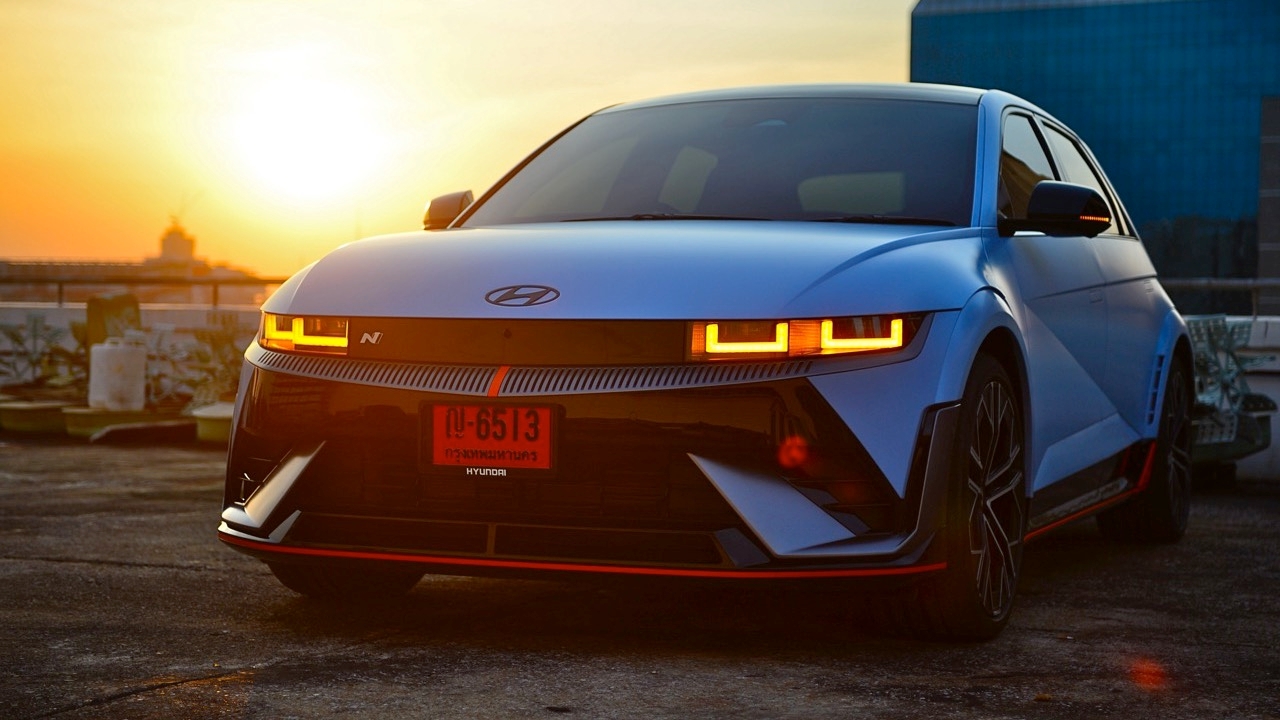
The IONIQ 5 N is a curious mix of a large hatchback and a race-tuned package for smooth track racing. It boasts dual electric motors delivering 650 horsepower, all-wheel drive, and torque between 740 and 770 Nm. This is a legendary, fiercely aggressive contender. While most high-powered EVs overwhelm petrol enthusiasts with massive horsepower and torque yet still fall short of the internal combustion feel, the technology in the IONIQ 5 N strives to convince drivers that it is an internal combustion car—except for the twin-motor pull that a 2.0-liter engine could never match, or could only achieve at an unaffordable price.


The development of the IONIQ 5 N has been overseen by German engineers from BMW M. It’s an electric car tuned to drive like a high-performance internal combustion vehicle. Today’s high-powered EV market covers all segments, with cars like the Tesla Model 3 Performance, BMW i5 M60, MG, Lotus Eletre, and Porsche Taycan already powerful. On the Chinese side, the BYD Seal offers over 500 horsepower at Accord and Camry pricing, while MG’s iM6, priced at 1.6 million baht, delivers 600 horsepower. With prices like these, buyers often spend extra on suspension and brakes for confidence. This is a new era where half-a-thousand horsepower isn't limited to the wealthy, tuners, or car experts anymore.


The IONIQ 5 N produces 650 horsepower priced at 3.7 million baht, while some Porsche 911 models costing 15 million baht have less power. This car isn’t just about horsepower without proper handling. It’s nurtured by German experts who have shifted to assist a Korean brand, some with prior experience in high-performance cars. After completion, it underwent rigorous testing at the Nürburgring track and icy roads in Arjeplog. The suspension was tuned to ensure that although it cannot respond with the nimbleness of light cars like the GR86, many testers agree it’s a heavy two-ton vehicle that responds like a 1.7-ton car, accelerating to 260 km/h quickly—a perfect match for all performance enthusiasts.
Key Features of the Hyundai IONIQ 5 N
Differences from IONIQ 5 and IONIQ 5 N Line


The 5 N incorporates aerodynamic parts distinct from regular EVs—not just for style but functional cooling. Engineers optimized airflow for cooling various components. The subframe and suspension mounts differ from the standard IONIQ 5, with heavy-duty motor mounts, battery mounts, and additional 42 spot welds plus industrial adhesive bonds extending 2.1 meters on the body to enhance torsional rigidity during acceleration, braking, and cornering. Comparing the IONIQ 5 and 5 N is like comparing a Mitsubishi Lancer 1.8 CVT to a Lancer Evolution 8MR—the difference is that significant.


The Ioniq 5 N's dimensions differ from the standard Ioniq 5, being 20 mm lower at 1,585 mm, 50 mm wider at 1,940 mm, and 80 mm longer at 4,715 mm. The front track measures 1,628 mm and rear 1,638 mm, with a 3,000 mm wheelbase and 160 mm ground clearance. The front features a new splitter, air panel, and air curtains; the rear has a unique spoiler, prominent diffuser, triangular brake lights, and a rear wiper unlike the standard model. It rides on forged 21-inch aluminum wheels wrapped in Pirelli P Zero 275/35ZR21 tires.


The interior departs from the standard Ioniq 5 with a race-inspired design crafted by Hyundai’s N division. The leather-wrapped steering wheel is visually striking and offers excellent grip, featuring N buttons including N Grin Boost. A new gear lever is positioned below the turn signal stalk. The center console is designed for track driving with motor-sport-inspired gauges and displays. N sports seats combine standard leather and Alcantara, with manual racing-style adjustments. Controls are designed for ease, avoiding cluttering the central touchscreen. The round instrument cluster is customizable and resembles combustion engine gauges, showing simulated RPM, speed, and gear position, clearly mimicking fuel-powered cars.

The IONIQ 5 N features adjustable torque distribution, operable in both AUTO mode and manual control. Drivers can send 100% torque to the front (disabling rear motor), 100% to the rear, or any ratio in between. (Tesla Model 3 Performance has similar capability.) For buyers aiming to hone driving skills, this means one car can train front-wheel-drive snap understeer at launch, rear-wheel-drive drifting, Scandinavian Flick rally techniques on slippery surfaces, or balanced all-wheel-drive handling with 40% front and 60% rear torque—all adjustable on-screen anytime.

Sound is another key aspect. Many petrol car enthusiasts insist on engine noise, though not everyone prefers it loud—some want just enough to evoke emotion and excitement. Cars like the Porsche Taycan, Mercedes EQE53, and BMW EVs have synthesized sounds, sometimes selectable. Similarly, the IONIQ 5 N offers three sound modes. I won’t judge which sounds best without hearing in person, but options include a Hyundai 2.0-liter turbo engine mimic, electric motor sounds, and jet engine tones. While synthetic sounds may seem silly in combustion cars, for usually silent EVs, a well-crafted soundscape enhances driving emotion, rather than just futuristic whines or alien-like noises of unclear purpose.


Hyundai’s N division resembles BMW M, Mercedes-AMG, Audi Sport, Nissan Nismo, and Toyota GR Sport. The concept of adapting an all-wheel-drive electric hatchback like the Ioniq 5 with over 600 horsepower motors, an N Grin Boost button for 10-second power bursts, and 0-100 km/h acceleration in 3.4 seconds matches Ferrari 458's performance. This acceleration lets the Ioniq 5 N leave behind a 3-million-baht Honda Prelude without effort. Its top speed is 260 km/h, placing it among the world's fastest EVs. The straight-line acceleration is controllable via torque distribution software, which allows equal front-rear torque or 100% rear for drifting with a fingertip swipe. The 700 Nm torque on the rear axle alone could easily shred tires, as confirmed by local tuner U Spin 9.


The N brand is Hyundai's official high-performance division, akin to BMW M or Mercedes-AMG. It specializes in enhancing standard Hyundai vehicles to elevate performance, injecting more driving fun closer to motorsport levels. The first N car sold in the US was the Veloster N, which quickly earned the 2020 Car of the Year award. Following this, the Elantra N was introduced with superior speed and handling, alongside the fun front-wheel-drive Kona N crossover. In Europe, Hyundai N markets include the i20 N and the excellent i30 N hot-hatches, followed by high-performance electric models like the Ioniq 5 N and Ioniq 6 N.
The N brand’s history centers on engineering excellence. However, creating a worthy N version of the Ioniq 5 was unprecedented for Hyundai. The Ioniq 5 N is the brand’s first high-performance electric vehicle, powered by the latest software and a fundamentally different platform and electric drivetrain from the standard Ioniq 5. Transforming the Ioniq 5 into a driver’s favorite was a major task for this South Korean EV. Hyundai crafted a special electric car capable of high speeds and precise cornering near race car levels, complete with a soundtrack reminiscent of combustion engine sports cars.


The Ioniq 5 N uniquely resembles a race-prepared hatchback, simulating the feel of a dual-clutch transmission using software to control dual motors. It mimics the RPM behavior and driving dynamics of internal combustion engines. For driving enthusiasts, this trio—gear simulation, motor tuning, and driving dynamics—creates thrilling EV engagement, usually lost in typical single-speed electric cars. The Ioniq 5 N’s entire drivetrain is software-tuned, including N e-shift, to give the sensation of driving a clutch-equipped, engine-powered car. Hyundai’s engineers developed specialized torque curves to emulate gear changes in race cars, producing continuous torque surges near simulated redline RPMs. Accompanied by engine sound simulation, the Ioniq 5 N feels like a 2.0-liter turbo engine revving high, not just a silent EV racing fast without exciting sound.


Built on the Electric-Global Modular Platform, Hyundai leverages expertise from its EV lab, known for producing innovative prototypes like the 810-horsepower RM20e, 570-hp RN22e, and 670-hp hydrogen-powered N Vision 74. The Ioniq 5 N features an 84 kWh battery and front and rear electric motors, with improved continuous torque transfer. The front motor delivers 166 kW (222 hp), the rear 282 kW (378 hp), totaling 448 kW (601 hp). In N Boost mode, power peaks at 478 kW (650 hp), outclassing any sports car priced around 3.7 million baht.


With an average torque of 700 Nm, the Ioniq 5 N accelerates 0-100 km/h in 3.4 seconds and achieves a top speed of 260 km/h. Hyundai N products avoid boasting raw numbers, instead focusing on delivering a true sports car feel akin to race cars. Beyond acceleration and top speed, Hyundai N cleverly appeals to petrol car enthusiasts skeptical of EVs by embedding the spirit, emotion, and tactile feedback of combustion engines. This balance makes the Ioniq 5 N a unique marvel globally. Its intensity even makes cars like the Porsche Taycan Turbo, BMW i5 M60, and AMG EQE53 4Matic+ seem unusual. It’s surprising that German brands abandoned engine sounds in high-performance EVs, while Hyundai includes a soundtrack evoking Tom Cruise chasing alien spacecraft.


Regarding charging, this high-performance model features an 800-volt electrical system and an 84 kWh battery. It supports DC fast charging from 10% to 80% in 18 minutes, with a peak rate of 238 kW. A two-stage inverter powers the dual motors up to 478 kW (650 hp) and 740 Nm torque. Maximum power is available in the special N Grin Boost mode, activatable via touchscreen or automatically after 10 seconds in N mode. Caution is advised when unleashing full power. Braking performance is vital, as high power requires stronger braking than typical combustion cars for safety. The battery cooling system is upgraded with a dedicated radiator to cool battery and motors separately. Heat extraction from battery cells and motor cooling are optimized. The battery cooling system is designed to resist energy degradation from heat better than typical EV systems, outperforming competitors’ high-performance electric vehicles.


Testing at Nürburgring showed the battery and motor cooling system enables sustained high-performance driving without heat buildup. A new efficient radiator and enhanced front airflow cool the battery, aided by a high-pressure electric pump circulating coolant faster through battery cells. Hyundai’s innovations extend beyond hardware; sophisticated cooling software maintains optimal battery temperature. The Ioniq 5 N offers two preconditioning battery temperature settings: one for daily driving or intense track use with temperatures between 30-40°C to maximize output for short bursts, and a Race mode maintaining 20-30°C to stabilize battery energy during prolonged high-speed track runs.


Designed for racing, the Ioniq 5 N’s structure is reinforced with 42 additional weld points and industrial-grade adhesive bonding, increasing torsional stiffness against twisting forces during racing or drifting. Hyundai engineers describe the car's handling as rally-like. The motor-driven power steering rack features a quick ratio, matching increased torque. The N Pedal mode enhances cornering by allowing entry without braking beforehand while maximizing regenerative braking, which recovers kinetic energy during deceleration to recharge the battery.


The vehicle’s electronic systems not only increase speed but also introduce innovative EV control concepts. The user-friendly menu allows drivers to customize settings easily, including engine sound modes ranging from a furious internal combustion imitation to jet engine or alien spacecraft sounds. The synthetic combustion engine sound is surprisingly effective, realistic, and engaging.
The emulation of combustion car sensations extends beyond sound, suspension, and steering to an 8-speed paddle-shift transmission simulation—the first of its kind in EVs. The single-speed Ioniq 5 N’s software mimics the lively response of an 8-speed dual-clutch gearbox. The engineers created authentic experiences, including torque management across four wheels to simulate gear shifts. When simulated RPM hits the 8,000 redline, torque surges replicate gear changes, infusing combustion spirit. During hard braking before corners, the system downshifts up to three gears, with simulated rev-matching and engine roars mimicking a 2.0-liter turbo race car. No other EV brand has achieved this. The Ioniq 5 N is a high-tech marvel with finely tuned systems that feel natural—so much so that one forgets it’s software, not combustion explosions and clutch gear shifts, delivering this experience.


The best way to describe the Ioniq 5 N’s behavior is as a BMW M3 G80 with xDrive, blending N Electric’s character with the maturity of a hatchback. You feel the mass in tight corners but not as much as in heavy luxury German EVs, which exhibit noticeable understeer and steering resistance under heavy cornering. The Ioniq 5 N effectively conceals its 2.2-ton weight with agile steering and excellent weight transfer. The battery's floor placement ensures a low center of gravity. Engineers enhanced chassis stability and integrated stability control for confidence at speed. Balanced torque distribution to all wheels depends on accelerator and steering input. On one occasion, I nearly experienced oversteer entering a corner too fast, but stability control quickly corrected the car’s balance.
Thanks to all this technology, drivers clearly sense that the Ioniq 5 N is a high-level EV with aggressive power delivery. Its 740 Nm instant torque launches it like a slingshot. Its 2.2-ton weight isn’t problematic in tight, fast corners due to suspension tuning and intelligent power distribution. In N all-wheel-drive mode, grip is strong with no loss of control near limits or power drop-off. It’s challenging to assess the Ioniq 5 N’s true capabilities on public roads. For full enjoyment, a standard race track with ample runoff, like Chang International Circuit, suits the car’s high-speed potential better.


The Ioniq 5 N offers three selectable synthetic engine sounds. The Engine Sound mode is the best, closely resembling internal combustion engines. Evolution and Supersonic are more spacey; personally, I dislike synthetic sci-fi sounds. The Engine Sound mode is realistic and exciting. Evolution features a high-pitched electric motor whine. In N mode, selecting Engine Sound and flooring the accelerator produces explosive backfire sounds from virtual race exhausts. At idle, the synthetic engine mimics a racing engine’s fluctuating idle RPM. Lifting the accelerator triggers loud backfires from rear cabin speakers. Supersonic sounds like a jet engine unrelated to cars, with sonic booms heard inside upon gear changes—oddly inspired by Top Gun Maverick.


Weighing 2.1 tons, the Ioniq 5 N turns quickly. It's a nimble, fast EV with rapid straight-line acceleration. Its 0-100 km/h time surpasses the BMW M2 CS. Steering is lighter than the 600-hp AMG GT-R I drove at Buriram Circuit. The heavy weight doesn’t hinder fast, tight cornering from turn 10 to 18 at Korea International Circuit, which is full of tricky bends. Torque vectoring across four wheels ensures excellent grip, reminiscent of an Audi RS 3 Quattro but with double the power. Stability control manages the vehicle’s mass well, enabling sharp, fast turns with surprisingly light steering. In city driving, the accelerator is sharp and aggressive, requiring caution. The real fun comes from learning each driving mode, then testing them on the track to understand and feel the car’s capabilities.
The N Drift Optimiser was disabled due to insufficient space and to avoid destroying P ZERO tires with aggressive drifting. This software mode sends 100% torque to the rear axle, cutting front motor torque to zero except for minimal electronic feedback, allowing controlled oversteer with rear wheels spinning and tire smoke. Torque split between front and rear is adjustable via a slider on the central monitor, from full rear-drive to full front-drive. N Drift Optimiser disables all aids, letting drivers throttle and steer aggressively for drifting. It simulates a fake clutch realistically, delivering massive torque to the rear tires. This mode demands patience and skill in throttle and steering control, is not recommended for beginners, and requires a safe closed area.


The N Race mode is specially designed for track use in the Ioniq 5 N and includes two additional modes: Sprint and Endurance. Sprint focuses on timed laps, providing maximum battery power to the motors. Endurance prioritizes longer distances with energy management. Both modes enhance track performance with exciting simulated engine sounds throughout. The goal is either fun or lap time improvement, depending on choice. During development, BMW veteran Biermann, who has led R&D for Hyundai, Genesis, and Kia since 2015, reported that the Ioniq 5 N can complete two 23-km Nürburgring laps before battery power diminishes.
All these features are thoughtfully designed to enhance enjoyment, driver-vehicle interaction, and the passion combustion engine drivers have. The Ioniq 5 N acts as a portal to future possibilities—a high-performance electric vehicle that drives like an internal combustion car. This is both incredible and encouraging.


The Hyundai Ioniq 5 N comes with high-performance brakes (though I wish they were larger), including 400 mm (15.7-inch) front discs with orange four-piston calipers bearing the N logo, and 360 mm (14.1-inch) rear discs with single-piston calipers also painted orange. The regenerative braking system has been upgraded to provide 0.6 G deceleration, blending regenerative and hydraulic brake feel like a race car. N Race mode offers settings for 'Endurance' and 'Sprint'—the first reduces peak power for long-distance driving, the second prioritizes maximum power for balanced stability at speed. The suspension features a front sport MacPherson strut with tuned springs and anti-roll bar; rear suspension is multi-link with springs, shocks, and anti-roll bar.
The independent drive axles take inspiration from Hyundai’s World Rally Championship cars, reinforced to withstand the immense torque of electric motors while reducing weight. The steering column is strengthened for better response, with a quicker ratio power steering system and enhanced torque feedback. The N Pedal improves accelerator response and vehicle sensitivity. Using i-Pedal, which applies regenerative braking to slow the car and recharge the battery, aids weight transfer and sharp cornering. Drift optimization tools and 11 torque distribution settings between front and rear axles are available. An electronic limited-slip differential enhances cornering performance.


Today, electric vehicles face a tough challenge to break internal combustion cars’ acceleration records. With abundant torque and strong road grip, most EVs still lack driving enjoyment. Drivers transitioning from combustion engines value dynamics, control feel, lightweight bodies, perfect gearboxes, excellent cornering stability, high-revving engines, and authentic exhaust sounds produced by valve-controlled ignition to evoke deep emotion. These qualities define combustion sports cars but are absent in most EVs—except the Ioniq 5 N.


No manufacturer had cracked this code until Hyundai introduced the Ioniq 5 N. Among competing EVs, most lack engine sounds or produce unreal noises absent in the real world. They have no engine vibrations, idle sounds, revving, or explosive gear-shift noises. High-performance EVs typically tune steering and suspension, adding odd soundtracks that sound alien. Ninety-nine percent of EVs feel soulless and silent despite marketing claims of orchestral space sounds created by world-class composers. The Hyundai Ioniq 5 N is the first to win over combustion engine skeptics by cleverly incorporating elements beloved by petrol heads into an EV.
The Ioniq 5 N is a sporty hatchback merging advanced technology and N brand motorsport experience to push electric vehicle performance limits. It changes the game in high-performance EVs. Its significant development will boost Hyundai’s future competitiveness across all models. It’s expected to launch in Thailand at a price below Mercedes-AMG EQE53 and even BMW i5 M60.