

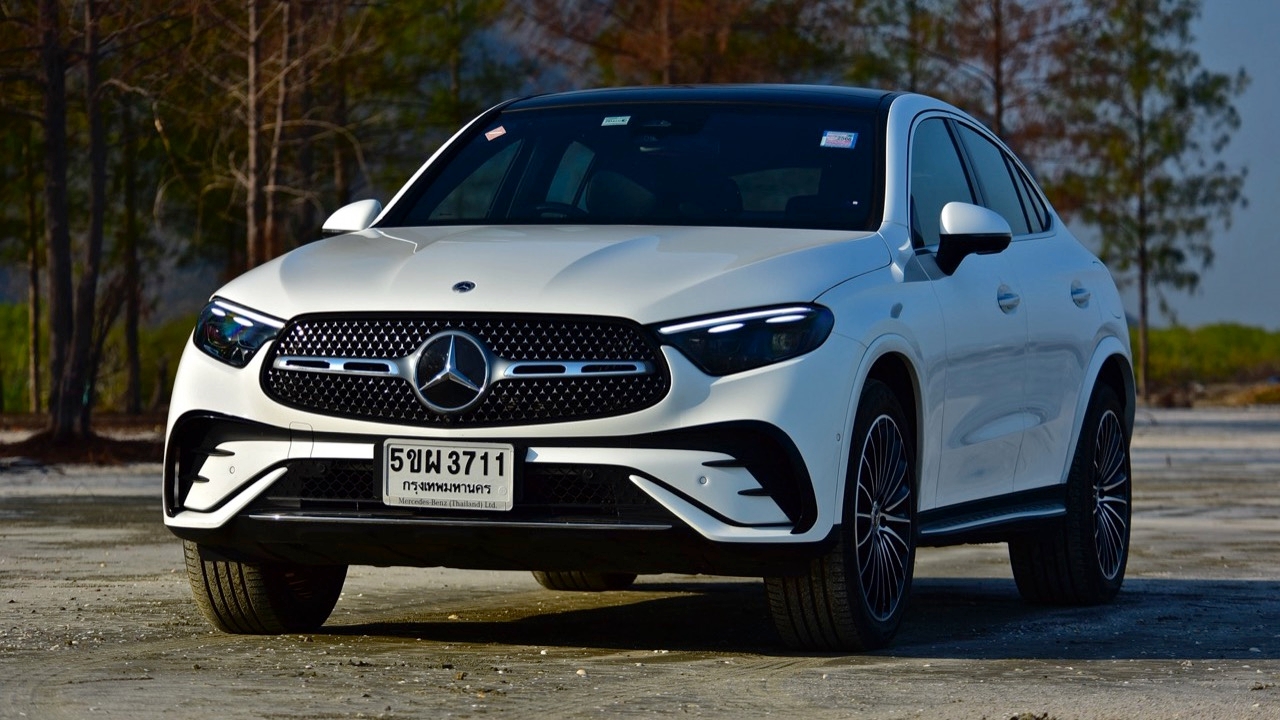
Simply put, this star-branded SUV is the new Mercedes GLC model with a more rounded roofline than before. The GLC has entered its second generation, and given the current popularity of SUV Coupes across brands, launching a coupe version was inevitable. This is the new model we see now. Its most significant competitor is undoubtedly the BMW X4, but other rivals include the Audi Q5 Sportback (again, the coupe variant of the Q5 SUV – notice the pattern), as well as the Range Rover Evoque and Porsche Macan, all positioning themselves as stylish, attractive choices.


What has changed in the GLC Coupe compared to the previous model? The new Mercedes-Benz GLC350e AMG Dynamic, priced at 4,240,000 baht, is slightly larger than its predecessor. The new coupe body is 31 millimeters longer and 5 millimeters taller. Mercedes designers focused on enhancing cabin width by extending the wheelbase and slightly increasing track width. The size difference is barely noticeable. Overall, the design is excellent, providing great seat usability for four passengers; the rear seats comfortably accommodate two adults or two adults plus a child, though side space is somewhat limited (6 mm at the front and 23 mm at the rear). This results in a modest increase in interior space. The drag coefficient improved slightly to 0.27, a three-hundredths reduction that is practically imperceptible.


The New GLC-Class Coupe Plug-in Hybrid features Digital Light headlights, similar to those on the New S-Class. This system integrates three powerful LED modules in each headlight, which refract and control the light beam to avoid dazzling vehicles ahead or oncoming traffic. Using micro-mirror technology with 1.3 million pixels per side, it not only adjusts beam angles for high-resolution lighting but also offers new functions such as illuminating lane markings, road shoulders, and warning symbols on the road ahead.


Design changes resemble those on the standard GLC SUV, consisting mainly of minor tweaks rather than a complete overhaul. Notice adjustments to the headlights, grille, lower front bumper, wheel arches, and taillights. Compared to the older model, the new car looks more modern with elongated LED taillights linked together. The rounded rear pillars flow smoothly into the rear and the stylish tailgate design. The electric tailgate with sensor-activated automatic opening reaches a maximum angle, making loading cargo very easy. However, it's advisable to use a protective mat since the soft carpet lining in the trunk is prone to scratches when heavy items are placed inside.


The new Benz GLC Coupe isn't particularly spacious as a utility vehicle, but it emphasizes stylish looks and practical performance. The standard GLC 220d I tested in 2025 offers a 620-liter cargo capacity, bigger than all main rivals (X4/Q5 Sportback). However, converting the rear into a more attractive coupe style reduces trunk volume to 545 liters. The vertical cargo space shrinks considerably due to the rear window’s curved angle following the rear pillar, making it challenging to load tall items. But buyers of this model likely have another vehicle for transporting plants rather than using their luxury star-branded car to haul potted plants and risk dirtying the carpet!


The interior, similar to the New C-Class, represents a new level of full digital vehicle integration. The large central screen resembles that of flagship models. Interior trim borrows display and user interface concepts from the New C-Class but is adapted with sportier parts and decorations. The central monitor is angled perfectly at six degrees, slightly offset towards the driver, making it easier to view and operate via touchscreen.


The instrument panel divides into upper and lower sections flowing into an airplane wing-like design, featuring new circular flat air vents. Mercedes-Benz engineers say this design evokes the wing parts of an aircraft for driver and front passenger. The interior emphasizes luxury and premium materials, with open-pore brown veneer and black wood veneer trimmed with aluminum parts complementing the dashboard’s curves. The dashboard is wrapped in faux leather with nappa-look stitching, standard in the AMG Dynamic model.


Sport seats use layers and surfaces crafted for softness and comfort. The headrests are entirely redesigned, integrated into the seatbacks with seamless covers and adjustment mechanisms. The dashboard features modernized, high-resolution LCD displays with customizable layouts. A 12.3-inch digital instrument cluster and an 11.9-inch vertical touchscreen—about an inch smaller than the S-Class—are included. Dual-zone automatic climate control, Comfort Seats with electric adjustment and memory for driver and front passenger, four-way electric lumbar support, and split-folding rear seats (60:40) complete the setup.


The AMG sport three-spoke steering wheel includes multifunction switches. Remote engine start is possible via key fob, alongside a push-button ignition. Interior trim uses H64 Metal Structure elements on the dashboard and upper door panels, wrapped in Nappa-look leather. The central console features high-gloss black finishes. Ambient lighting offers 64 colors. Aluminum pedals and AMG floor mats are standard. The digital displays can be set to three layouts, including a "Sporty" mode emphasizing red tones, with a dynamic-style central tachometer.


The full digital instrument cluster measures 12.3 inches, paired with an 11.9-inch vertical touchscreen supporting Apple CarPlay and Android Auto. LTE Advanced communication module operates Mercedes Me Connect. The new MBUX entertainment system includes a premium connectivity package. Navigation features hard-disc storage with real-time traffic updates. Emergency call system, fingerprint scanner, USB Type-C ports, Bluetooth wireless, and a 710-watt Burmester 3D surround sound system with 15 speakers and sound personalization complete the technology suite.
A wireless charger for mobile phones is included.


The GLC Coupe’s trunk space is only 5 liters smaller than the diesel BMW X3, which is impressive given the popularity of coupe-style SUVs in Bangkok traffic. The X3 excels in driving feel and interior quality. BMW’s transition to the coupe X4 is reasonable, but the standard GLC focuses on practicality, leaving the coupe version to appeal mainly to style-conscious customers. The small, steeply sloped rear window limits rear visibility and creates blind spots around the C-pillar, requiring caution when changing lanes.Rear passenger space is not bad; legroom nearly matches that of the standard GLC, with only about one inch less headroom. This means even a 180 cm tall person can sit comfortably without needing to tilt their head under the roof.


The GLC Coupe AMG Dynamic’s interior mirrors the standard GLC body, featuring a 12.3-inch digital gauge cluster and a prominent 11.9-inch vertical infotainment touchscreen on the center console. It includes the third-generation MBUX system, designed for ease of use. Almost all physical buttons have been removed. However, when parked in direct sunlight—such as during Thailand’s winter daytime at 32 degrees Celsius—the infotainment screen gets very hot due to sunlight reflecting between the windshield and the rear of the screen. Switching between menus is enough to make your fingers feel warm. It’s best to park in the shade to protect the screen. The infotainment system integrates a navigation map as the home screen background, with recently used apps overlayed for quick access. Shortcut controls for settings and communications remain fixed, with large climate control buttons below for easy use while driving. Wireless Apple CarPlay and Android Auto connections remained stable during an 8-day test in early 2026, automatically connecting upon entering the vehicle.
The updated infotainment system also allows drivers to set automated routines. For example, the system can adjust interior lighting and activate heated seats when it detects the cabin temperature drops below 60 degrees Fahrenheit. Users can program routines based on conditions such as day of the week, temperature, or time, then select actions to perform when those conditions are met.


The New GLC350e Plug-in Hybrid powertrain uses a 23.3 kWh battery, extending pure electric range to 120 kilometers. Charging supports DC fast charging at 55 kW and AC charging at 11 kW. The gasoline engine is a new M254 inline 4-cylinder turbocharged unit with an intercooler, producing 204 hp at 6,100 rpm and 320 Nm torque between 2,000-4,000 rpm. The electric motor embedded in the gearbox delivers 129 hp and 440 Nm torque, up from 122 hp previously. Combined system output is 313 hp and 550 Nm torque, transmitted via a 9-G Tronic automatic gearbox. Five driving modes are available: Hybrid, Battery Control, Electric, Sport, and Individual.


The GLC Coupe delivers a firm and thrilling ride that fulfills the sporty promise advertised, especially appealing to Thai customers. Its sport-tuned suspension greatly enhances agility on winding roads. Steering and tires improve cornering precision. At low speeds, the ride is smooth and comfortable, ideal for relaxed cruising. The plug-in hybrid technology strives to be clean when battery charge remains, but when depleted and the engine engages, it seems to excite older customers more than new wealth favoring electric motors. The hybrid powertrain management is smart enough to make you forget this is a large vehicle smoothly navigating narrow roads. The plug-in hybrid benefits fully from aerodynamic efficiency. With an electric range of 120 km, if your commute is only 45 km, you can nearly avoid fuel consumption by charging overnight and driving electrically the next day, achieving close to the claimed range.


The electric motor draws power from a 23.3 kWh battery, sufficient for the GLC 350e to travel about 100 kilometers on electric power alone, according to EPA estimates. When the battery is depleted, I charged the GLC at home using an EV charger cable, taking about three hours to reach full charge. Using a DC fast charger reduces charging time to approximately 30 minutes.


Driving the plug-in GLC Coupe reveals the vehicle’s true character and emotional appeal. On routes along a large reservoir and coastal roads, you appreciate the GLC 350e’s refinement in vibration, balance, and drivetrain harmony between engine and electric motor. Other plug-in models might lose composure in tight corners or experience vibrations over rough roads. The GLC 350e glides smoothly and elegantly, a feat only German engineers seem capable of. While many hybrids appear eager for acceptance with noticeable mode changes or awkward switching, this star-branded coupe operates so smoothly that sometimes it’s hard to tell whether the engine or motor is driving.


The GLC 350e cruises smoothly at 110 km/h with the quiet comfort typical of a Mercedes-Benz gentleman’s ride. The gasoline engine shuts off and restarts repeatedly under hybrid mode, turning off when easing off the accelerator or stopped in traffic. The 9-G Tronic gearbox shifts smoothly. The 2.0-liter inline four-cylinder turbo engine runs quietly; the tachometer indicates engine activity. On secondary roads near Pranburi, with a size similar to the X4, 4Matic all-wheel drive, and excellent steering response, the GLC feels agile. Control is precise, and the Sport mode provides a satisfying sporty drive, matching the SUV’s sporty styling. Performance improves in Sport mode due to combined engine and motor drive linked to the 9-speed transmission. The accelerator is more responsive, and gear shifts are optimized for higher revs to maintain engine performance. The engine also charges the battery simultaneously. After 25 km of fast driving, the battery gained 7 km of range. However, this high-performance mode is not fuel-efficient but focuses on driving enjoyment or urgent trips.


With ample remaining battery charge, the EV mode and 134 hp electric motor suffice for steady city driving without acceleration issues up to highway speeds. Mercedes limits electric mode speed to 140 km/h until battery charge is nearly depleted. On mixed highway and city drives, the battery ran down after 98 km. I maintained a steady speed without overly cautious driving to test electric range. The 350e Coupe slightly exceeds EPA’s estimated 90 km, though below the claimed 120 km. While driving on electric power, the car’s computer calculates energy consumption similarly to a full electric vehicle.
Fully electric vehicles excel in urban settings with abundant charging stations. However, on long intercity highways with uncertain charging infrastructure and hot daytime temperatures, expected electric range can vary. Well-tuned plug-in hybrids address these limitations for long-distance trips to remote natural areas lacking charging points. The GLC PHEV emphasizes quiet operation, whether navigating congested streets, the 22 roundabout, or packed evening traffic in Yaowarat.


The electric motor embedded in the 9-speed gearbox not only drives the wheels but also acts as a generator. Regenerative braking and energy recovery when lifting off the accelerator improve hybrid efficiency. The new 23.3 kWh hybrid battery extends range, charging fully in six hours via home power or just three hours with a Wall Box charger. The instrument panel displays battery level and estimated range of 110-120 km. In real driving, the EV mode covers about 98 km without engine start. When charging at home without an official Mercedes-Benz charging station, it’s advisable to use outlets with thicker wiring to prevent overheating and hazards. Charging a plug-in hybrid is like powering a large appliance similar in size to an air conditioner. Using a charger with thick cables enhances safety; if unsure, it’s worth investing in an official Mercedes Wall Box for peace of mind when charging overnight.


The GLC350e’s drivetrain blends engine and electric motor operation, managed automatically by a central electronic control unit (ECU). It assesses key factors such as driving style, accelerator angle, and speed ratio to determine whether to use the engine, electric motor, or both. In Sport automatic mode, the vehicle uses both engine and motor to maximize acceleration and torque output.


It’s recommended to charge the battery via plug-in rather than driving while charging, which consumes more fuel. In Battery Level mode, the engine drives the car and generates electricity to maintain a preset battery charge level for later use. The system records the battery’s charge at activation and preserves it by prioritizing engine drive and using the motor only when necessary. Drivers can select Battery Level mode when the battery is at a desired charge—for example, 60%—to maintain that level during engine driving. When reaching a location where electric driving is preferred, switching to Electric E-MODE uses motor-only propulsion.


In Sport mode, the fuel gauge awakens from dormancy, as this mode consumes fuel. The drivetrain operates with the engine linked to the electric motor in the gearbox, which spins like a generator to recharge the battery. The electric motor embedded in the 9-G Tronic gearbox functions both as a drive motor and generator. In this mode, the vehicle runs solely on the engine, maintaining a moderate battery charge without using electric drive, allowing continuous battery recharging. Engine torque, lifting off the accelerator, and braking convert kinetic energy into electricity stored in the battery—a process called regenerative braking.


The Mercedes-Benz GLC350e 4Matic Coupe AMG Dynamic’s standout feature is the torque from its 2.0-liter turbo gasoline engine—a plug-in hybrid derived from a small 2-liter 4-cylinder engine but delivering enormous torque. Power delivery is immediate when the accelerator is fully pressed. Acceleration from 0-100 km/h takes 6.7 seconds, slower than the previous GLC300e Coupe’s 5.8 seconds. The nearly 2,000 kg curb weight is mostly due to the hybrid system’s battery and motor embedded in the 9-speed gearbox. The engine delivers continuous acceleration as long as there is fuel, with a single tank range around 550 km amid varied speeds. The long-distance test drive to Kui Buri involved mostly continuous acceleration rather than slow driving over a 500+ km round trip. Leisurely driving would extend travel until dusk. For buyers willing to pay 4 million baht, fuel cost is not a major concern.


Combined engine and motor power should not be underestimated despite being a battery-assisted motor vehicle. The 550 Nm torque transmitted to all four wheels via the 4Matic system feels progressive, smooth, and comfortable, while the speedometer needle reacts quickly—contrasting with the chassis’s composed stability. Pushing the vehicle to its limits results in rapid acceleration reminiscent of a small sports car. Mercedes-Benz’s focus on power, comfort, and safety is evident. The GLC Coupe handles well at high speeds with stability. Its forte is confident highway driving. Regardless of load, on smooth roads without ripples, the suspension offers both comfort and grip. This contrasts with its SUV appearance, similar to the excellent driving feel of the Porsche Macan, which uses a V6 engine and delivers stronger pulling force. The GLC350e 4Matic Coupe accelerates smoothly and consistently beyond expectations. Full throttle driving is stable thanks to 20-inch wheels with high-performance Continental UltraContact UX7 low-profile tires.


In summary, the components that make up the GLC350e result in a surprisingly capable plug-in hybrid SUV. Despite being a midsize SUV and relatively heavy, it delivers consistently enjoyable driving. While not as sporty as the CLE53, it offers a more relaxed experience. Weight transfer in corners and heavy braking cause no unsettling sway or instability. The GLC is capable of high-speed cornering with composure. The suspension and 20-inch UltraContact UX7 tires contribute significantly by providing excellent grip, keeping the GLC Coupe firmly planted. When driven moderately, it shows no body roll under centrifugal forces. This performance challenges the BMW X4 to improve, fostering competition in automotive engineering that ultimately benefits customers choosing between these brands.