

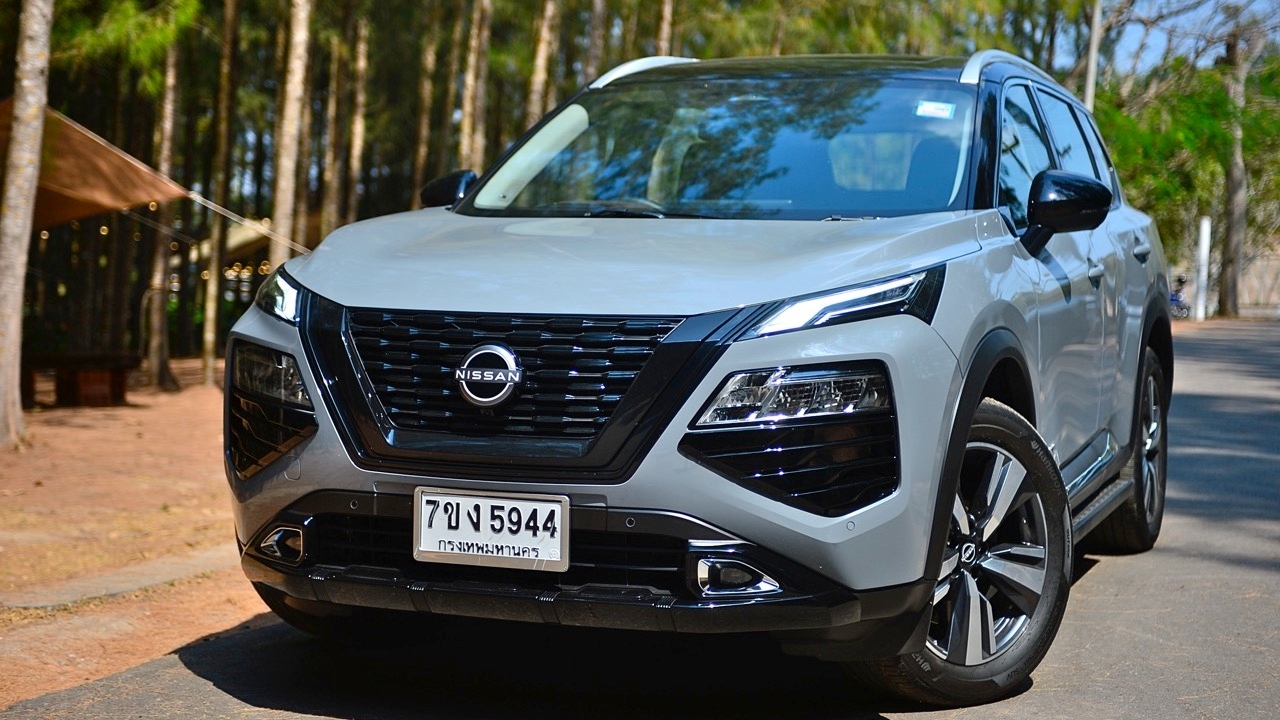
Nissan takes a different approach from Toyota, which focuses mainly on hybrids, by using the e-Power system aimed at delivering a driving experience similar to an electric vehicle. This enhances efficiency and driver satisfaction, including a refined control feel distinct from traditional electric cars. On my first long-distance drive from Bangkok to Suan Phueng district, Ratchaburi, everything felt like a combustion engine four-wheel-drive X-Trail, the latest model sold in Thailand. This is due to its fully Japanese-assembled import status as the latest X-Trail e-Power is built entirely in Japan.


By 2025-2026, the new X-Trail has transformed from its previous look into a luxurious and spacious SUV packed with more technology inside. Its dimensions are similar to Honda's CR-V and Mazda's best-selling CX-5. The innovation under the hood is a 1.5-liter gasoline engine with the e-Power system and dual front and rear motors. To explain the drivetrain: the engine does not drive the wheels; all power comes from electric motors producing 201 horsepower. Essentially, e-Power uses a gasoline engine running on a small amount of fuel to act as a generator. Advanced technology allows variable compression ratios for more efficient fuel combustion under varying RPMs and loads.

The e-4orce concept delivers an electric vehicle driving feel because the X-Trail e-Power is propelled by dual electric motors. The gasoline engine, a KR15DDT 3-cylinder turbocharged unit, generates electricity to charge the battery. Nissan’s e-Power system in the X-Trail combines with a new electric all-wheel-drive system called e-4orce, which uses two motors with a combined output of 157 kilowatts (213 horsepower).
The New NISSAN X-TRAIL e-POWER x e-4ORCE is priced at 1,699,000 baht and imported from Japan (CBU).


The all-wheel-drive system powered by dual electric motors on the front and rear axles responds faster than traditional combustion engine four-wheel-drive systems, though not quite as swiftly as pure electric dual-motor vehicles in terms of responsiveness and torque. Since the engine’s role is solely as a generator supplying electricity to the motors, Nissan states that e-4orce clearly responds faster than direct mechanical AWD systems. It also offers more versatile capabilities via an electronic AWD-by-wire system, including precise individual wheel torque control, front-to-rear and side-to-side torque distribution to maintain vehicle balance through the Electronic Stability Program (ESP) and e-4orce’s torque vectoring technology. Although the system is complex, the driving feel during acceleration, cornering, and braking differs from pure electric cars, resembling a quieter combustion four-wheel-drive with superior acceleration potential.


The battery allows pure electric driving for only 2-3 kilometers. However, the three-cylinder engine’s charging efficiency is impressively high, quickly replenishing the battery. This means the gasoline engine runs continuously during acceleration but is surprisingly quiet at low RPMs when driving in the city at speeds of 50-60 km/h. This mid-size SUV is tuned for aggressive driving, supplying more power to the motors under sustained throttle, with the engine-generator working constantly to meet the motor’s electrical demand on both front and rear axles. The engine charges the battery directly during normal driving conditions, while regenerative braking recovers energy during deceleration. The battery system’s peak electrical power is 66 kilowatts.


For first-time users of the e-Power system, the X-Trail e-Power can feel somewhat disjointed or confusing when the engine charges the battery while the vehicle is moving. Often, the engine runs to charge the battery with a humming or high-pitched sound (due to the three-cylinder gasoline engine) even when stationary and the battery is low. This is normal behavior for e-Power technology and may seem unusual at first, but after some use, the driving experience resembles that of a hybrid electric vehicle (HEV) during low-speed and continuous highway driving.


Power output is 150 kilowatts/330 Nm at the front axle and 100 kilowatts/195 Nm at the rear. The X-Trail e-4orce accelerates faster than a 2.0-liter combustion engine four-wheel-drive Japanese SUV, achieving 0-100 km/h in 7 seconds. This is a balanced performance since faster acceleration around 6 seconds might be difficult for average drivers to control. With a 55-liter fuel tank, the vehicle can travel approximately 900 kilometers on a full tank.
The X-Trail includes a second electric motor mounted on the rear axle, delivering 100 kilowatts. However, the total peak power of the vehicle is not a simple sum of 150 kilowatts at the front plus 100 kilowatts at the rear because the engine and battery cannot supply that much electricity simultaneously. The system’s maximum power is 157 kilowatts, but the maximum torque is a high 525 Nm. This torque advantage allows flexible torque distribution between front and rear axles, balancing the vehicle to reduce pitching during acceleration and braking.


On the long-distance drive through the mountainous western region of Ratchaburi, the e-4orce system was quiet and smooth at low speeds, allowing pure electric driving for two to three kilometers or slightly more. At low speeds, the electric motors require little power, so the internal combustion engine does not need to maintain high RPMs continuously. The new X-Trail also features Active Noise Cancellation (ANC), making the engine quieter than usual and almost inaudible when not revving. However, initial acceleration from a standstill lacks the heavy pull and rapid response typical of dual-motor pure electric vehicles, due to the time the combustion engine needs to reach peak power. The e-Power system responds faster at moderate to high speeds. Flooring the accelerator slightly increases engine noise but not excessively. The e-4orce technology appears effective in controlling the vehicle body, as the X-Trail does not dive under heavy braking or sag during sustained acceleration on winding roads.


Regenerative braking allows adjustment of energy recovery levels. In Drive (D) mode, braking is light, but regenerative power can be increased by shifting the gear lever briefly backward into Brake (B) mode. The X-Trail also features an e-Pedal mode similar to the Nissan Leaf, with stronger regenerative braking that reduces the need for using the brake pedal. However, passengers may feel discomfort if the driver releases the accelerator quickly due to a forward lurch sensation. Setting the regenerative braking to a moderate level provides a more practical driving response. The Eco mode on the rotary dial disables regenerative braking, suitable for steady cruising and improving fuel efficiency.


On paved slopes and winding roads in western Ratchaburi’s mountainous terrain, the e-4orce all-wheel-drive system, combined with the suspension and electric steering, handled everything flawlessly. Driving faster on the return leg, all systems responded quickly and smoothly. The winding mountain roads felt surprisingly easy to navigate. The Hankook Ventus S1 evo3 SUV tires provide excellent grip on wet and dry roads, with precise steering control and smooth ride quality, also improving fuel efficiency due to ProMileage and HSSC Silica compound technologies. These ultra-high-performance SUV tires, originally for European brands, complement the firm suspension. Overall, the X-Trail is not a sporty or off-road SUV but a family crossover that balances performance in all weather and terrains. Although it has five driving modes, they are rarely used because the smart drivetrain calculates the necessary torque per wheel. e-4orce includes hill descent control and two off-road modes, plus modes reducing throttle sensitivity on slippery roads and a highest mode for agile driving.


Driving control and overall performance are very good. The X-Trail e-4orce drives smoothly and confidently on winding paved roads. The e-4orce system works effectively, helping the X-Trail track precisely to the intended path and providing confidence even at higher speeds. The capability to quickly transfer power from front to rear or side to side stabilizes the vehicle and improves road grip.


What’s missing is the “engine revving” sensation felt in CVT hybrid vehicles when pressing the accelerator, which engages the combustion engine alongside the electric motor. Nissan explains this is partly because the small three-cylinder engine is designed to run at RPMs matched to vehicle speed continuously, avoiding abrupt revving for acceleration. Nissan avoids the disconnected rubber-band feeling typical of some CVT hybrids. Instead, the engine speed increases linearly with vehicle speed, simulating fixed-gear acceleration like an electric vehicle. During smooth acceleration, the engine speed stays low and quiet. Even during sustained hard acceleration, engine noise remains moderate, helped by active noise cancellation speakers in the cargo area. Under normal driving, the engine emits a faint sound when accelerating hard, but often is nearly silent.


Looking at the interior, the X-Trail offers a reasonably luxurious cabin with good build quality and materials in the test vehicle. The interior design blends technology and practicality well. It includes a 12.3-inch digital instrument cluster and infotainment touchscreen, plus a large Head-Up Display that Nissan says offers a 35.5-inch viewing area.


The screen quality and sharpness lag behind some Chinese electric vehicles, with the X-Trail’s displays less crisp or vivid than competitors in the same price range. However, the new X-Trail provides abundant storage space. The rear seats can be folded, slid, and reclined, with a 6-seat configuration option. There is also a convenient 40/20/40 split-folding rear seat, making it easy to carry long items. The third-row seats have limited legroom, suitable more for children or pets than tall adults.


The interior reflects modern Japanese car design, featuring frequently used function buttons such as climate controls. The gear selector is a small "e-shifter" with separate buttons for EV mode—prioritizing battery electric drive until depletion—and e-Pedal mode, which enhances regenerative braking for one-pedal driving like the Nissan Leaf. The center console opens like a butterfly, a design characteristic of European cars. The third-row seats fold in a 40/20/40 split, and the second-row seats slide up to 220 mm. The power tailgate opens up to 85 degrees, nearly 90 degrees. The Bose sound system includes nine speakers, and there is an automatic rear sunshade. The hands-free tailgate adds convenience. Front space is ample, with two adults of 180 cm fitting comfortably even in a three-person rear seating arrangement, thanks to a wide, flat middle seat and a small transmission tunnel. The third-row seats are flat and easily accessible through rear doors that open to 85 degrees.


In reality, the X-Trail should be considered a five-seater with two additional auxiliary seats in the rear cargo area. To seat passengers in the third row, the second row must be slid forward sufficiently to create legroom. The vehicle offers three-zone climate control with independent temperature settings, integrated rear door sunshades, and a cargo capacity of 575 liters—one of the largest in its class. The Divide-n-Hide cargo management system enhances versatility with foldable rear seats and a power tailgate. Other features include a panoramic sunroof, a 12.3-inch touchscreen with navigation, a 10.8-inch windshield Head-Up Display, wireless phone charging, wireless Apple CarPlay connectivity, and a 12.3-inch digital TFT instrument cluster with two display modes.


Despite facing challenges from the rising Chinese electric vehicle market, Nissan clearly demonstrates it can build a powerful crossover with impressive driving dynamics and grip. Fuel consumption rivals the CR-V e:HEV, but the X-Trail e-4orce’s strength lies in its performance and agile handling rather than fuel economy. Buyers choose it for superior dynamics compared to rivals, which this test confirmed exceeds the average in its segment. It is reasonably fuel-efficient and comes with a stylish, well-equipped design. This should boost showroom appeal, though the fully imported Japanese model’s 1.69 million baht price seems high compared to Chinese electric vehicles. Honestly, Nissan fans will find it hard not to like after a test drive.
Key Features
Panoramic glass roof with electric open/close and power sunshade.
Power tailgate with automatic sensor open/close.
Active Noise Cancellation technology.
Three-zone independent climate control.
BOSE® Premium Audio System with NissanConnect supporting Wireless Apple CarPlay and Android Auto.
12.3-inch touchscreen display.
12.3-inch color TFT driver information display with Head-Up Display.
Electric parking brake and Auto Brake Hold.
Intelligent Cruise Control (ICC).
Descent Control System (DCS) for downhill speed control.
Blind Spot Warning (BSW).
Automatic Tire Pressure Monitoring System (TPMS).
Additional advanced safety systems.
Two-tone exterior colors (White Storm with black roof, Silver Champagne with black roof, and Stealth Gray with black roof) add 20,000 baht. White Storm single-tone color adds 12,000 baht.
Engine
Fuel type: Gasoline.
Transmission: Single Speed Gear Reduction automatic.
Powertrain: e-POWER.
Drive motors (front/rear): BM46 / MM48.
Maximum motor power (front/rear): 204 PS (150 kW) at 4,501–7,422 rpm / 136 PS (100 kW) at 4,897–9,504 rpm.
Maximum motor torque (front/rear): 330 Nm at 0–3,505 rpm / 195 Nm at 0–4,897 rpm. Engine (generator):
Engine model: KR15DDT.
Engine: 3-cylinder inline VC-Turbo (variable compression turbocharged engine).
Fuel injection: Direct injection.
Number of cylinders: 3.
Bore x stroke (mm): 84.0 x 90.1.
Displacement (cc): 1,497.
Maximum power: 144 PS (106 kW) at 4,400–5,000 rpm.
Maximum torque: 250 Nm at 2,400–4,000 rpm.
Variable compression ratio: 8.0–14.0 : 1.
Fuel tank capacity: 55 liters.
Fuel consumption: 17 km/l.
CO2 emissions: 130 g/km.
Emission standard: TIS 3017-2563 (EURO 6).
Dimensions and weight.
Overall length: 4,680 mm.
Overall width: 1,840 mm.
Overall height: 1,725 mm.
Wheelbase: 2,705 mm.
Track width (front/rear): 1,585 / 1,590 mm.
Ground clearance: 185 mm.
Approximate vehicle weight: 1,929 kg.
Suspension system.
Front: Independent strut suspension.
Rear: Independent multi-link suspension.
Steering: Rack and pinion with electric power steering (EPS), adjustable in 4 directions.
Minimum turning radius: 5.4 m.
Braking system.
Front: Ventilated disc brakes.
Rear: Ventilated disc brakes.
Wheels and tires.
Wheel size.
19 x 7.5 ET40 alloy wheels.
Tires: Ventus S1 evo3 SUV (K127) 235/55R19.
Spare tire: Emergency tire repair kit.
19" diamond-cut black alloy wheels, 19 x 7.5 ET40.
Exterior standard equipment.
Glossy black front grille with chrome accents.
LED projector headlights with auto on/off and LED signature lights.
LED daytime running lights (DRL).
Auto headlight on/off with Follow-me-home function.
LED front fog lights.
LED taillights.
Power tailgate with sensors.
Body-colored side mirrors.
Black side mirrors.
Power-adjustable and folding side mirrors with turn signals.
Auto-folding side mirrors upon locking.
Speed-sensing front wipers with delay function.
Rear wiper with delay.
Timed rear window defogger.
Electric panoramic glass roof with power sunshade.
Roof rails.
Acoustic glass for windshield and front doors to reduce noise.
Interior standard equipment.
10-way power adjustable front driver and passenger seats with power lumbar support.
Second-row seats split 40:20:40, sliding front-back, reclining, with central armrest.
Third-row seats split 50:50, fold flat into floor.
Dashboard trim with black synthetic leather featuring gray stitching (to be confirmed).
Leather-wrapped steering wheel with audio and phone controls.
Controls for TFT display and Intelligent Cruise Control on steering wheel.
Auto-dimming rearview mirror.
Drive mode switch button.
EV mode switch button.
e-Pedal step driving control system.
12.3-inch color TFT driver display with 10.8-inch Head-Up Display.
Front map reading lights.
Interior cabin lighting.
Cargo area lighting.
Six cup holders.
Front row center armrest with dual storage compartments.
Second-row center armrest, under-console storage, and front console storage box.
Rear passenger sunshades.
Cargo area privacy cover.
Three-zone automatic climate control for driver, front passenger, and rear passengers.
12.3-inch touchscreen supporting Wireless Apple CarPlay and Android Auto.
12V power outlet.
Front USB Type-A and Type-C ports.
Rear USB Type-A and Type-C charging ports.
Wireless charging pad.
BOSE Premium Audio System with nine speakers and ambient lighting.
Safety equipment and technology.
e-Pedal Step system.
Dual front SRS airbags.
Side airbags.
Side curtain airbags.
Anti-lock Braking System (ABS).
Electronic Brakeforce Distribution (EBD).
Brake Assist (BA).
Electric Parking Brake.
Auto Brake Hold.
Front and rear parking sensors and immobilizer.
Anti-theft alarm system.
ISOFIX child seat anchors.
Emergency Stop Signal (ESS).
Third brake light.
Vehicle Dynamic Control (VDC) stability system.
Hill Start Assist (HSA).
Descent Control System (DCS).
Intelligent Forward Collision Warning (IFCW).
Intelligent Emergency Braking (IEB).
Driver Attention Alert (DAA).
Intelligent Around View Monitor (IAVM).
Moving Object Detection (MOD) system.
Intelligent Cruise Control (ICC).
Blind Spot Warning (BSW).
Rear Cross Traffic Alert (RCTA).
Lane Departure Warning (LDW).
High Beam Assist (HBA).
Tire Pressure Monitoring System (TPMS).
Vehicle Sound for Pedestrians (VSP) alert system.
Driver ELR seatbelt with pretensioner on all seats.
Double pre-tensioner with load limiter seatbelts for front seats.
Pre-tensioner with load limiter seatbelts for second-row seats and child door lock system.