

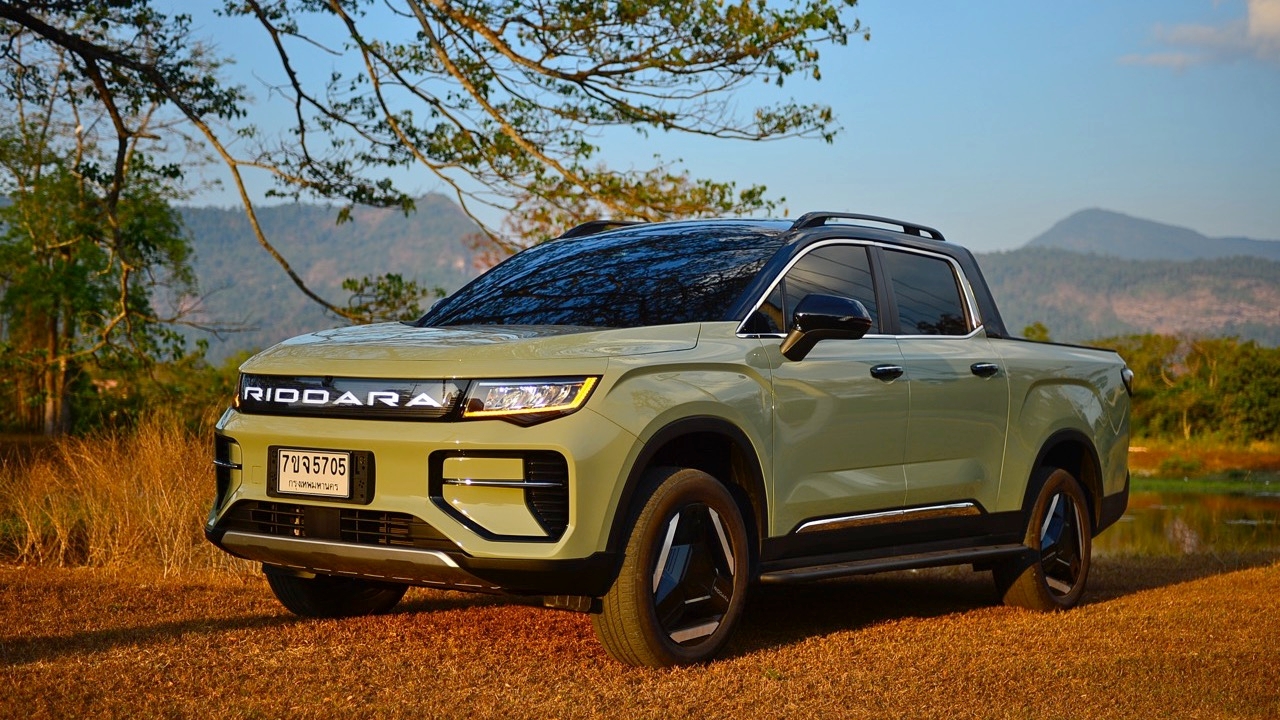
Riddara, an electric pickup truck entering the Thai market, faces competition from new models like the Toyota Hilux Travo e, a dual-cab battery-powered pickup. However, the Riddara RD6 boasts longer range thanks to its larger battery. It adapts an SUV chassis into a pickup form, which, although it carries less load than traditional pickups, offers a monocoque SUV-style suspension that provides more comfortable driving and riding than the heavy-duty leaf spring suspension typical of pickups.


Geely Holding Group, the parent company of leading brands like Volvo, Polestar, Smart, Zeekr, and Lotus, allows all its brands to benefit from Geely’s extensive expertise in electric vehicles and hardware as a major Chinese automaker. The Riddara electric pickup has expanded into markets such as Australia and New Zealand. In fact, the Riddara RD6, the name used outside China including Thailand, was launched nearly two years ago.The RD6’s infrastructure is developed from Geely’s Sustainable Experience Architecture (SEA) platform, the same technology used in models like the Volvo EX30, Polestar 4, Smart #1, and Zeekr X. The version used in the RD6 is called the Multiplex Attached Platform.

RIDDARA RD6 86 kWh 2 Motor 4WD priced at 1,335,000 baht.
As mentioned, Riddara differs from other electric pickups by using a monocoque chassis instead of a traditional body-on-frame chassis. The front suspension is MacPherson strut, and the rear is independent multi-link. This setup distinguishes it from typical pickups. The rear-wheel-drive RD6 can tow 2,500 kg and carry 755-775 kg depending on the trim. The AWD RD6 impressively carries 865 kg and tows 3,000 kg. Geely states this 4WD model can wade through water up to 815 mm deep, with 225 mm ground clearance.


The RD6 4×2 dimensions are comparable to popular pickups like the Ford Ranger and Toyota Hilux, measuring 5,260 mm long, 1,900 mm wide, and 1,880 mm high, with a 3,120 mm wheelbase. The pickup bed measures 1,525 mm long, 1,450 mm wide, and 540 mm high, smaller than the Hilux and Ranger. It rides on 18-inch alloy wheels with Chaoyang radial RP76 tires sized 235/60R18 107H. The bed is lined with a McLiner protective material, providing a 1,200-liter cargo volume. The RD6 supports 21 kW V2L (Vehicle to Load) power through a control panel in the bed, supplying electricity to devices like small refrigerators, lights, and sound systems—ideal for family camping trips. Geely reports that during development, the RD6 underwent rigorous testing in the extreme heat of the Middle East, with its battery and electrical systems engineered to withstand Southeast Asia’s hot summers.


The RD6 is positioned more as a family vehicle than a heavy-duty work truck, offering full equipment and a luxurious cabin atmosphere. It features a 10.2-inch digital dashboard, a 14.6-inch infotainment touchscreen, a 9.0-inch head-up display, and interior ambient lighting adjustable to 72 colors. The seats, dashboard, and door panels are trimmed in finely stitched leather, with mostly soft-touch surfaces except for the center console’s hard plastic. The interior layout is neat, with most functions controlled through the 14.6-inch touchscreen.


The 14.6-inch central touchscreen monitor is user-friendly, making system settings easy to customize. The stereo system includes 8 speakers. The panoramic sunroof and side steps add to convenience. Driver aids include seven driving modes: Economy, Comfort, Sport, Snowfield, Mud, Off-road, and Water. Regenerative braking offers three levels: low, medium, and high. Inside, the cabin is almost flawless, with comfortable seats and good all-around visibility—except for the heavily tinted test vehicle windows, which made night driving challenging.


The three-spoke multifunction steering wheel is leather-wrapped and equipped with controls for phone, audio, voice commands, adaptive cruise control, and driving modes. The steering wheel size is well balanced, and the seating position is well arranged. The front seats are electrically adjustable in six directions. The gear selector resembles those in SUVs, using a toggle to shift between R, N, and D. Controls for climate, hazard lights, wireless charging pad, and cup holders (a bit small) are thoughtfully positioned. The interior color scheme and materials, including seats, dashboard, and console, are well executed.


The rear seats are comfortable, matching the RD6’s design philosophy. The door sills are low, offering clear visibility. Rear air vents and convenient storage under the rear seats add practicality. However, the seatback angle is slightly too upright. For safety, controls like side mirror adjustment, temperature, mode selection, and hazard lights are separated from the touchscreen to ensure ease of use and safety, rather than crowding all controls into one display.


The RD6 4WD’s electric drivetrain includes dual motors powered by an 86 kWh Lithium-ion (LFP) battery, delivering 428 horsepower and 595 Nm of torque. It accelerates from 0 to 100 km/h in 4.5 seconds, with a top speed of 185 km/h. The claimed full-charge range is 461 km, while real-world driving at normal speeds achieves approximately 380-400 km.Charging options include 6.6 kW AC charging and 110 kW DC fast charging at home.Energy consumption averages between 15.6 and 16.7 kWh per 100 kilometers.


Riddara’s strengths lie in performance from its drivetrain and smooth SUV-like suspension, thanks to the monocoque chassis and multi-link rear suspension instead of heavy-duty leaf springs. It offers versatile accessories and supports 6 kW Vehicle to Load (V2L) power output for camping equipment.


The monocoque structure, rather than a body-on-frame chassis, enables impressively smooth and quiet driving (benefiting from the absence of engine noise). At startup, a soft electric motor whir is audible, and wind noise near the A-pillar becomes noticeable at speeds around 110 km/h.The RD6 4WD accelerates incredibly quickly. Flooring the accelerator requires clear, open road ahead; otherwise, frequent braking is necessary. The single motor rear-wheel-drive version offers more than enough torque for daily use and can easily overtake multiple vehicles with a single press. However, sustained heavy acceleration does consume significant battery power. The most energy-efficient cruising speed is around 80-90 km/h; driving slower can be hazardous as empty 18-wheel trucks often exceed those speeds.The RD6 4WD looks unassuming but is remarkably powerful, launching off traffic lights and leaving diesel pickups far behind without a chase.Its driving dynamics are solid; it maintains stability at high-speed cornering. The steering adjusts weight well and provides good feedback and connection to the vehicle.


When fully charged, the RD6 4WD achieves a range of455 kilometers with its 86 kWh battery. On long test drives from Bangkok to Prachinburi, Nern Hom checkpoint, and Khao Yai National Park, it managed approximately 350-380 kilometers. Driving carefully and avoiding continuous heavy acceleration helps preserve battery life and leverages the vehicle’s superior responsiveness compared to diesel pickups. However, carrying a heavy 800 kg payload (up to 865 kg max) or towing a large 3-ton boat trailer drastically reduces range, making the RD6 more suitable for daily urban use or weekend trips within a 200-300 km radius. Nowadays, charging stations are widespread, but home AC charging remains best for battery health.


The Riddara RD6 4WD’s rear-wheel-drive model feels more like an SUV than a traditional pickup like the Ranger. Modern pickups have evolved far beyond their utilitarian roots, resembling regular vehicles in comfort and refinement. The RD6 eliminates the harshness associated with leaf-spring suspensions, offering greater smoothness. Its electric drivetrain’s fewer moving parts contribute to reliability. While it handles light off-road conditions well, with good road grip and decent handling on dirt roads, the highway-focused tires and limited front ground clearance make it unsuitable for serious off-road use. Its undercarriage clearly indicates it’s a family-oriented vehicle designed mainly for smooth roads rather than rugged terrain.


The RD6 4WD’s drawbacks include unsuitability for heavy loads over 500-700 kg due to its car-style independent four-wheel suspension rather than leaf springs. Its driving range is more limited than diesel pickups, and heavy loads or high-speed long-distance driving can cause some body roll, though not excessive. The suspension isn’t designed for heavy-duty use or demanding off-road conditions. Overall, the Riddara fits urban family use better than commercial heavy-duty tasks typical for traditional pickups.


The steering is very light but still maintains adequate connection, lighter than any pickup tested before. The RD6 dual-motor version with 428 horsepower accelerates 0-100 km/h in 4.5 seconds, with a top speed capped at 185 km/h. This pickup prioritizes comfort and quietness, with Pure Electric NVH Silent technology. Unlike body-on-frame off-road pickups, its monocoque chassis drives like an SUV with its roof shortened into a pickup bed. As an early electric pickup, it cannot match diesel pickups’ range and payload capacity but offers a distinct alternative to typical electric vehicles. Is it good? Moderately so, though its price leads most buyers to prefer electric SUVs over pickups, which are losing popularity.
Interesting information about the Riddara.
Models and prices: Riddara ECON (focused on utility and economy) starting at 739,000 to 999,000 baht.
Riddara RD6 4WD Sunroof priced at 1,335,000 baht (tested model).
Performance: Powered by the M.A.P. (Multiplex Attached Platform), the top model claims a maximum range of 503 kilometers per full charge (NEDC standard).
After-sales service includes RIDDARA CARE, offering a 6-year or 150,000 km vehicle warranty, and an 8-year or 200,000 km warranty on battery and motor.
Riddara focuses on being an electric pickup for modern lifestyles and agile load-carrying needs.
Highlights of the RIDDARA RD6.
- Accelerates from 0 to 100 km/h in 4.5 seconds.
- Maximum torque of 595 Nm.
- 6 kW European-standard power outlet in the pickup bed.
- Intelligent power delivery system allows electricity supply while parked, locked, charging, or even driving.
- Quiet cabin featuring Pure Electric NVH Silent technology.
- Large 14.6-inch touchscreen supporting Apple CarPlay.
- Carbit Link with 50W wireless smartphone charger.
- Dual-zone air conditioning system.
- The 2WD RD6 comes with four automatic drive modes and seven driving modes suited for various terrains: Sand, Mud, Off-road, Wading, Economy, Comfort, and Sport.
- Capable of wading in water up to 815 mm deep.
- Maximum towing capacity of 2,000 kg.
- Body constructed of over 70% high-strength steel.
86 kWh Lithium Iron Phosphate (LFP) battery provides a 455 km range (NEDC standard).
Exterior features include LED headlights with daytime running lights, illuminated RIDDARA grille, full-width LED tail lights, electrically unlocked tailgate, cargo bed lights, power-adjustable and folding side mirrors with defoggers, automatic wipers, and 18-inch alloy wheels (standard features vary by trim).
Interior features synthetic leather seats with 6-way power adjustment for front seats, ventilated front and rear seats, one-touch windows with anti-pinch on all four doors, 10.2-inch full LCD driver information display, electric parking brake with auto hold, dual-zone automatic climate control, and rear air conditioning.
Intelligent driver assistance safety systems include:
Intelligent Cruise Control (ICC).
Adaptive Cruise Control (ACC).
Automatic Emergency Braking (AEB).
Forward Collision Warning (FCW).
Lane Keeping Assist (LKA).
Emergency Lane Keeping Assist (ELKA).
Lane Departure Warning (LDW).
Lane Change Assist (LCA).
Blind Spot Detection (BSD).
Door Opening Warning (DOW).
Rear Cross Traffic Alert (RCTA).
Rear Cross Traffic Braking (RCTB).
Rear Collision Warning (RCW).
Front Departure Alert (FDA).
Other standard safety features include:
Electronic Stability Control (ESC).
Traction Control System (TCS).
Hill Hold Control (HHC).
Hill Descent Control (HDC).
Six airbags.
Front seatbelt reminder.
ISOFIX child seat anchors.
Available in five body colors:
Nordic Green with Black Top.
White Cloud with Black Top.
Black Knight.
Moonlit Silver.
Serene Blue.