

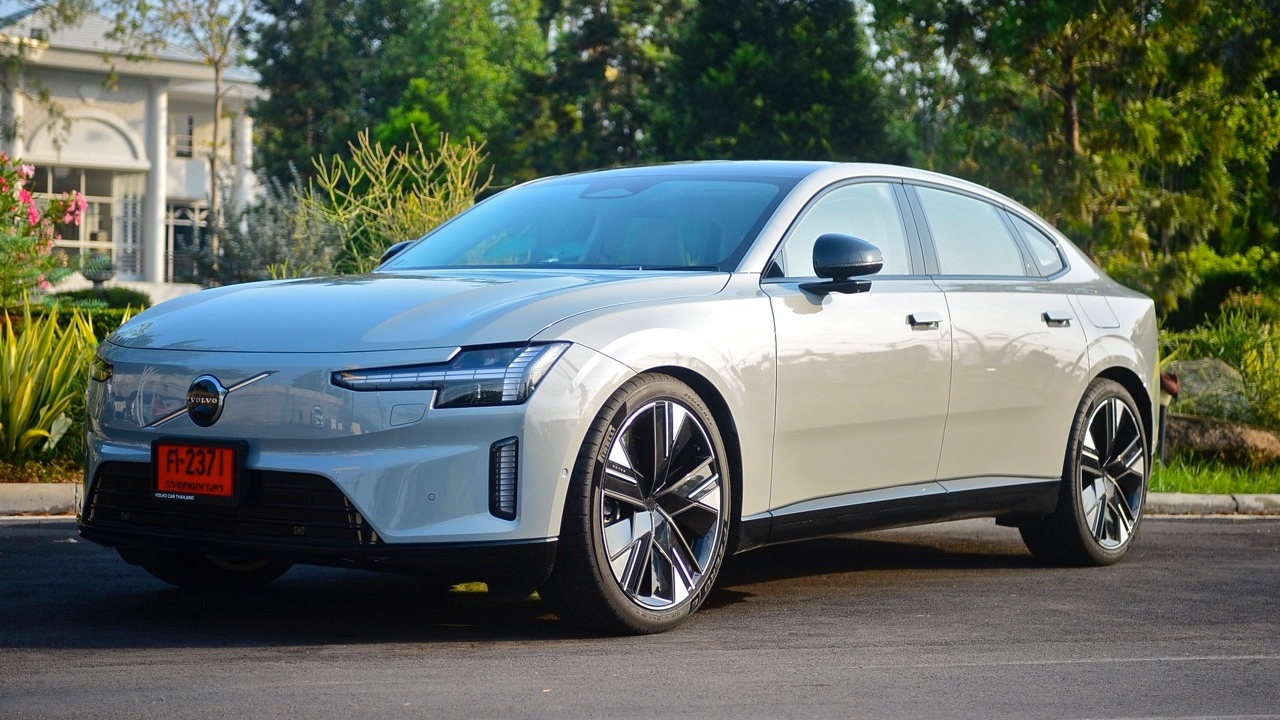
This is Volvo’s luxury sedan, exactly 5 meters long, with a limousine-like long wheelbase that conveys a stable, elegant feeling. However, calling it a sedan may not be entirely accurate because the ES90 is taller than typical cars, resulting in proportions that seem somewhat off. It therefore looks more like a tall fastback.


The competitors of the ES90 include
the Audi A6 e-tron priced at 5,899,000 baht, BMW i5 40 at 3,499,000 baht and iX 45 at 5,999,000 baht, Mercedes EQE 350 at 3,790,000 baht, and the Porsche Taycan ranging from 5,290,000 to 7,890,000 baht.

In Thailand, the Volvo ES90 is available in a single version: the Ultra Single Motor Extended Range, starting at 2,990,000 baht. The Ultra model features interesting additions such as an auto-dimming roof, a 1600-watt Bowers & Wilkins sound system with 25 speakers and four sound modes, adaptive air suspension with air springs, and a LiDAR sensor mounted on the roof. This sensor is central to Volvo’s longstanding commitment to safety. The Safe Space Technology system includes seven cameras, five radars, 12 ultrasonic sensors, and one LiDAR, enabling the flagship EV to have a full 360-degree view of its surroundings and real-time road data independent of navigation routes. It can also detect obstacles in the dark.
Volvo states that their ‘user understanding’ system uses specially designed algorithms to monitor driver focus and intervene if necessary. Additionally, a full sensor system inside the cabin can detect movements at the millimeter level. Naturally, the ES90 is ready for autonomous driving.


Today’s new cars look very different from those a decade ago. In the fiercely competitive automotive industry, designers face tough challenges, such as concealing sensors that enable autonomous driving and other features. Mounting sensors on the roof is a practical solution that does not compromise the ES90’s modern Scandinavian aesthetics. New LiDAR units from Luminar are integrated into the windshield frame; their compact size does not intrude on headroom.


Looking closely, the ES90 features slightly rounded lines and a cleaner appearance, with surfaces that convey strength and elegance. The iconic ‘Thor’s Hammer’ headlights remain unchanged. The front is smooth since, as an electric vehicle, a grille for air intake is unnecessary. Longtime Volvo customers seeking links to models like the 264 or 760 will find few. Volvo notes that the coupe 780 designed by Bertone in the late ’80s inspired the ES90’s shape.
The body dimensions are 1,942 millimeters wide, 5,000 millimeters long, and 1,546 millimeters tall, with a 3,120-millimeter wheelbase and 178-millimeter ground clearance. The front overhang is 891 millimeters, and the rear overhang is 1,007 millimeters. Notably, the wheelbase has grown by 161 millimeters, providing ample rear passenger legroom.


The Volvo ES90 Electric stands out for its unusually high height—18 centimeters taller than normal—with a raised H-point seating position. The rear roof slopes rather than follows a typical sedan’s shape. This unique design blends comfortable driving position and classic limousine elegance with SUV-like ground clearance. The ES90 achieves excellent aerodynamics with a drag coefficient of 0.25, reflecting advanced airflow design unlike the upright front ends of classic Volvo models from the ’70s and ’80s. Additionally, 63 percent of the ES90’s parts are made from recycled materials, reflecting Volvo’s long-standing commitment to reducing CO2 emissions.


The Volvo ES90 excels in long-range performance thanks to its battery capacity and energy management software, typical of modern vehicles. It builds on the EX90, launched less than a year ago, improving software, power management, and hardware. The charging software, upgraded by Volvo’s recently invested joint venture Breathe Battery Technologies, supports an 800-volt electrical system.
The advanced energy management system results in longer range and better efficiency. Battery options include 92 kWh or 106 kWh NMC lithium-ion packs with nickel, manganese, and cobalt cathodes. Environmentally conscious owners can trace raw material sources through Volvo’s 'battery passport,' developed with UK startup Circulor using blockchain technology. Scanning a QR code on the driver’s door reveals detailed supply chain information.

The ES90 Ultra Single Motor Extended Range features a single rear-wheel-drive motor priced at 2,990,000 baht, with a WLTP range of approximately 755 kilometers. The single motor on the rear axle delivers 333 horsepower and 480 Nm of torque, accelerating from 0 to 100 km/h in 6.6 seconds. A dual-motor all-wheel-drive version with 443 horsepower and 670 Nm torque, accelerating to 100 km/h in 5.6 seconds, may be introduced later. The 755-kilometer range ranks among the longest for electric vehicles sold in Thailand. The rear permanent magnet motor is designed to handle heavier loads than the front, with a new cooling system and updated inverter and power modules to reduce torque loss. This makes the flagship electric car the most powerful in Volvo’s history, exceeding the needs of older customers. The top speed is limited to 180 km/h for safety.
Charging speed may be more important than overall range. The ES90 slightly outperforms the EX90, particularly with its 800-volt system instead of 400 volts, delivering more power and range at the same current. When connected to a 350-kilowatt DC fast charger, it can add 300 kilometers of range in 10 minutes and charge from 10 to 80 percent in 22 minutes. The third-generation electric drive system is highly versatile.


The ES90 is Volvo’s second software-controlled electric vehicle, focusing not just on range improvements but also on driving performance and safety. It uses the Superset technology suite, combining hardware and software developed through a closed-loop process. The ES90 has significant upgrades, utilizing two Nvidia Drive AGX Orin processors capable of 508 trillion operations per second, doubling performance compared to the EX90. Although the EX90 will receive updates for its 2026 model, the ES90’s software will continue to receive regular over-the-air updates, ensuring ongoing feature enhancements.


The ES90’s interior is luxuriously appointed with materials that feel more refined and comfortable than competing electric sedans from BMW and Mercedes, depending on personal taste. This might be, quietly speaking, the best car interior in the world right now in terms of atmosphere. It offers six interior lighting themes, and the ambient lighting uses flicker-free natural light to reduce eye fatigue, showing careful design. The higher seating position and comfortable seats continue Volvo’s tradition. The equipment and materials are excellent, featuring birch wood dashboard trim and Nordico upholstery that feels good to the touch and is environmentally friendly, made from recycled plastics and bio-based materials from Sweden’s sustainable forests.


Operating the screens might not be immediately intuitive but becomes easier with familiarity. The infotainment system is controlled via a 14.5-inch central touchscreen, while the driver has a smaller 9-inch display for key information. The layout is clearly similar to the EX90 and Polestar 3, though with slight differences in graphics and human-machine interface. Small Volvo icons at the bottom serve as gateways to other screens. The interior space also differs, with a uniquely designed center console and dashboard shelf.


Volvo has faced criticism from the media for moving key controls, including main switches and climate controls, almost entirely to the central touchscreen. The lack of traditional physical buttons for adjusting seats, side mirrors, and steering wheel is inconvenient. Previously, Volvo designed large enough buttons for use with gloves, essential for Sweden’s long, harsh winters. Today, the focus on technology seems to have overshadowed ease of use and safety.
The usability depends on the owner’s preferences. In practice, settings can be saved in personal profiles and left alone. However, most Thai drivers tend to adjust settings frequently. Adjusting driving position and mirrors via touchscreen while driving may cause some frustration.


The ES90 integrates Google services, including Google Assistant, Maps, Waze, and the Google Play Store. Apple CarPlay and Android Auto are standard and essential in modern vehicles. It includes built-in 5G connectivity. The climate control offers four-zone temperature settings with a PM 2.5-level air purifier. There are B-pillar air vents, a leather-wrapped steering wheel, a premium sound system, and very comfortable rear seats.


Naturally, as a flagship luxury chauffeur vehicle, the ES90’s rear cabin is excellent, almost limousine-like, with ample legroom and a refined atmosphere. Even the door panels are newly designed with artistic touches. The rear features a central armrest with two cup holders and extra storage compartments. There is a separate rear climate control panel, heated and cooled seats, and improved LED ambient lighting.
Technically, the ES90 is a practical fastback. The trunk offers 424 liters of space, and the rear seats fold nearly flat in a 40/20/40 split, expanding total capacity to 1,427 liters. The rear suspension lowers to ease loading, with 16 liters of underfloor storage and a 22-liter front storage compartment.


The Volvo ES90 uses a top-tier Bowers & Wilkins High Fidelity Audio System specially tuned for this electric sedan.


Key technical details include:
A total of 25 speakers distributed throughout the cabin.
A 28-channel amplifier delivering a maximum of 1,610 watts.
Technology features include
Tweeter-on-Top: an iconic tweeter speaker design located in the center console that reduces reflections from the windshield.
Continuum™ Cone: speaker cones using technology from high-end home audio speakers for precise midrange sound.
Dolby Atmos®: an immersive 3D surround sound system.
Abbey Road Studios Mode: a special sound mode simulating the experience of listening in a world-class recording studio.
Volvo +7


In entertainment, the Bowers & Wilkins system deserves praise. Many past Volvo customers chose the brand for its high-quality in-car sound systems. The modern British system is grand and sonically pleasing, featuring 25 high-performance speakers, dual dome tweeters, and a total power output of 1,610 watts. Sound engineers developed special sound programs in collaboration with the renowned Abbey Road Studios. Experts measured, sampled, and tuned the equipment to replicate the studio atmosphere in the cabin, creating a relaxing travel environment. It offers four sound modes: Open, Energised, Intimate, and Expansive, plus a Producer mode that allows tailoring sound settings to different music genres or eras, enhancing audio depth. The ES90’s very low overall noise levels provide a truly perfect soundstage inside.


The ES90 drives well, meeting expectations for a large luxury sedan. Behind the wheel, the car feels refined—a good example in both aspects—and is one of the quietest vehicles I’ve tested. The steering is precise and smooth, reminiscent of a Swedish lake. It can reach speeds that might make older owners question the need for more, as higher speeds increase risk. The two-chamber air suspension provides a smooth ride. The expensive suspension dampers yield good overall control, though not as dynamic as the Audi A6 e-tron or BMW i5. However, premium electric cars are rarely bought for aggressive driving, unless you head to the Taycan.


The ES90’s design prioritizes comfort, reviving Volvo’s traditional values of calmness and coziness, adapted for the electric vehicle era. It follows the EX30 and EX90 as Volvo’s latest fully electric vehicles. Currently, SUVs dominate among upscale middle-class families, but there remains a charm in well-designed luxury sedans. The ES90 embodies the brand’s core values tailored for daily life, especially long-distance travel.


The complexity of the ES90, packed with the latest technology and software upgrades, should resolve issues seen in the EX90. Its interior is a great place to sit, think, work, or relax. It is meticulously designed—not a car focused solely on speed and power, but one that blends refinement and elegance to compensate for any lack of excitement that some may dislike (such as aggressive handling in large cars).


The ES90 is Volvo’s second model using the SPA2 electric architecture, which impresses with its smoothness. Wind and tire noise are nearly nonexistent, exemplifying high-end electric vehicles. The ES90 glides on roads with grace and power, effectively isolating occupants from external noise. The cabin’s noise isolation calls to mind the Rolls-Royce Ghost. The ride is smooth with excellent vibration damping, without pitching or loss of control. Rough road surfaces may occasionally overload the suspension, but comfort remains uncompromised.


Its streamlined aerodynamics enhance the extremely calm driving feel. The car’s substantial weight adds to this stability during fast cornering. The calmness also includes the absence of annoying alerts and beeps common in modern EVs. Although packed with advanced driver assistance systems, Volvo appears to have designed these technologies to operate smoothly without irritating interruptions, all of which can be disabled via the menu. Volvo’s Intelligent Speed Assist limits throttle response if the driver exceeds speed limits. A simple warning is insufficient for reckless drivers, but this is excellent for safety.


Overall, the car’s shape, interior finish, drivetrain, suspension, steering, and Bowers & Wilkins audio create a refined atmosphere and excellent driving and riding experience. Driving enjoyment is another matter; customers in this segment generally don’t seek highly interactive steering or handling but rather capability and reliability. The brand’s character and new zero-emission drivetrain are now found within a warm cabin ambiance and an overall pleasant driving feel. The touchscreen menu offers many customization options, including increasing steering and throttle sensitivity. However, smooth settings suit the ES better than aggressive modes. The one-paddle driving mode is quite assertive but is a minor detail adjustable to personal preferences for regenerative braking response.
The ES90 is not Volvo’s best-selling electric model, given its somewhat unconventional style and the fiercely competitive EV market. It is a low-defect, well-executed, and charming vehicle. This first test aimed to evaluate the car’s performance, capabilities, and driving quality objectively. Scoring it 8.5 out of 10 is quite good for a large, luxury-focused car that is easy to use in various environments. The ES90 is an appealing choice, especially in the premium EV market with many expensive options. Another advantage of choosing Volvo is that you are unlikely to see many identical cars on the road.