

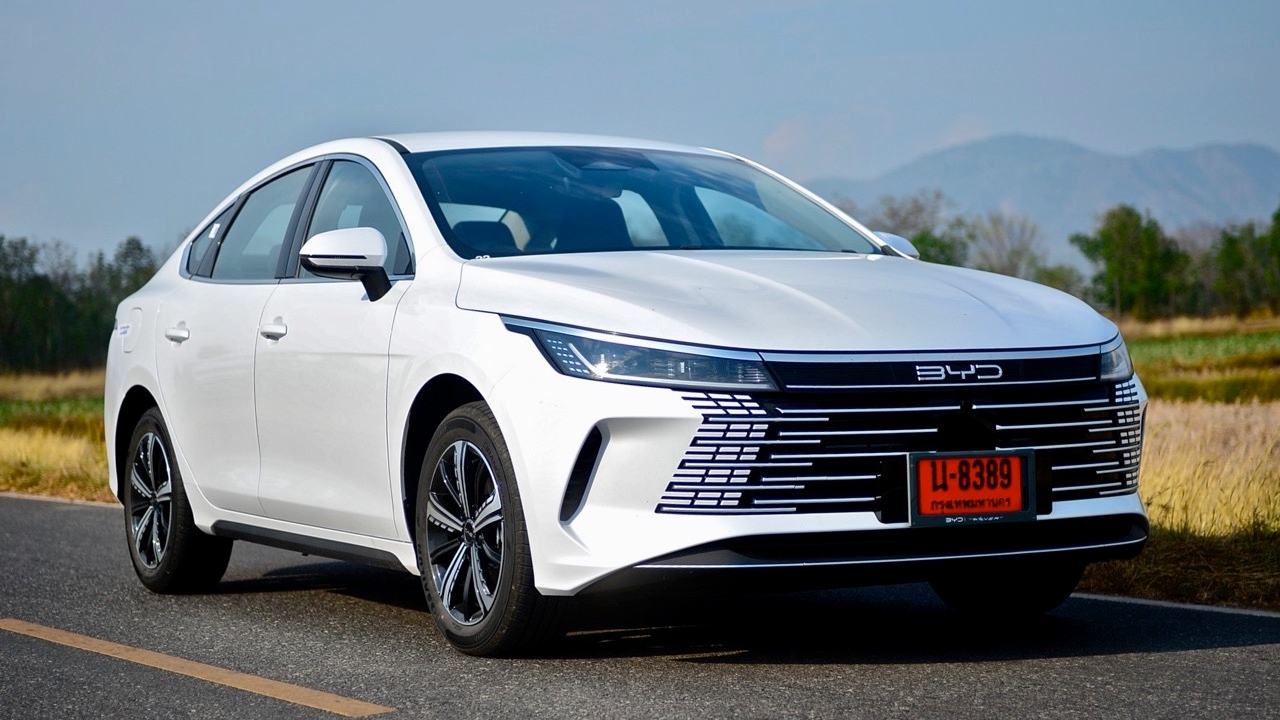
The BYD SEAL 5 DM-i SUPER PHEV STANDARD, an entry-level plug-in hybrid car, was priced at 599,900 baht in an announcement on the evening of 24 Feb 2026 GMT+7. This sedan combines an engine and electric motor to achieve over 1,000 kilometers range using its plug-in hybrid system, emphasizing fuel efficiency and value. The SEAL 5 DM-i Super PHEV highlights long-distance pure electric driving and low fuel consumption at an accessible price.


The BYD SEAL 5 DM-i SUPER PHEV competes with the TOYOTA YARIS ATIV HEV. It uses a 1.5-liter inline 4-cylinder gasoline engine paired with BYD’s proprietary Blade Battery plug-in hybrid system with a 13.8 kWh capacity, known for safety and durability. The SEAL 5 DM-i SUPER PHEV offers up to 85 kilometers pure electric range (NEDC standard). It delivers strong acceleration in its class with an efficient energy management system. BYD claims fuel efficiency of 28.6 km/liter; test drives achieved 24.8 km/liter at 90-100 km/h.


The SEAL 5 STANDARD trim features a modern design with a graphic pattern on the grille reflecting BYD’s OCEAN AESTHETIC design philosophy. It includes LED headlights, LED daytime running lights with auto on/off, frameless DOT MATRIX grille, smoked Full LED taillights with sequential turn signals, a third LED brake light, and 17-inch two-tone alloy wheels with 215/55 R17 tires. Exterior colors are limited to Horizon White and Quantum Black.


The SEAL 5 DM-i’s body dimensions place it in the C-Segment sedan category. Compared to similarly priced competitors, it is noticeably larger: length 4,780 mm, width 1,837 mm, height 1,495 mm, wheelbase 2,718 mm, ground clearance 160 mm unloaded (about 120 mm fully loaded). The trunk offers 450 liters of cargo space.
Compared to Thai competitors: Honda Civic is 4,681 mm long and 1,802 mm wide (SEAL 5 is 9.9 cm longer and 3.5 cm wider). Toyota Yaris ATIV measures 4,425 mm long and 1,740 mm wide (SEAL 5 is 35.5 cm longer). Positioned to compete with smaller cars like the City and Yaris ATIV, its larger size offers notably spacious interior, turning its extended length into valuable usable space.


The cabin is spacious due to the longest wheelbase in its segment, with a 450-liter trunk that fits six 20-inch suitcases. Rear seats fold 60/40 for extra cargo flexibility. Multimedia includes an 8.8-inch instrument cluster and a 10.1-inch floating touchscreen with Apple CarPlay® and Android Auto™ support. There are four speakers, sport-designed fabric seats, six-way manual driver seat adjustment, four-way manual front passenger seat adjustment, leatherette multifunction steering wheel, dial e-shifter, and electronic parking brake (EPB).


The driver’s seat adjusts manually in six directions, the front passenger seat adjusts manually in four directions but cannot be raised. The dashboard and console use materials superior to some competitors. The 10-inch touchscreen connects quickly and stably to smartphones during a two-day test drive from Chiang Rai to Bangkok without disconnecting or lagging. After starting the car, infotainment reconnects to paired phones within about 30 seconds. The touchscreen also controls the climate system and various vehicle settings, designed for easy and fast access with minimal lag.


The three-spoke steering wheel is wrapped in genuine leather. Controls on the left handle adjust adaptive cruise control, while the right side includes buttons for driver display, phone call handling, and volume control for the four speakers. The speaker sound quality is adequate but not outstanding; sound tuning options yield similar results. The four speakers provide decent clarity but low power, suitable for clear music listening without subwoofer bass. Overall, the audio system is passable but could be improved.
Features include automatic climate control, PM2.5 dust filtration, rear center air vents, keyless entry and start, NFC card electronic key, and over-the-air (OTA) software updates.


Engine and Powertrain (DM-i Super Hybrid)
BYD’s DM-i (Dual Mode intelligence) system uses the electric motor as the main drive source with the gasoline engine supplementing or generating electricity. The 1.5-liter gasoline engine combined with the electric motor delivers a total output of approximately 218 horsepower and 300 Nm torque (Standard model). It uses an e-CVT transmission focusing on smooth, seamless operation. The Blade Battery capacity is 13.08 kWh (Standard) or 18.3 kWh (Premium), supporting pure electric mode range of 80–120 km (NEDC).

The DM-i system in the Seal 5 is an electric-driven hybrid featuring four main automatic operating modes designed for maximum efficiency.
Pure Electric Mode (EV Mode)
In this mode, the electric motor draws energy directly from the Blade Battery to drive the wheels, while the gasoline engine shuts off completely.
The driving experience is silent with instant acceleration like a 100% electric vehicle, ideal for city or traffic jam driving.
Series Hybrid Mode activates when battery charge is low or extra power is needed. The gasoline engine starts to generate electricity to power the motor and recharge the battery. The engine runs at efficient, steady RPMs as it does not directly drive the wheels.


Parallel/Engine Drive Mode engages at steady or high speeds (e.g., motorway over 100 km/h), where a clutch connects the engine directly to the wheels, as combustion engines are more efficient at high speed. The electric motor assists with additional power during acceleration. Regenerative braking converts kinetic energy back to electric energy when decelerating, with adjustable intensity for smooth driving.


The system uses an electronically controlled e-CVT transmission without traditional gears, ensuring seamless switching between electric and gasoline modes. This e-CVT is well-suited for affordable hybrids and plug-in hybrids. The SEAL 5 DM-i Super PHEV's powertrain delivers smooth and faster acceleration than similarly priced competitors. The engine is optimized for electricity generation and propulsion, eliminating jerky throttle responses. The 0-100 km/h acceleration time is 7.8 seconds, which is quite good.


Charging time depends on battery size (13.08 kWh or 18.3 kWh) and charger type.
AC charging uses a BYD Wallbox or public charger supporting up to 3.3 kW or 6.6 kW depending on the trim. The 13.08 kWh battery takes about 2.5 to 4 hours for a full charge, while the 18.3 kWh battery requires about 3 to 5 hours. The base model lacks DC fast charging; only the 18.3 kWh top model supports DC fast charge, which is rare for PHEVs at this price.
Home charging using a portable plug takes approximately 6 to 9 hours via household socket. Installing a home Wallbox allows overnight charging similar to a smartphone—plug in at home and wake up to a full charge. Pure electric range is about 80 km, sufficient for city driving, school runs, and idling without pollution. Daily driving under 70-80 km can nearly eliminate fuel use.


A long-distance test covered over 1,134 kilometers from Chiang Rai through Lampang, Uttaradit, Phetchabun, Saraburi, Sing Buri, Ayutthaya, and finally Bangkok. Using a full 45-liter fuel tank and 18.3 kWh battery, the car maintained speeds of 90-100 km/h, occasionally accelerating to test stability on high-speed curves and mountain roads at Khao Kho. The SEAL 5 DM-i Super PHEV base model at 599,900 baht showed excellent fuel efficiency and range.


Suspension features MacPherson Strut front with coil springs and anti-roll bar, standard for this class, focusing on shock absorption. Rear suspension is a torsion beam, offering durability and increased trunk space but less sharp handling than multi-link at high speeds. Brakes are ventilated front discs and solid rear discs, with electronic parking brake (EPB) and auto vehicle hold. Ground clearance is 160 mm unloaded, reducing to about 120 mm fully loaded, typical for sedans.


The suspension is tuned for a firm yet comfortable ride, with slightly stiff tires aiding fuel economy but making the ride feel a bit firm. Springs and shocks absorb road imperfections well, suited for city and family driving. At high speed, the handling is stable but shows some body roll on sharp curves or uneven roads. Using unfamiliar Chinese tires impacts grip, but the performance is adequate. Upgrading to high-performance tires would significantly improve handling.


The steering and brakes meet standard expectations. The electric power steering adjusts weight based on speed, making city driving easy with light steering. At high speeds, it lacks appropriate feedback. The drive-by-wire braking system may feel soft or spongey initially, requiring some driver adjustment.


Performance and economy: 0-100 km/h acceleration is about 7.9 seconds, providing responsive but not aggressive throttle response. The SEAL 5 PHEV focuses on maximum fuel efficiency, with BYD claiming 26-34 km per liter. With a full tank and battery, it can easily cover over 1,000 to 1,100 kilometers. A real-world test covering 1,134 km from Chiang Rai to Bangkok via Phetchabun used almost all fuel and battery capacity, confirming its suitability for frequent long-distance travel without frequent charging stops.


Charging times for the BYD Seal 5 DM-i depend on battery capacity (13.08 kWh or 18.3 kWh) and charger type as follows.
AC Charging
AC charging occurs via BYD Wallbox or public chargers supporting up to 3.3 kW or 6.6 kW depending on the trim. The 13.08 kWh battery takes about 2.5 to 4 hours to fully charge. Portable plug home charging takes approximately 6 to 9 hours. Installing a Wallbox allows convenient overnight charging, like a smartphone—plug in at home and wake up to a full battery, enabling 80 km pure electric driving, enough for urban use with minimal fuel consumption.
The base model is priced at 599,900 baht, a competitive price challenging B-segment and C-segment market leaders.
The BYD Seal 5 DM-i suits buyers prioritizing maximum fuel efficiency and ride comfort, but may not satisfy those seeking sporty driving with sharp suspension and precise high-speed handling.
After-sales service for the BYD Seal 5 DM-i, managed by RÊVER Automotive in Thailand, includes key points users should know.
1. Maintenance Package (RÊVER Care)
New car purchases include RÊVER Care benefits covering basic maintenance costs.
Free maintenance covers labor and parts for specified mileage or time (usually 8 years or 160,000 km, subject to promotion terms).
Warranty covers the vehicle and high-voltage Blade Battery for 8 years or 160,000 km, with 24-hour nationwide roadside assistance.
Service centers exceed 142 locations across almost every province, providing convenient maintenance access. Customer feedback praises quick response from call centers and effective coordination with local technicians.
Maintenance costs
Compared to gasoline cars, hybrid electric (PHEV) maintenance is less frequent and cheaper. Average service in Thailand costs about 4,000 to 5,000 baht, versus 6,000 to 8,000 baht for gasoline vehicles.
Service intervals are typically every 20,000 km or 12 months, longer than gasoline cars that often require servicing every 10,000 km.
User cautions and feedback
Waiting for parts: Bodywork or major accident repairs may face long wait times (1-2 months) due to import scheduling.
Technician standards: Some service centers vary in hybrid system diagnostic expertise, potentially causing longer repair times for complex issues.
Summary: Routine servicing is convenient and cost-effective, but body and paint repairs after accidents still face delays due to parts availability. BYD states efforts are underway to improve turnaround times.
BYD Seal 5 DM-i safety systems include two main categories: active prevention and passive protection.
1. Advanced Driver Assistance Systems (ADAS)
Highlights that improve comfort and safety:
Adaptive Cruise Control (ACC): Automatically adjusts speed with Stop & Go functionality following vehicles ahead.
Automatic Emergency Braking (AEB): Automatically brakes to avoid frontal collisions.
Lane Departure Warning and Prevention (LDW/LDP): Alerts and steers back when drifting from lane.
Blind Spot Detection (BSD): Alerts of vehicles in blind spots via side mirrors.
Rear Cross Traffic Alert (RCTA): Warns of cross-traffic when reversing.
Active Safety Features
360-degree surround-view camera with high-definition display aids precise parking.
Front and rear parking sensors.
Hill Hold Control (HHC) assists starts on slopes.
Tire Pressure Monitoring System (TPMS).
Passive Safety Features
Six airbags: front, side, and full-length curtain airbags.
High-strength steel frame designed to distribute impact forces protecting the cabin.
Blade Battery safety: Passed nail penetration test without fire, a key strength of BYD.
The BYD Seal 5 DM-i uses BYD’s proprietary Blade Battery (LFP) technology, notable for safety and durability. Technical details include:
Battery capacity and driving range.
Three trim levels are sold in Thailand with different battery capacities.
The Standard model has a 13.08 kWh battery, offering up to 80 km pure electric range (NEDC).
Energy storage and durability.
Uses lithium iron phosphate (LFP) blade-shaped cells with an energy density of about 140 Wh/kg at the pack level.
Cycle life: Blade Battery supports over 5,000 charge-discharge cycles while maintaining high performance.
Thermal management: Designed for uniform heat dissipation and no oxygen release under high heat, reducing fire risk even under severe impact.
Warranty: RÊVER Automotive offers 8-year or 160,000 km warranty on the high-voltage battery, whichever comes first.
Power supply function (V2L): The Premium battery can serve as a backup power source via Vehicle to Load (V2L), allowing external electrical devices to be powered directly. To prolong battery life, experts recommend maintaining state of charge (SOC) between 20-80%.