

The Land Rover Defender is one of the most renowned off-road vehicles worldwide. Beyond its distinctive shape, many design elements have been preserved in the new model, along with its long history spanning several decades. The Defender name carries great prestige. Between 1980 and 2000, the grueling Camel Trophy competition captured the imagination of adventure lovers, making excitement and challenge core values in the four-wheel-drive automotive world. The Camel Trophy began oddly when six Germans selected by RJR in West Germany set off in 1980 to compete on a 12-day off-road route across Brazil's Trans-Amazon Highway, famed as an extremely challenging rainforest path.


The Rodovia Transamazônica was built in the 1970s, cutting through much of Brazil and winding through the Amazon rainforest across seven states. Its purpose was to facilitate interstate trade and create land connections to other South American countries. However, high construction costs and Brazil's struggling economy meant that the 2,500-mile road was only partially paved with asphalt; the rest was dirt, gravel, mud, and many hazards capable of destroying any vehicle passing through. Driving conditions worsened severely in the rainy season, with massive potholes forming when dry. The harsh rainforest climate naturally created an excellent setting for off-road racing.
The six German drivers, divided into three teams, failed to complete the arduous 1,000-mile race using Ford U50 vehicles (actually Ford Brasil-built Jeep CJ5s). The competition aimed to promote Camel cigarettes; while successful as advertising, it fell short as a race. The teams returned to Germany as heroes, inspiring adventure enthusiasts worldwide, a fact not lost on Land Rover's executives.


In fact, the first Camel Trophy gained such popularity that Land Rover supported the second event held the following year. This tougher competition took place on Sumatra Island, featuring extremely rugged terrain ideal for heavily modified Land Rovers designed to endure and traverse the toughest tropical landscapes. Each team drove factory-produced Land Rover V8s, all painted Sandglow Yellow (known as Camel Trophy Yellow), sporting Camel logos, roof racks, climbing ladders, snorkels, spotlights, and more. Thus, the legendary competition was born.


Top German off-road racers regularly competed for the Camel Trophy, prompting the contest to expand globally. Each year, it gathered the world's most skilled off-road drivers piloting the best 4x4 vehicles across the most dangerous terrains. It became the ultimate human and machine test, motivating many drivers to compete for the chance to bring home the Camel Trophy to their countries.
During the years when Land Rover vehicles were used, Italian teams won the Camel Trophy three times—in 1982, 1984, and 1987. Teams from the Netherlands, France, Germany, and Turkey each won twice, while the United States team took the trophy once in 1993.


Over 17 years, the competition moved to increasingly challenging and exotic locations such as Papua New Guinea, Zaire, Borneo, Madagascar, Sulawesi, Siberia, and Tanzania-Burundi. Vehicles used included Land Rover Series III 88-inch, Defender 110, Defender 90, Range Rover TD (Turbo Diesel), Discovery 200Tdi, Discovery 300tdi, and Freelander.

Eventually, the competition evolved to attract wider audiences by requiring teams to complete mandatory tasks along the way, including vehicle winching, water crossings, navigation, and timed trials. Non-automotive events like running, swimming, kayaking, and mountain biking were also included. This blend of physical and vehicular challenges earned it the nickname "The Olympics of four-wheel drive." Twenty years later, as these tasks overshadowed the original race purpose, Land Rover withdrew to launch a new adventure competition, effectively ending the Camel Trophy amid increasing tobacco advertising bans worldwide.


Five years after withdrawing from the Camel Trophy, Land Rover introduced the Land Rover G4 Challenge, a global off-road competition held every three years, but only conducted twice—in 2003 and 2006. The planned 2009 event was canceled due to the severe global financial crisis. Though thrilling, the G4 Challenge never achieved the legendary status of the Camel Trophy and has not resumed since the crisis. Nevertheless, both competitions cemented Land Rover’s reputation as a true international off-road vehicle brand.

Since launching the new Defender, several high-performance models have been introduced, including the Defender X, Defender V8 (powered by a supercharged V8 engine), and the Defender OCTA (featuring a BMW V8 and extensive mechanical upgrades). Recently, the Defender 110 Trophy joined the lineup, focusing especially on exceptional off-road capabilities.


Land Rover celebrated the Defender 110 Trophy launch by starting a new competition inspired by past Trophy and Challenge events, named the Defender Trophy. Participants worldwide face various challenges, with local qualifiers held globally. Winners advance to a final competition scheduled in Africa in 2026, which will be broadcast live online worldwide.
Each stage of the new Trophy competition includes multiple challenge stations testing driving control, ingenuity, physical strength, and navigation skills. Challenges involve navigating rough terrain and unpredictable obstacles. Ingenuity tests problem-solving and team thinking, while physical challenges focus on fitness and strength, including tasks like river crossings and valley trekking.


The final competition winner undertakes a wildlife conservation mission with the Tusk conservation organization, which has operated across Africa for over three decades. The Defender Trophy not only honors Land Rover’s heritage but also supports environmental preservation.


By mid-2025, a new star emerged with the Defender 110 Trophy, a luxury off-road vehicle blending high-end design, comfort, and rugged terrain capability. Its name honors the latest adventure competition launched by Defender, celebrating the model’s long history in global races and events. The Defender 110 Trophy features key attributes that qualify it as the ultimate luxury off-road vehicle, equipped for owners seeking to conquer difficult terrain.


Additionally, the Defender Trophy includes an Expedition Roof Rack providing extra storage space, ideal for long journeys through rugged terrain where carrying camping or sports gear is necessary. For easier access to roof storage, a black foldable roof ladder is fitted to simplify climbing up to retrieve items.


If roof space is insufficient, additional storage options include a side-mounted gear carrier, finished in glossy black like the hood and wheels, increasing cargo capacity. This is especially useful when returning from adventures with muddy, sandy, or wet equipment. Classic mud flaps on front and rear protect the vehicle from dirt, while the raised air intake filters dust. These features ensure the Defender 110 Trophy is ready for the toughest challenges.


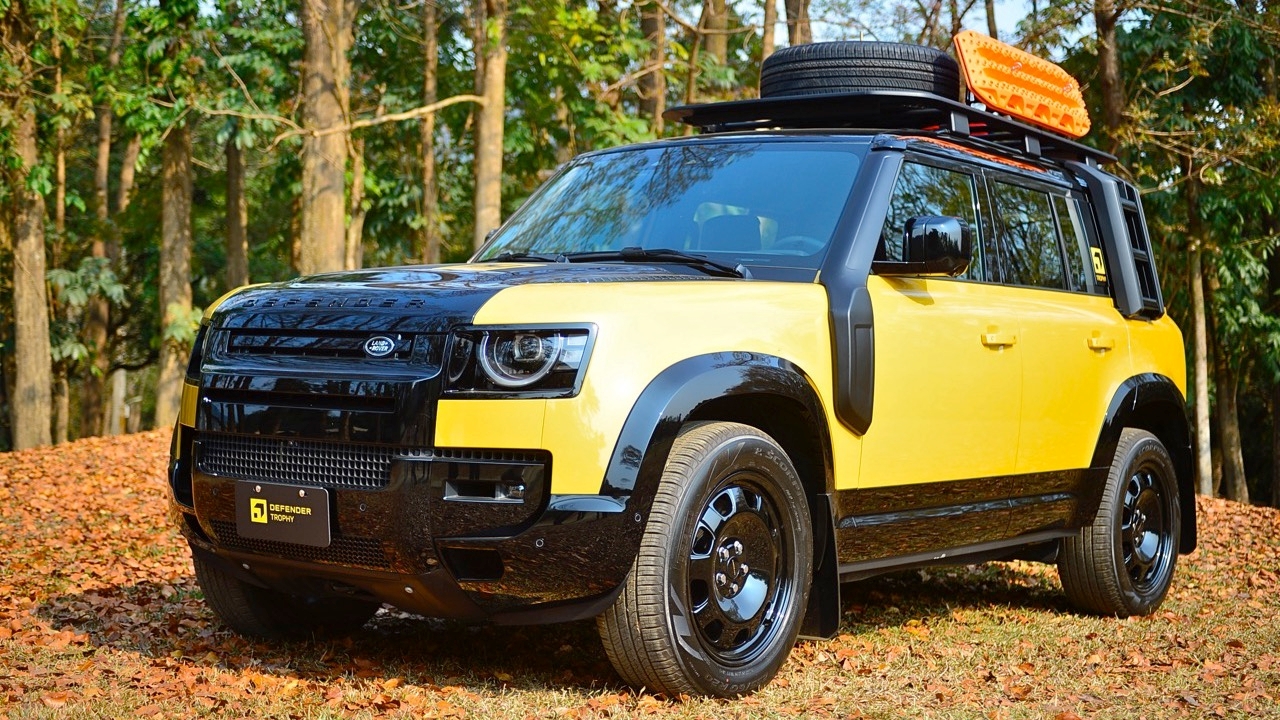
Beyond function, the Defender Trophy retains a spirit of luxury and attention to design and style. The Defender 110 Trophy is crafted to look good and perform excellently. It pays tribute to the Defender’s racing heritage through visual elements recalling its history. Two new colors inspired by the Defender Trophy legacy are offered: Deep Sandglow Yellow and Keswick Green.


The classic yellow is inspired by the color used on Defenders in international off-road competitions like the famous Camel Trophy. The green, named after a town in northwest England, honors the British countryside explorations—the Defender’s homeland. The hood is accented with glossy black paint for contrast, and 20-inch gloss black alloy wheels complete the look. The Trophy model also features special graphics and badges commemorating the brand’s racing history, including Trophy stickers on the hood and C-pillar and a Trophy emblem at the rear.

The Defender 110 Trophy is equipped for both rugged off-road adventures and everyday city driving, designed to maximize comfort for driver and passengers. The interior boasts a high-end atmosphere, illuminated treadplates embossed with the Trophy logo distinguish it from other Defender models. Ebony Windsor leather seats offer durability and softness. As a sub-model of Defender 110, it includes full convenience features such as high-tech infotainment, front power-adjustable heated seats with memory, wireless charging, and heated steering wheel. Storage compartments are thoughtfully distributed throughout, including a large armrest bin and door pockets.

Recently in Thailand, Land Rover has allocated a limited quota of just 10 special edition Defender 110 Trophy units. These vehicles are based on the Defender 110 PHEV platform, fully equipped with off-road accessories to evoke the legendary spirit of adventure.


The Trophy Edition suits urban roads, rough gravel paths, muddy dirt roads, sand, small water crossings, and mountains. The high-performance AT tires and Sandglow Yellow color stem from Defenders used in international off-road competitions. Alternatively, Keswick Green celebrates exploration of remote, rugged areas. Standard equipment includes Trophy stickers, 20-inch gloss black wheels resembling steel rims, All-Terrain tires, wheel arch protectors, black front underbody skid plate, rear guards, illuminated treadplates, leather seats, and off-road accessories like roof racks, roof ladder, side gear carrier, plus standout features like a raised air intake and mud flaps.
The special edition Defender 110 Trophy starts at 7,799,000 baht.

The Land Rover Defender 110 Trophy Edition is a special model celebrating the legendary spirit of adventure and off-road racing (Camel Trophy). Only 10 units are imported and sold in Thailand at a starting price of 7,799,000 baht. The Thai market model uses the P400e Plug-in Hybrid code, combining power and eco-friendliness. It features a 2.0-liter inline-four turbo petrol engine paired with an electric motor, delivering a combined maximum output of 404 horsepower and 640 Nm torque. Acceleration from 0 to 100 km/h is 5.6 seconds, very fast for a large SUV. The EV mode allows pure electric driving for approximately 43-44 kilometers (WLTP standard).


The distinctive Trophy Kit sets this model apart from standard Defenders by focusing on full expedition readiness.
The body color options include two special shades: Deep Sandglow Yellow (the iconic amber yellow from the Camel Trophy era) and Keswick Green (a classic green).
Exterior accessories include a foldable deployable roof ladder.
An Expedition Roof Rack for carrying additional gear.
A waterproof side-mounted gear carrier.
A snorkel (raised air intake) that reduces dust intake and assists with water crossings.
Front underbody shield and classic mud flaps for protection.
20-inch gloss black alloy wheels.
All-Terrain tires designed for all road conditions.
Off-road capability: Test results confirm the Defender retains its title as the "off-road king" with technology enabling everyday drivers to perform like pros. Terrain Response automatically adjusts to surface conditions such as mud, sand, rocks, and snow. Wade Sensing assists in water depth measurement, enabling water crossings up to 900 millimeters deep. Electronic Air Suspension adjusts ride height from 218 to 291 millimeters to overcome obstacles. ClearSight Ground View provides undercarriage camera views for precise front wheel positioning over rocks. The 2.0-liter four-cylinder PHEV engine produces a combined 404 horsepower and 640 Nm torque, achieving 0-100 km/h in 5.6 seconds, and a top speed of 191 km/h. It can travel up to 43 kilometers on electric power alone (WLTP standard). The drivetrain features an 8-speed ZF automatic transmission.


Four-wheel drive and off-road systems.
The drivetrain operates full-time all-wheel drive with a two-speed transfer case (High/Low Range) for climbing. It includes Electronic Active Differential controlling torque distribution to the rear wheels, Terrain Response for automatic terrain adaptation, All-Terrain Progress Control (ATPC) for automatic speed control on difficult off-road paths, and Wade Sensing for water depth detection.
Driving modes (Terrain Response).
The system offers selectable modes tailored to road conditions.
Eco/Comfort for regular paved roads; Grass/Gravel/Snow for slippery surfaces; Mud and Ruts for muddy, rutted terrain; Sand for sandy surfaces; Rock Crawl for rock climbing; and Wade for water crossings.
Suspension and braking systems.
The suspension features Electronic Air Suspension with adjustable ride height adapted to terrain and usage. The brakes consist of four-wheel disc brakes with gloss black calipers, enhanced with an off-road tuned ABS system.

Wheels and tires: 20-inch special design gloss black alloys fitted with All-Terrain tires for grip on both road and off-road surfaces.


Inside the Land Rover Defender 110 Trophy Edition (limited to 10 units in Thailand), the interior combines luxury with functionality for long trips and adventures. Ebony Windsor leather seats in black provide a premium, durable feel. Door scuff plates are engraved with the Trophy emblem, highlighting the model’s exclusivity. Premium Cabin Lighting sets the interior ambiance adjustable to preference.


Premium Ebony Windsor leather seats, a cross car beam laser-etched with the "Trophy" logo, illuminated treadplates bearing the Trophy insignia, and a 13.1-inch Pivi Pro touchscreen infotainment system supporting wireless Apple CarPlay and Android Auto. Convenience features include a ClearSight digital rearview mirror enhancing rear visibility even when roof racks or cargo obstruct the view.


The Land Rover Defender 110 performance test took place outside Kaohsiung, Taiwan’s largest southern port city, featuring diverse terrain from coastline to lush limestone mountains and coastal plains. The highlight was Shoushan mountain by the sea and Yushan peak, Taiwan’s highest point, offering urban, sea, and forest environments.


The first test station outside the city simulated uneven terrain, mud pits, slopes, bridges made from logs, and vehicle positioning at walking speed. The ground clearance facilitated driving over off-road obstacles. Short front and rear overhangs with 38 and 40-degree approach and departure angles, engine torque delivered to the four-wheel-drive system, and a 26-degree breakover angle tested the vehicle’s survival systems on difficult terrain. The Defender’s body is exceptionally strong, built on a new aluminum monocoque chassis replacing the traditional frame, enhancing rigidity.


On the rocky dry creek test path, the Adaptive Air Suspension raised the vehicle up to 295 millimeters, enough to clear obstacles comfortably. The air suspension uses durable components similar to those in the Discovery model. The Defender 110’s adjustable height allows water fording up to 900 millimeters. While few wealthy Land Rover owners fully exploit this capability, the company’s success is rooted in producing vehicles with performance exceeding typical customer needs.


The Defender is designed for mixed terrain use, including both paved roads and severe off-road conditions. Its target customers include affluent adventure drivers. The new Defender 110 especially appeals to genuine outdoor enthusiasts, with a long history linked to remote exploration. It encourages drivers to use all vehicle capabilities and control skills, with four-wheel-drive aids covering all terrain types to tackle obstacles like mud, snow, or towing trailers. The Defender inspires confidence, with ample cargo capacity and durability against dirt and moisture, enabling long journeys across the country comfortably and quickly.


Unlike rugged off-road trucks like the Ford Ranger Super Duty, the Defender does not feel harsh on roads. It lacks the vague steering of the Tank 300 or dizziness-inducing effects of the Land Cruiser 250. The drivetrain is solidly mounted, design prevents vibration at attachment points, and the body remains stable on the strong chassis during off-road driving. The drivetrain integrates torque distribution, long-travel suspension, and adjustable air suspension settings smoothly. The air springs provide a soft, gentle response, contrasting the stiff ride typical of pure off-road brands, and absorb shocks well to keep wheels stable on rough surfaces.


Impressively, the vehicle controls body roll and yaw precisely, gliding smoothly over potholes. The electric power steering performs excellently, allowing fast and comfortable driving on rough roads, nearly matching luxury German SUVs. The chassis and suspension have been strengthened to handle tough off-road driving without compromising city driving comfort. Acceleration from 0 to 100 km/h in 5.6 seconds is impressive for a vehicle with the aerodynamics of a 1960s skyscraper. All models come with a smooth 8-speed automatic transmission featuring a two-speed low gear. The Defender 110 drives all four wheels continuously. The test vehicle was powered by a potent six-cylinder diesel suitable for all uses. The engine runs smoothly and quietly, but the Thai market version uses a 2.0-liter four-cylinder petrol engine with a plug-in hybrid system, combining a turbocharged 2.0-liter petrol engine and a 105 kW electric motor for a total output of 398 horsepower and 640 Nm torque. A 19.2 kWh lithium-ion battery enables 44 kilometers of electric-only range. Despite the boxy shape, the Defender cruises comfortably on highways but lacks quick lane changes unless accelerating fully.


In summary, driving both on- and off-road, including harsh off-road conditions, the new Defender 110 is very quiet with smooth engine operation and minimal tire and suspension noise. Adding accessories like roof racks may increase wind noise and drag, as will the thick-tread off-road tires. The vehicle can tow trailers up to 3,500 kilograms.


Overall, the Defender 110 feels like a large luxury SUV. When leaving paved roads for off-road trails on day two, it transforms into a different vehicle. Its stability, grip, water fording, hill climbs and descents, slopes, mud, and sand are not only conquered but are easy to control, surprising the driver. The drivetrain, suspension, anti-roll bars, gear ratios, differentials, and tires work harmoniously and tirelessly. Coupled with software, the Defender 110 outperforms competitors in heavy off-road conditions. Features like launch and traction control, low-speed throttle management, surround cameras, and off-road survival modes make traveling tough terrain much easier. Drivers can select Terrain Response modes manually or let the system auto-switch to achieve optimal grip in each situation. Letting the computer control is an unusual experience for automotive journalists who frequently test off-road vehicles, but the Defender 110 performs admirably.