

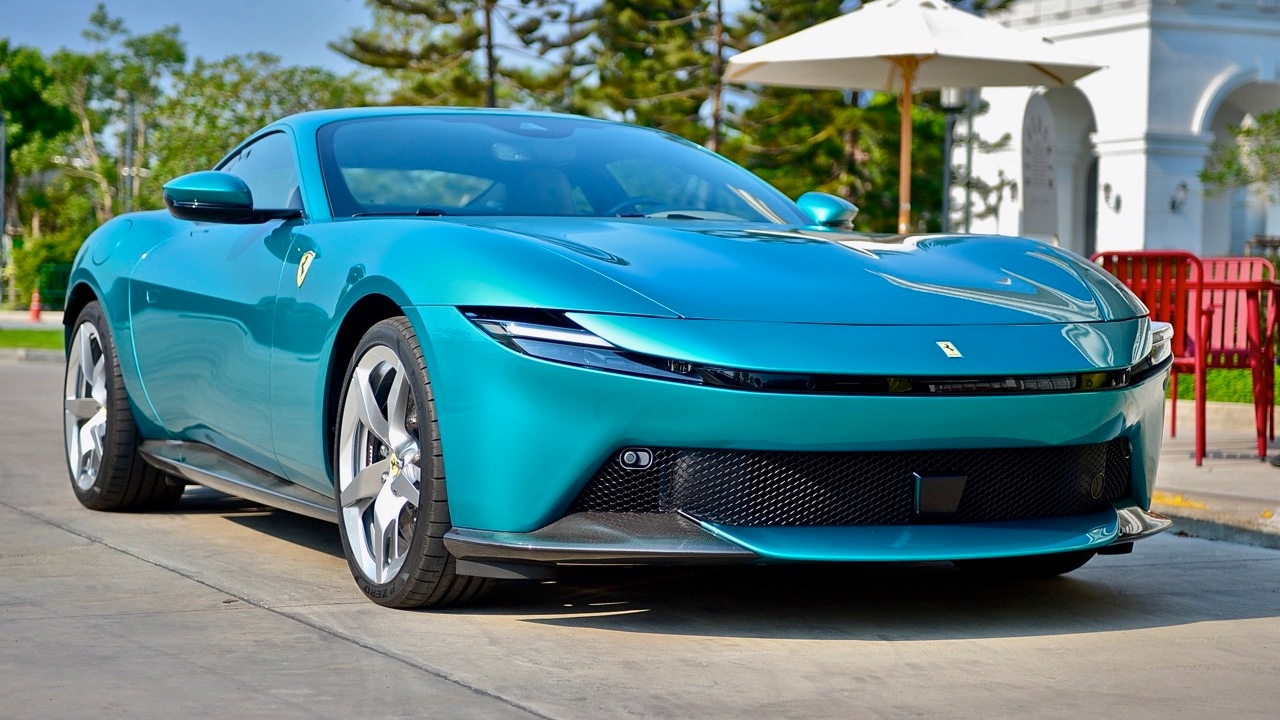
The new Ferrari model offers a balanced 640 horsepower at a reasonable price just under 30 million baht. The Amalfi targets new wealthy clients who have never driven a prancing horse, inviting them into the fold of the historic Italian sports car brand. Amalfi also competes for market share with the Aston Martin Vantage, Mercedes-AMG GT63, and Porsche 911 Turbo S. If you want a front-engine, rear-wheel-drive sports car bearing the yellow prancing horse badge, this should be your starting point. In fact, Amalfi replaces the Roma, marking a novel move for Ferrari to build a front-engine, two-seat GT coupe with a V8 engine. Named after Italy's Amalfi Coast region southeast of Rome, this is a major redesign of the six-year-old Roma, refreshed for a thrilling drive in true prancing horse style.

The Ferrari Amalfi is a new 2+ seat sports coupe replacing the Ferrari Roma, launched in Thailand starting at 28.5 million baht. It features a 3.9L twin-turbo V8 engine producing 640 horsepower and an updated Active Aero system.


The V8 twin-turbo engine and basic structure remain the same, but everything else has been newly tuned. Beautiful multi-spoke alloy wheels and the brake pedal is no longer linked to the left footrest. The interior has been redesigned for easier use. Ferrari separates driver and passenger zones with a large gear tunnel and differing materials between compartments. Power is slightly increased, and driving modes are more varied. It resembles a sports car for mature drivers who prefer simplicity, with no flashy details except for customizable body colors.


The Amalfi's sleek front design has sparked varied opinions among car experts and lively debate. The front hood design integrates well with the lighting and grille, giving the car a refined, mature look. The front is long, typical for front-engine Ferraris, with a sloping roofline and a rounded rear, especially the muscular wheel arches reminiscent of Olympic athletes. The plump, flat rear matches the smooth curves of the roofline harmoniously. This GT coupe's proportions recall classic styles that owners of the 275 GTB would especially admire. Details enhance both comfort and speed.


Modern Ferrari front ends are more aerodynamic than before, with key components like lights and sensors concealed for a futuristic design. The Amalfi blends contemporary design language with the sleek luxury of a Grand Tourer.The design emphasizes fluidity coupled with muscular strength, inspired by Italy's Amalfi Coast. Lines flow continuously from the long front hood to the fastback-style sloping rear.At the front, slim L-shaped LED headlights (S-Duct Signature) flank large air intakes in the bumper to cool the brakes and manage airflow. The rear features single round LED taillights, Ferrari's signature, with a large diffuser and vertically arranged quad exhausts depending on the trim package. Aerodynamics include an Active Aero system with a rear spoiler that rises automatically to increase downforce at speed.


The chassis is designed with a low center of gravity and extra width for stability. Dimensions: length about 4,720 mm, width 1,980 mm (excluding mirrors), height 1,240 mm (emphasizing low height for aerodynamics), and a 2,750 mm wheelbase. Weight ranges from 1,550 to 1,600 kg depending on carbon fiber options. Wheels are 20-inch forged alloys front and 21-inch rear, with Michelin Pilot Sport Cup 2 or Pirelli P Zero Corsa tires sized 245/35 ZR20 front and 305/30 ZR21 rear. Brakes use carbon ceramic discs with six-piston calipers up front and four-piston rear.

The heart of the Amalfi is a V8 engine developed from Formula 1 technology to deliver immense torque. Unlike the hybrid V6 in the 296 GTB, the Amalfi uses an evolved legendary 3.9-liter (3,855 cc) twin-turbo V8 (F154 BH series) producing 640 PS at 7,500 rpm—about 20 PS more than the Roma—and 760 Nm of torque from 3,000 to 5,750 rpm. Improvements include lighter camshafts, a newly tuned ECU based on the 296 GTB, and turbochargers spinning at 171,000 rpm for sharper response. Performance figures are 0-100 km/h in 3.3 seconds, 0-200 km/h in 9.0 seconds, and a top speed of 320 km/h.

The transmission is an 8-speed dual-clutch automatic (Magna 8DCL900), an oil-bath design borrowed from the SF90 Stradale but with gear ratios tuned for Grand Tourer style. Shifts are smooth at low speeds and aggressive at high speeds. The Amalfi uses a front-engine, rear-wheel-drive layout with an electronic limited-slip differential (E-Diff 3).

Suspension and control technologies include a front double wishbone setup with springs, shock absorbers, and anti-roll bars; a rear multi-link with the latest Magneride electromagnetic dampers (SCM-Frs) offering finer viscosity control. Stability control SSC 6.1 works with brake-by-wire and ABS Evo for precise cornering and braking even on slippery surfaces. The steering rack is newly tuned electric power steering for sharper, steadier responses.

The 2026 Ferrari Amalfi is fast enough to silence critics of its design, thanks to turbochargers spinning 7,000 rpm faster than on the Roma, now at 171,000 rpm. Power increases from 620 to 640 horsepower, and torque is finely mapped per gear to keep the driver glued to the 7,500 rpm redline, extending torque up to a strong 760 Nm.
Despite sending all power to the rear wheels alone and weighing around 1,570 kg, the Amalfi accelerates from zero to 100 km/h in 3.3 seconds, reaches 200 km/h in 9.0 seconds, and tops out near 320 km/h on straights. It decisively outperforms more powerful Aston Martin Vantage S and DB12 models, with only all-wheel-drive, electrified rivals matching or surpassing it.
Ferrari has not disclosed Fiorano lap times for the Amalfi, stating it is a GT sports car, contrasting with mid-engine models like the 296 and SF90/849 Testarossa. However, the engine is mounted deep behind the front axle line, effectively making it a front mid-engine car like other Ferrari models.

The front mid-engine layout is key to the Amalfi's GT performance close to that of mid-engine supercars. Normally, front-engine cars mount the engine over or ahead of the front axle, but the Amalfi's V8 is pushed back behind the front axle line, placing it between the front wheels and the cabin—a vehicle midsection. This layout improves weight distribution (about 47% front, 53% rear), enhancing rear-wheel traction, reducing wheelspin on launch, and lowering the polar moment of inertia by concentrating mass near the center. Steering response in corners is sharper and more agile due to less weight at the front extremities.

The Amalfi's low center of gravity is achieved by mounting the V8 very low using a dry sump system, stabilizing the car and reducing body roll in high-speed corners. Moving the engine behind the front axle necessitates a long hood to accommodate the large V8 block and shifts the cabin rearward, making the driver feel closer to the rear axle—an iconic GT Ferrari trait. In short, front mid-engine means the engine is centrally located but forward, blending race-car agility with practical cabin space and elegant road car styling.

Managing engine heat in the Amalfi presents a major challenge because the deep front mid-engine placement reduces cooling space and brings heat sources close to the cabin. Ferrari employs Total Thermal Management technology including:
1. Dynamic Smart Air Intake System
Active Grille Shutters: Electric shutters in the front grille open or close based on speed and temperature. They close during normal driving to reduce drag but open fully under high engine temperatures to direct air to the radiator.
Central Air Vent: A low-pressure vent on the bonnet extracts hot air from the engine bay to prevent heat buildup above the engine.
2. Split Cooling System
Ferrari separates coolant circuits for maximum cooling efficiency:
High-Temperature Circuit: Cools the V8 engine block specifically.
Low-Temperature Circuit: Cools the intercoolers to lower intake air temperature, enabling sustained power during extended track use.
3. Hot-V System and Turbo Heat Management
The Ferrari V8 has side-mounted turbos with spacecraft-grade heat shielding:
Isolating Wraps: Thermal insulation covers exhaust pipes and turbochargers to prevent heat spread to electronics and cabin walls.
Post-Run Cooling: Electric fans and pumps run after engine shutdown to prevent heat soak, which could damage components.

4. Underbody Aerodynamics Management
Engine underbody panels include NACA ducts that channel cool air beneath the car to cool the 8-speed DCT transmission and rear exhaust system.
This airflow also generates downforce while maintaining low drag coefficient.

5. Firewall Insulation
With the engine positioned close to the firewall, Ferrari uses composite materials and high-efficiency reflective foil to ensure cabin temperatures remain comfortable and insulated from engine heat.
Additionally, the Amalfi's braking system includes cooling ducts from the front bumper directing air to carbon ceramic discs. Hot brake air is vented through wheel arches to avoid interfering with engine cooling.

Ferrari applies a multi-material approach to balance lightweight construction with thermal durability required by the deep-mounted twin-turbo V8.
1. Bonnet Construction
The Amalfi's bonnet is a sandwich-structured panel, not a single metal piece.
It uses Carbon Fiber Reinforced Polymer (CFRP) of F1-grade, which is stronger and 30% lighter than aluminum.
The underside is lined with real gold or silver heat-reflective foil positioned under the turbos to reflect infrared heat away, protecting the paint finish.
Air outlets use high-heat resistant pre-preg carbon fiber to prevent deformation from exhaust gases hotter than 150°C.

2. Engine Bay and Firewall Structure
Because of the front mid-engine layout, the firewall serves as both structural support and heat insulation.
The firewall is a composite of cast aluminum and carbon fiber bonded with high-temperature structural adhesive to block heat transfer to the cabin.
Titanium heat shields protect areas near exhaust manifolds, chosen for low thermal conductivity and light weight compared to steel.
The dry sump oil tank beside the engine is lightweight aluminum designed to help dissipate oil heat through surface contact.

3. Front Chassis Structure
Extruded aluminum alloys (6000 and 7000 series) form the front frame supporting the radiator and intercoolers, providing toughness and impact absorption.
Carbon fiber strut tower braces increase torsional rigidity at the front to support the V8 engine's weight without excessive mass.

4. Aero-Thermal Integration Innovation
Wheel arch liners use lightweight synthetic materials with louvers that channel hot air out of the engine bay via the Venturi effect from rotating wheels.
Underbody diffusers made from durable thermoplastics organize airflow swiftly past the oil pan and transmission for passive cooling.
Material selection in the Amalfi minimizes weight while precisely controlling heat containment and dissipation as engineered.
The front mid-engine layout influences not only driving performance but also cabin structure and safety technology integration, differentiating it from typical front-engine cars.


Interior architecture adapts to the engine pushed behind the front axle. The seating is set back so occupants feel positioned closer to the rear axle. The hip point is low and near the car’s rotational center, enhancing driver feedback and precision.


The high-bridge center console, raised due to the rear-mounted 8-speed DCT transmission, creates a cockpit-like enclosure distinctly separating driver and passenger (dual-cockpit concept). The pedal box is ergonomically aligned with the driver’s shoulder axis to reduce twisting during long drives, matching Grand Tourer comfort standards. Thick composite firewalls help tune the V8’s roar to an enjoyable acoustic level without becoming overwhelming on long trips.


Ferrari reimagined vehicle interaction with driver and passenger, marking a shift toward a digital yet sporty Grand Tourer experience. The passenger gets a widescreen (about 8.8-inch) full HD touchscreen seamlessly integrated into the dash, showing real-time performance data such as speed, RPM, gear, and G-force during cornering. Media and navigation controls allow setting GPS or selecting playlists without distracting the driver. The Manettino status displays the current driving mode for passenger anticipation. Climate and seat massage settings are also accessible via this screen.

Driving Modes on the Manettino (5-Position Switch)
The Amalfi’s steering wheel Manettino dial is software-tuned (Evolution 8.0) to maximize the V8 engine and Magneride suspension potential, offering five main modes.
WET prioritizes maximum safety. Stability control (ESC) and traction control (F1-Trac) intervene quickly to prevent skidding, ideal for wet or slippery roads.
COMFORT is the standard mode for city or long-distance driving (GT mode), softening suspension, smoothing 8-speed DCT shifts, and controlling exhaust noise to moderate levels.
SPORT sharpens throttle response, opens exhaust valves for a fierce roar, stiffens suspension slightly to reduce body roll, and allows limited rear slip before ESC intervention via Side Slip Control (SSC).
RACE is for track or high-speed driving, with millisecond-level gear shifts, ABS Evo braking in maximum performance mode, and firm suspension settings for optimal road grip.
ESC OFF disables all stability aids, letting expert drivers fully control this spirited machine by skill alone.

The Ferrari Amalfi delivers a better engine sound than the Roma, more power, and meets emissions standards without hybrid complexity. Advanced driver aids (ADAS) remain but are easier to toggle via touch controls. The interior is more user-friendly with significantly improved material quality. Above all, the Amalfi is easy to drive, beginner-friendly, and entertaining for experienced Ferrari owners who find older, stiff models less comfortable.
Safety and Driver Assistance Systems (ADAS)
The Amalfi borrows technology from elder siblings like the Purosangue and SF90 to be both easy and safe to drive.
Ferrari Active Suspension Technology (FAST) is an electronic suspension that cooperates with safety systems. It can adjust damping and raise the car immediately upon detecting impacts or emergencies to maintain stability.
ADAS 2.0 (Advanced Driver Assistance Systems) includes:
Adaptive Cruise Control (ACC) with Stop & Go functionality for urban traffic.
Predictive Emergency Braking works with brake-by-wire to achieve smoother, shorter stops than traditional hydraulic brakes.
Lane Keeping Assist and Blind Spot Detection warn and gently steer to prevent lane departures.
Side Slip Control (SSC) 8.0 is Ferrari’s most advanced system for 2026, calculating real-time slip angles and dynamically adjusting torque vectoring to enable the fastest safe cornering.
Digital Rearview Mirror: Due to the small fastback rear window, a high-resolution screen displays rear camera footage with a 180-degree view for clear visibility.


The Amalfi removes some driver aids common in other Ferraris to highlight raw, thrilling driving without discomfort. It lacks rear-wheel steering, electric power assistance, or active anti-roll bars found in the Purosangue. Ferrari calls it a return to basics: a pure V8, rear-wheel-drive sports car.The steering is responsive, making the car feel more natural than larger V12 12-cylinder models focused solely on top speed.
Central to Ferrari’s modern drivetrain is the rear-mounted 8-speed dual-clutch gearbox, providing smooth city driving and powerful motorway performance. Gear ratios favor high-speed cruising. Shifts are quick and precise to throttle input. Compared to a latest Porsche 911 Turbo S hybrid, the Amalfi’s throttle feels gentler. Near redline, blue shift lights illuminate on the wheel, and the V8 roars briefly with a tone reminiscent of the 458 Italia before hitting the rev limiter, suggesting even greater potential beyond the spec sheet.


Ferrari employs electronic brake-by-wire for the Amalfi’s carbon ceramic brakes, ensuring consistent, precise braking during aggressive track use. The system manages brake temperatures and prevents pedal fade longer than traditional brakes. Integration with driver aids like adaptive cruise control is also simplified.
This is not a gradual rollout of autonomous driving in a Ferrari. The brake-by-wire system originated in the hybrid SF90 to balance regenerative braking and friction braking. Pleased with the results, Ferrari extended its use across the 2026 lineup. Ultimately, Ferrari transformed the stunning Roma into the Amalfi, tailored for mature owners. It surpasses typical V8 coupes in drivability, comfort, and value, delivering an exceptionally satisfying driving experience.