

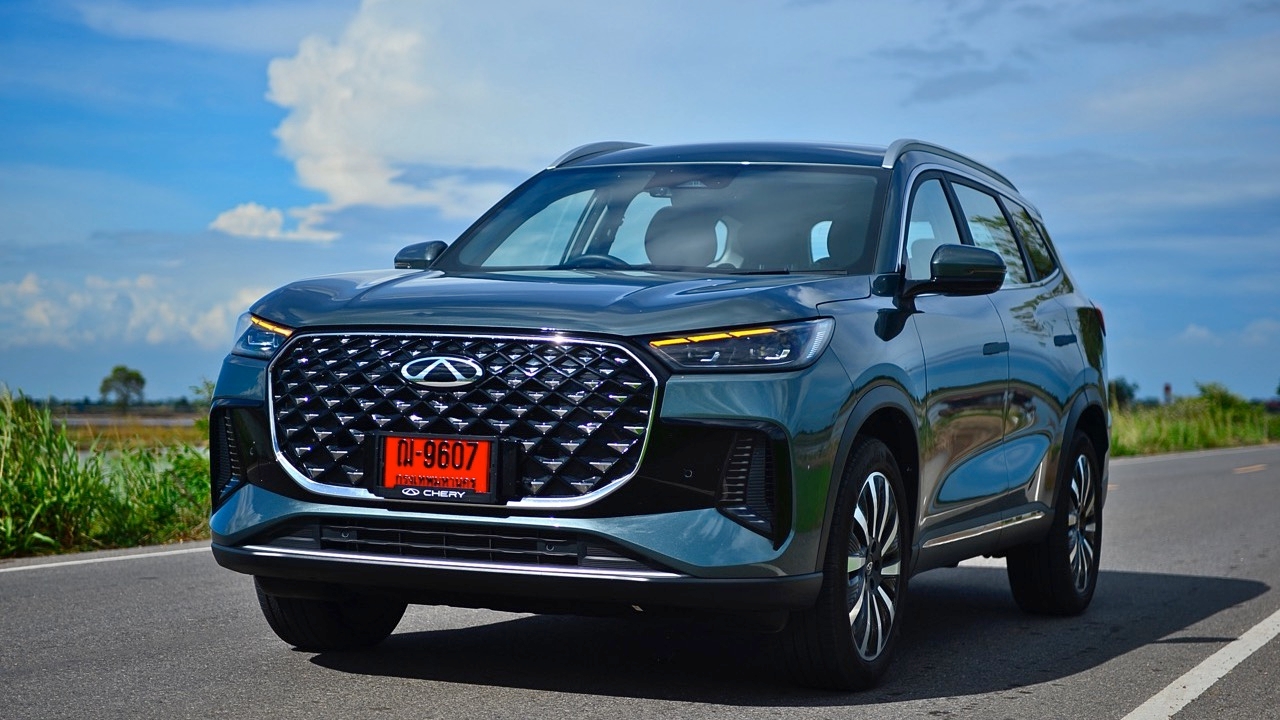
The Chery Tiggo 8, a 7-seat SUV from China, challenges local rivals with its pricing and overall features. What exactly is it? The Chery Tiggo 8 CSH PHEV is a new SUV from mainland China that has officially entered the Thai market. While this might sound like a familiar story given the influx of Chinese cars, its sharp design and attractive price—under 900,000 baht for a large vehicle—make it undeniably interesting.
From the perspective of Thai consumers looking for a crossover, the past 1-2 years have been confusing due to the rapid expansion of new Chinese car models and numerous emerging brands making it hard to keep track. The confusion deepened as newcomers like Jaecoo and Omoda began capturing market share from Japanese and even European competitors, with their vehicles appearing on nearly every street corner. If you haven't noticed, it's because Jaecoo and Omoda's designs cleverly mimic competitors from various countries, becoming a highly successful copycat strategy.


Chery is the parent company owning both mentioned brands, and today they are marketing a vehicle under their own name. Positioned at a lower price point than Jaecoo (which is considered a more premium brand), most of the technology and parts are shared across the brands. The name Chery is intentionally a play on the word 'Cheery,' meaning cheerful, with the brand slogan 'Find Your Happiness.' Its logo resembles that of the luxury brand Infiniti, which in some markets helps enhance the car's prestige. Chery's pricing strategy likely improves its chances of survival and sustainability from the start. In Thailand, the Chery Tiggo 8 7-seat PHEV ESTEEM 2WD is priced at 949,000 baht (test unit) and the top PHEV ELITE 4WD at 1,069,000 baht.


The vehicle before you is the Tiggo 8, a 3-row, 7-seat SUV with rear-wheel drive, priced at 949,000 baht. It may seem expensive until you consider its size. Simply put, it's a Chinese SUV with both an engine and electric motor plus a third row of seats. Its uniqueness doesn't end with the seats; the plug-in hybrid (PHEV) exterior design features more harmonious headlights, a sparkling grille, and sharper body lines, along with a spacious interior. This shows the intent to compete seriously, not just test the waters and retreat. Oddly, the newer and more modern-looking model is the internal combustion engine (ICE) version, while the pricier hybrid model has a plainer appearance. This contradiction might confuse those already puzzled by sibling brands like Jaecoo. Clearly, Chinese automakers are rapidly adapting products in Thailand unlike anything seen before. Chery's strategy is to get vehicles into showrooms quickly, then refine details later, prioritizing market presence over traditional marketing methods. The CSH powertrain—Chery Super Hybrid—combines a suitably powered electric motor and an 18.4 kWh battery with a smaller 1.5-liter gasoline engine, producing a combined 201 horsepower to the front axle. Acceleration improves slightly with a 0-100 km/h time of 8.5 seconds, though top speed decreases to 180 km/h.

The Chery Tiggo 8 CSH PHEV was developed by Chery’s global design team and engineers who played a key role in shaping this generation and current models. The project leader is Steve Eum, Global Vice President of Design at Chery Group. The latest Tiggo 8 design and technology improvements seen in this CSH PHEV version are driven by two main development focuses led by Steve Eum.

Steve Eum is a Korean-American automotive designer who graduated in automotive design from the renowned ArtCenter College of Design in California. He has over 35 years of experience in the global automotive industry. His past work includes collaborations with major car companies like Ford (including studios in Australia and Ghia in Italy), General Motors, and he served as Director of Exterior Design for Hyundai. He also worked on new brands related to SAIC.
At Chery, upon taking charge of design, Steve Eum has revolutionized the vehicle design language, giving the cars a more global look, premium feel, sportiness, and clear luxury. This transformation extends to Chery’s affiliated brands such as OMODA and JAECOO.
The Tiggo 8 PHEV was designed by Chery’s global R&D design team. The design was not completed solely in China but was a collaborative effort among Chery’s global technology and design centers, especially the Chery Europe Design Center in Germany and North American design centers. This ensured styling that appeals to European and global export markets. The vehicle’s architecture (Platform T1X) is a modular structure co-developed with luxury group Jaguar Land Rover, giving the car proportions, wheelbase spacing, and overall dimensions that reflect the dense, robust, and solid characteristics of European SUVs.


Exterior design emphasizes premium SUV luxury. The front features a large hexagonal grille (similar to Audi) with a sparkling diamond-shaped pattern, flanked by LED projector headlights and LED daytime running lights. The side profile is sleek and refined with hidden door handles that blend into the body, and side mirrors with memory function. At the rear, LED taillights stretch across, connected on both sides with the Chery badge centered, complemented by dynamic turn signals. The 2WD model lacks a panoramic sunroof and does not have a sensor-activated power tailgate. Dimensions classify the Tiggo 8 CSH PHEV as a C-SUV / Large SUV with 3 rows and 7 seats (5+2). It measures 4,725 mm long, 1,860 mm wide, and 1,705 mm high, with a 2,710 mm wheelbase and a 166 mm ground clearance (2WD Esteem version). Fuel tank capacity is 60 liters.


Cargo space with the third row folded is 494 liters, expandable up to 2,101 liters when folding both second and third rows. The 19-inch two-tone forged alloy wheels are fitted with Continental Premium Contact C tires sized 235/50 R19, the same for both front-wheel-drive and four-wheel-drive versions. The 2WD model has a manual tailgate requiring physical effort to open and close. The suspension is tuned for softness to absorb shocks, typical for family cars, yet remains stable without excessive body roll during lane changes. It uses a fully independent 4-wheel suspension with front MacPherson struts and anti-roll bar, and rear multi-link suspension with anti-roll bar. Brakes include ventilated disc brakes in front and solid discs at the rear. Safety brake features include electronic parking brake with Auto Vehicle Hold, ABS, EBD, emergency brake assist, automatic emergency braking (AEB) with rear cross-traffic braking (RCTB).


The cabin and features are certainly modern. Over six days of use, CarPlay connected seamlessly upon entry. But don't be deceived by the interior design and rear seat arrangement alone. The entire dashboard has been completely revamped, centered around a massive 15.6-inch touchscreen that integrates climate controls and side mirror adjustments, a typical setup in Chinese cars. At first glance, the interior looks luxurious and impressive, but in practice, operating functions by touch causes distraction and frustration, especially when adjusting the temperature, forcing drivers to look away from the road. Physical buttons for climate and mirror controls would be preferable.


However, this issue is not unique to Chery; many Chinese competitors fall into the same trap. Beyond warning systems, the car emits sounds from all directions, which might help new drivers perceive the surroundings. The rearview mirror’s unusual angle is designed to give a great view of the rear seats but is almost useless for looking through the rear window to see traffic behind due to its distant perspective. On the plus side, the surround-view cameras deliver high-resolution images, especially the augmented reality 540-degree system, which responds quickly thanks to a powerful processing chip. Although somewhat excessive, it is visually appealing and comes standard even in the base model.


The luxury contrasts with typical Chinese cars, featuring many quirky details that pricier European competitors tend to avoid. Chery counters this with interior materials and workmanship so upscale it’s surprising for the price. The cabin materials feel much more premium than expected. The Tiggo 8 makes a strong first impression with its flush, hidden exterior door handles—though it remains to be seen how easily they open when hands are full. The door panels have subtle embossing reminiscent of a budget Bentley Bentayga. The gear selector is moved to the steering column, freeing up center console space but risking accidental activation of windshield wiper stalk during initial use. The car provides more USB ports than smaller models, with USB-A and USB-C ports front and rear, plus a wireless charging pad under the dashboard.


With all seats deployed, rear cargo space shrinks to just 117 liters but expands to 494 liters when folding the third row, and up to 1,930 liters with second and third rows folded. This 7-seat cargo capacity lags behind European competitors, which may be a limitation for long trips with multiple passengers and luggage. Adults can squeeze into the third row but the narrow access and cramped space make it uncomfortable. Even though the right-side third-row seat folds to allow easier entry, many competitors offer more practical access and comfort in this area.
Performance figures are not the critical factor here; buyers of this type of vehicle mainly want to know if it can seat seven passengers comfortably. The third row is suitable for children but predictably cramped and uncomfortable. Also important is cargo space after everyone is seated.


With all three rows unfolded, rear cargo capacity shrinks to a mere 117 liters. Remember, the third row is intended for children only. Compared to competitors like the Honda CR-V, a value-oriented family car, or the luxury Ford Everest SUV, the Tiggo 8 falls behind. This is a key area to test personally at a showroom because for this car, "spacious cargo area" and "comfortable 7-seat accommodation" are mutually exclusive and handled less effectively than many rivals. Overall, the Tiggo 8 PHEV occupies a peculiar market position: priced lower than 5-seat SUVs like the Toyota Corolla Cross and HR-V, which are well-established and enjoyable to drive, yet its top version costs more than budget offerings like the Tiggo 8. Buyers should carefully consider loan payments and leasing programs since established brands with stronger networks typically offer lower monthly installments than new Chinese entrants. Therefore, before concluding this car is a cheap and good deal, it is advised to review and compare financial figures carefully.


On paper, the Tiggo 8 CSH PHEV is the most substantial and credible among newly launched vehicles, packing seven seats and a long list of standard features. Moreover, it costs about 450,000 baht less than comparable rivals, yet offers a surprisingly luxurious interior and an upscale atmosphere. Driving-wise, it is not bad at all. The plug-in hybrid powertrain provides a lively, smooth experience. However, in nearly every practical aspect, minor flaws remain that Chinese automakers need to revisit and improve.
Compared to local favorites like the CR-V and Everest, which perform well in this segment, the Tiggo 8’s limited 117-liter rear cargo space with all seats up is a drawback. For cash buyers, it may offer satisfying value, and for company fleets, the low CO2 emissions of its hybrid powertrain are appealing. But don’t jump to the conclusion that this car is a knockout winner based solely on its low recommended retail price. It’s wise to check fuel consumption figures, especially when driving fast.


How does it feel behind the wheel? A concise description for the gasoline plug-in hybrid model would not be "smooth and steady." The 1.5-liter engine combined with the electric motor clearly demonstrates swift acceleration that can be startling (braking might be difficult). The Tiggo 8 PHEV launches aggressively from a standstill, often with wheel spin, and can easily carry four adults. Imagine the performance fully loaded with passengers and luggage. The suspension can be somewhat stiff but remains tolerable at normal speeds. When overtaking urgently, the engine emits a raspy roar at high revs, while the rear motor’s torque can cause wheel spin. The vehicle lacks paddle shifters or manual mode, so drivers must rely on the suspension, steering, and safety systems. Amid a pleasant atmosphere, the driver’s spouse complained loudly to slow down.


For those seeking an affordable everyday vehicle, this Tiggo 8 PHEV offers a reasonably refined driving experience with lively horsepower. As a plug-in hybrid, it claims a total driving range (fuel plus electric) exceeding 1,100 kilometers, with pure electric range up to 90 kilometers for city driving. In reality, aggressive driving reduces fuel capacity (60 liters) range to around 600 kilometers, though such driving isn’t recommended due to speeding tickets risk.


It’s a smooth, quiet, adequately powerful, and comfortable vehicle. Is there anything else to know? Beware that the sportiest driving mode in this hybrid model loudly announces 'SPORT MODE!' through cabin speakers, as if broadcasting your intentions to race to everyone inside. This mode sharpens throttle response and tightens steering excessively. Pressing the accelerator aggressively while exiting a corner can cause front wheel spin, triggering the traction control system to abruptly cut power in a jarring manner, disrupting the cabin’s calm atmosphere.


The suspension and handling are generally "acceptable" but not outstanding. The car exhibits some body roll and instability over consecutive road undulations. The damping system struggles to settle before encountering the next bump, though the situation is not severe. Chery plans to establish an engineering R&D center in the UK, and after its launch, improvements in suspension sharpness and responsiveness are expected. Currently, local rivals like the CR-V and Ford Everest offer superior driving feel and sophistication. However, the Tiggo 8 PHEV’s significantly lower price is a clear advantage.