

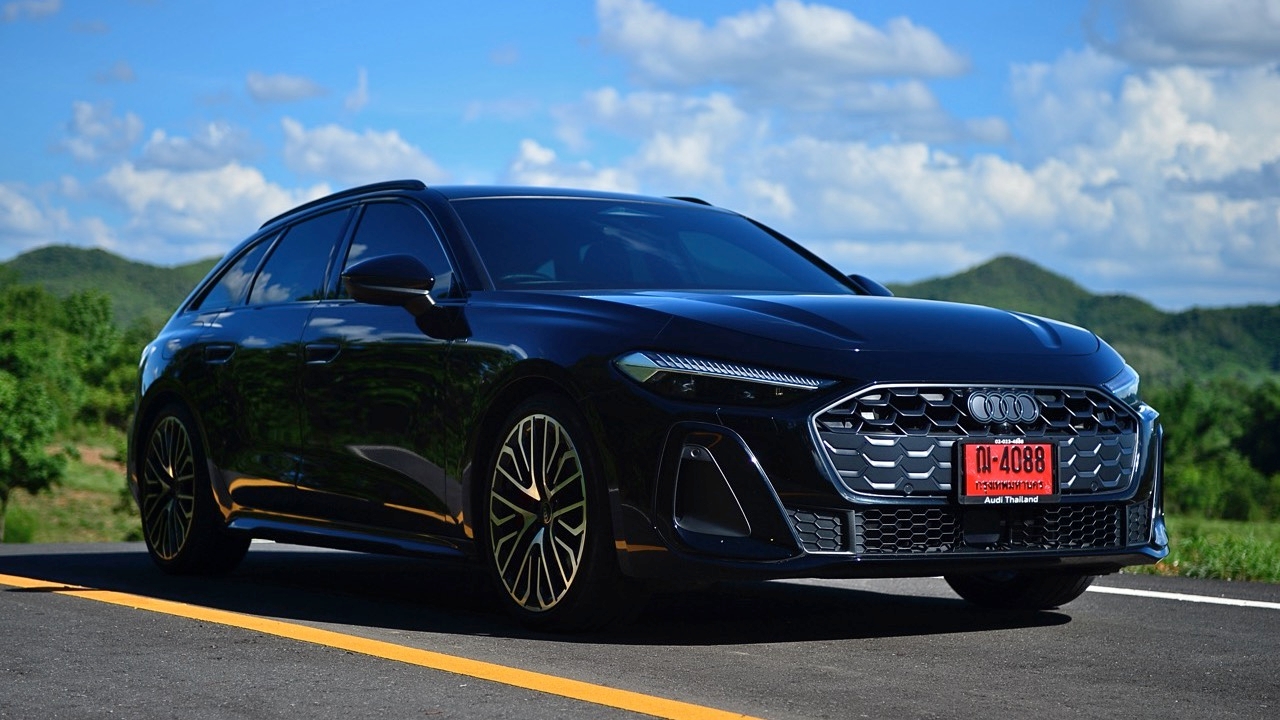
The story is that the original Audi A5 body styles, both the 2-door coupe and the 5-door sportback, have been discontinued, ending their legacy. The car that replaces the A4 Avant is almost the same car, but now equipped with a hybrid powertrain (plug-in hybrid) that delivers both speed and efficiency straight from the factory. It sounds contradictory, but the new four-ring model really achieves this. Today, the automotive industry no longer easily sells anything it produces. Previously, Audi stirred confusion by announcing, "Even numbers are electric cars, odd numbers are gasoline cars," but shortly after launching the A5, the brand reversed course and reverted to the old naming system. For this generation, it's best to accept that the A5 keeps the A5 name even though it arguably should be a new A4. Reading this is quite confusing.
Audi A5 Sportback TFSI e quattro Tech Pro priced at 3,899,000 baht.
Audi A5 Avant TFSI e quattro Tech Pro priced at 3,999,000 baht (test vehicle).


Audi claims the new A5 is a sedan or wagon with sporty lines (again). Upon inspecting the rear, it’s actually a 5-door station wagon with an electrically operated tailgate. The wagon remains a wagon, unchanged, though Audi calls it the Avant for prestige. The body borrows the sporty, sleek sloping design from the previous A5 but with narrower windows, giving a lower, more grounded feel typical of German cars. Possibly due to media spending too much time in SUVs lately. The new A5 Avant is longer, taller, and wider than before. Both sedan and wagon measure exactly 4.8 meters in length, featuring a sleeker, more aggressive, and slightly more luxurious look. Inside, the cabin is packed with cutting-edge technology.


Is it fun to drive? Absolutely, but in a smooth way. You immediately feel Audi's deliberate effort to tune this car to a neutral, easily controlled character with refined aggression. The brand’s hallmark grip is evident at higher speeds, inspiring confidence. All new A5 models pair with a 7-speed dual-clutch automatic transmission, which works hard to continuously propel the car forward. The feel isn’t raw or wild like the legendary twin-turbo V6 RS5, but the quattro all-wheel-drive system enhances traction, helping the 0-100 km/h time drop to just over 5 seconds.


The plug-in hybrid (PHEV) features a 2.0-liter gasoline engine paired with an electric motor and a 20.7 kWh usable battery capacity. Together, they produce up to 295 horsepower and 450 Nm torque, enabling a brisk 0-100 km/h in 5.9 seconds. However, the new A5 Tech Plus and Tech Pro models suit a more refined, composed driving style rather than aggressive bursts. The claimed fuel economy is an impressive 50 km per liter (141.1 mpg) and an all-electric range of up to 100 km per full charge.


Audi, BMW, and Mercedes-Benz have long relied on legacy, customer familiarity, and nostalgia to boost new model sales. However, in this year, the Audi A5 is no longer a common sight on roads as before, mainly due to import taxes pushing the wagon model’s price to 4 million baht instead of the previous A4 Avant’s 3.4 million. For driving enthusiasts prioritizing feel over utility, the A5 delivers an unmatched driving experience, outperforming all SUVs. Owners trade some passenger and cargo space compared to high-riding, four-wheel-drive SUVs, but the A5 wagon preserves Audi's heritage of low, sporty, yet comfortable cars. Only Audi achieves this; others may offer comfort but with harsher rides.


Regarding fuel efficiency, the plug-in gasoline hybrid initially claims average consumption around 14-16 km per liter. At minimum, the Audi A5 plug-in hybrid is reasonable in economy and maintenance costs (though this is debatable). The rear seats provide adequate space for two passengers comfortably, though the Sportback model has limited headroom, which may be uncomfortable for taller individuals. The luggage space is generous. However, the key issue is the price: the new A5 family, priced at about 3,999,000 baht including import tax, is notably more expensive. Incorporating plug-in hybrid technology and new exterior/interior designs adds significant cost, and with new import taxes, chances of owning such a quality car diminish at nearly 4 million baht.

The dynamics and stability of this Audi A5 are finely tuned to compete with the BMW 3 Series Touring and the new Mercedes C-Class Estate. A key advantage of the A5 Avant over these competitors is that neither Benz nor BMW offers station wagons in Thailand. The A5 drives more agilely and sportily, balancing sportiness with comfort. Owners get a harmonious blend of power and decent fuel economy when driving calmly without rushing.


In reality, the new Audi A5 is a familiar car to four-ring fans, known in every aspect except the confusing naming. Audi’s new naming will settle and become recognizable soon. Historically, previous models earned a reputation for durability and long-distance reliability, traits well preserved in this latest generation. Audi now loads the car with advanced technology, sometimes to the point of annoyance or distraction. Also, for those with children, skipping the Sportback for the Avant wagon is advisable due to its much more spacious interior.


The sharp steering and handling are moderated by driver-assist systems aimed at novice drivers. This leaves the A5 somewhat behind perennial rivals in the segment, despite being a fresh new model. Ultimately, Audi’s attempt to balance comfort and sporty performance results in a compromise that doesn’t fully satisfy either side.


The Audi A5 interior obviously offers full luxury and comfort for a price of 3.9 million baht. Materials are refined but not overly luxurious, making it family-friendly. However, Audi’s signature glossy black plastic is everywhere upfront and tends to attract dirt easily. Volkswagen Group has faltered somewhat in interior design, but the A5 includes advanced voice control. Steering wheel buttons are easy to press accidentally if not careful. The touchscreen partly controls cabin climate and electric seats. The dashboard is complex, featuring three screens: two for the driver and one for the front passenger.


The screens appear somewhat large—though not Mercedes’ Hyperscreen size, they dominate the dashboard, overshadowing other elements. The high-spec model includes a 10.9-inch touchscreen for the front passenger, an 11.9-inch digital instrument cluster, and a 14.5-inch infotainment screen. Wireless Apple and Android connectivity and wireless charging come with a cooling fan beneath to prevent phones from overheating. Interior lighting is simple yet elegant, with LED strips in doors and along the windshield base illuminating navigation prompts, and console edge lights signaling safety alerts or turn indicators.


Regarding the dashboard screens and new technology, there are pros and cons: the screens work well with sharp images, quick response, and extensive information to aid travel. However, the central touchscreen can be distracting despite large, easy-to-touch icons. The passenger screen likely boosts showroom appeal but is seldom used beyond navigation, radio, or video playback, as most prefer their own phones. The central screen tilts away from the passenger. Overall, the design emphasizes simplicity and luxury through material choice.


The Audi A5 is comfortable in front with ample space and decent rear legroom. The panoramic glass roof features a tinting film to reduce light and heat, though most owners will likely add further tinting as it remains quite bright. The sleek roofline reduces rear headroom, which may be tight for those over 180 cm tall. Choosing the Avant wagon provides cargo space comparable to SUVs, with 485 liters of rear storage (31 liters more than the Sportback). Folding the rear seats expands cargo capacity to 1,306 liters in the PHEV station wagon.


The new Audi A5 Avant e-hybrid quattro’s premium sound system is impressive. Beyond engineering the car on the new PPC platform, Audi maintains a strong partnership with Bang & Olufsen (B&O) to design an acoustic system that outperforms German rivals in travel sound quality. The top-tier system features 20 speakers with a total power of 810 watts.

For the top version (or options bundled with the Technology Pack / premium Vorsprung model), the Bang & Olufsen 3D Premium Sound System is upgraded to a powerful 810-watt digital ICEpower amplifier, up from the previous 685 watts. It includes 20 speakers positioned all around, advanced amplifier and woofer drivers, and digital amplification technology offering low heat and clean, dynamic bass. Notably, it features "Headrest Speakers" — small speakers embedded in the front seat headrests.

This marks a significant cabin innovation: four small speakers are embedded into the front seat headrests (two per side). Acoustically, they create a personal 3D sound field that envelops the ears perfectly without needing to raise volume for door panel speakers. Intelligently, the system isolates sounds such as navigation prompts or alerts to the driver’s headrest speakers only, so music playing is uninterrupted and other passengers are not disturbed.

The 3D soundfield and speaker placement use advanced software to simulate depth, width, and height of the soundstage, creating a concert-like experience centered in the cabin with vocals clearly positioned above the dashboard. Acoustic isolation (available in Advanced/Vorsprung trims) installs certain speakers in sealed enclosures separate from the door frame, reducing chassis vibrations, preventing sound leakage outside, and blocking outside noise to preserve soundstage quality.
The quietness advantage of the e-HYBRID system comes from a larger battery enabling pure electric (EV) driving over hundreds of kilometers. This makes city traffic or short electric sprints silent, free from engine vibrations or piston noise, lowering the noise floor for the B&O sound system. The amplifier delivers clear, detailed, sparkling sound at full potential.The 20-speaker, 810-watt setup with Audi’s headrest speakers is designed for realism and enveloping 3D sound with a classic style blended with futuristic front-stage control. In the longer Avant touring body, the extended rear space provides a larger reflective area, giving bass and ambient sounds a particularly open and spacious dimension compared to typical sedans.

The latest Audi A5 uses the new Premium Platform Combustion (PPC) to cater to eco-conscious enthusiasts who still want power via plug-in hybrid technology. Comfort, innovation, and technology are enhanced for daily driving. The new high-voltage battery generation increases capacity by 45% and features more efficient regenerative braking, extending the electric-only range to 110 km. Realistic driving achieves about 90 km electric range without gentle driving. Tested plug-in hybrids from Germany, Japan, and China show Audi’s battery management software preserves charge better with gradual discharge, a standout advantage over competitors.

The new A5 opens a new chapter for Audi’s mid-size cars with sharper design and hybrid powertrains featuring the latest combustion engines and control systems. Enhanced plug-in hybrid technology emphasizes flexibility and improved fuel economy (averaging 16.2 km/l at normal speeds and 14.5 km/l at high speeds). After confusing naming conventions, Audi now officially uses the "e-hybrid" designation.

Gernot Döllner, Audi’s CEO, revealed that under an aggressive product strategy, Audi expanded its plug-in hybrid lineup with up to 270 kW output. The new PHEV powertrains deliver the traditional sporty feel balanced with performance and efficiency. Geoffrey Bouquot, Audi AG’s technical development board member, added that the increased electric range allows nearly 100 km of daily driving at 100% electric, even at higher speeds.
The Audi A5 Avant e-hybrid quattro Tech Pro (estate/wagon) and A5 Sedan e-hybrid quattro Tech Plus (sedan) both produce 270 kW, powered by a 2.0 TFSI gasoline engine delivering 185 kW (252 hp) combined with an electric motor for a total of 367 hp and 500 Nm torque. Both sedan and Avant accelerate from 0-100 km/h in 4.5 seconds, with top speed electronically limited to 250 km/h.

The heart of the new A5 plug-in hybrid is a new generation high-voltage battery located at the rear. Audi upgraded capacity to 25.9 kWh (usable 20.7 kWh), a 45% increase over previous models. The AC charging system supports up to 11 kW, cutting charging time from 0 to 100% to just 2.5 hours. Regenerative braking strength can be adjusted via paddle shifters behind the steering wheel. The hybrid control system optimizes electric driving duration, integrating navigation data to assess routes and automatically recover energy. Even without navigation, the system intelligently manages energy recovery.

The hybrid management system is designed for maximum efficiency and convenience, automatically selecting the best driving strategy through two main modes:
EV mode: the car is driven entirely on electric power.
Hybrid mode: balances electric and combustion power while allowing the driver to lock a desired battery reserve for later use (e.g., conserving electric range for city driving). Notably, drivers can adjust the battery reserve level via a digital slider on the screen, a first for Audi.


Driving the Audi A5 Avant Quattro e-Hybrid offers a composed, predictable experience fitting for a key model of the brand. Audi knows its strengths and ensures this important model performs reliably. The e-Hybrid is an efficient long-distance car with great versatility, especially with the upgraded plug-in hybrid powertrain, making it ideal for fuel-conscious family men. For those desiring more excitement, a V6 gasoline RS5 model has just launched globally and should arrive in Thailand soon.


The suspension is tuned for dreamy softness despite using 245/35R20 98Y low-profile tires that can transmit some harshness depending on road texture. The test car featured Turanza Enliten sport suspension, which lowers the car by 20 mm and uses new shock-absorbing rubber compounds, reducing harshness on rough roads. The suspension strives to absorb shocks fully. Overall, the A5 excels at cruising speeds, providing a quiet and smooth experience on the M81 motorway.


The mature driving behavior owes much to the suspension (shock absorbers and springs) controlling body roll during cornering, whether tight hairpin turns or fast sweeping curves. The A5 Avant e-Hybrid doesn’t excite or urge you to accelerate aggressively. It trails behind rivals like the BMW 3 Series and Mercedes C-Class in driving fun, as engineers deliberately tune the engine for smoothness despite ample power. The new 2.0-liter TFSI engine is quiet and smooth but sacrifices sporty character for refinement and comfort, aided by advanced turbo technology improving fuel economy and emissions. The PHEV’s torque allows confident overtaking. The 0-100 km/h in 4.5 seconds shows it’s not supercar fast, but power is balanced with comfort. In Dynamic mode, full throttle delivers strong acceleration, so be mindful of clear roads and braking distance.


Officially, both models (Sportback Tech Plus and Avant Tech Pro) easily achieve over 14 km/l (40 mpg). Impressively, the Avant wagon doesn’t consume more fuel than the sedan. The plug-in hybrid powertrain with a 2.0-liter TFSI engine produces 248 hp, paired with a 141 hp electric motor for a combined 367 hp and 500 Nm torque. The new high-voltage battery, located at the rear, has a total capacity of 25.9 kWh (usable 20.7 kWh), a 45% increase over the previous A6 TFSI e hybrid. Battery size increased only slightly to 992 × 996 × 177 mm. Audi also improved cooperation between mechanical brakes and regenerative braking for smoother, more efficient energy recovery.

Due to limited rear space, the A5 e-hybrid battery cells are arranged in a single layer using prismatic cells, each storing about 46% more energy than previous C-segment cells, with standby capacity of 70 ampere-hours per cell. The 102 cells are grouped into six stacks of 17 cells each. Audi adopts a Cell-to-Pack design, eliminating modular boxes and bonding cells directly into the main battery case. This results in denser packing, more energy storage in less space, and improved chemical formulas boosting consistent power delivery even when the battery is low or in cold conditions.
Charging is upgraded to 11 kW AC for a full charge in 2.5 hours. Audi fans will appreciate this improvement from the previous 7.4 kW two-phase system to a three-phase 11 kW system (depending on charging station voltage). The higher power shortens charging times significantly. Standard delivery includes a Mode 3 Type 2 charging cable for home or public charging. In Europe, Audi offers "Audi charging," providing access to AC charging stations across 29 countries.


The intelligent deceleration system recovers energy automatically. Compared to the previous A6 plug-in hybrid, Audi has significantly enhanced regenerative braking in the new A5 e-hybrid. The car strives to maximize electric driving distance, optimizing battery use before reaching destinations. Regenerative braking strength during coasting is adjustable based on the selected drive mode via MMI. The system intelligently adapts energy recovery using navigation data including road gradient, curve radius, city limits, and speed restrictions, also considering traffic and leading vehicles.


When automatic regeneration mode is selected, the Predictive Efficiency Assistant (PEA) proactively controls braking forces. Impressively, even without navigation enabled, the A5 e-hybrid can manage energy recovery automatically based on real road conditions. The system provides smooth braking without jolts, with electric regeneration power up to 88 kW when braking. The car switches between electric motor regeneration and mechanical brakes seamlessly, with the integrated Brake Control System (iBRS) ensuring smooth pedal feel and precise braking, activating hydraulic brakes only during sudden or heavy braking.


The new electronic architecture E³ in the Premium Platform Combustion (PPC) enables the A5 to adjust regenerative braking during coasting (Thrust Recuperation) in EV mode with three levels via paddle shifters behind the steering wheel, similar to Audi’s battery electric vehicles. Pulling the left paddle (minus) increases electric braking and energy recovery, while the right paddle (plus) decreases it. At level zero, the car coasts freely without motor braking, recovering energy only when the brake pedal is pressed. The smart energy management system locks the drive mode to optimize efficiency with two main modes: EV and Hybrid.


In EV mode, the car runs entirely on electric power. The combustion engine only activates when necessary, such as when the driver disables EV mode via buttons or MMI, selects Sport driving mode, chooses Dynamic mode via Audi drive select, or activates navigation with hybrid assistance. The engine also engages instantly for full-throttle kickdown acceleration and returns to EV mode afterward. Otherwise, the car quietly runs on battery power until depleted. In EV mode, the battery reserve slider is locked to allow full electric use. Top speed in EV mode is 140 km/h. Notably, the system remembers the last drive mode upon startup, so drivers don’t need to reset it each time.


Hybrid mode is suitable for city driving and long trips. The system manages battery charge to conserve electric energy for critical moments, like congested urban traffic. WLTP EAER City figures indicate the A5 e-hybrid quattro can drive up to 116 km purely on electricity in city conditions, with real-world results around 90 km—quite generous. Hybrid mode automatically balances electric and combustion power for optimal efficiency. The car prioritizes electric driving in urban areas and gradually increases hybrid operation at higher speeds. With navigation, the energy management system plans energy use along the route, reserving battery for low-speed or stop-and-go traffic. The hybrid system overrides driver settings to maximize fuel savings automatically.


The brand-new Audi A5 Avant e-hybrid quattro on the PPC platform is a handsome station wagon true to Audi’s wagon legacy. Measuring 4,835 mm long with a 2,900 mm wheelbase, its proportions are well balanced with pronounced wheel arches. Parked beside competitors, it stands out as a car for discerning, tasteful owners—not just an old-fashioned van. It’s the perfect choice for those reluctant to switch to fully electric vehicles yet wanting quiet, powerful, and efficient technology. The smart hybrid heart is a large 25.9 kWh lithium-ion battery (usable 20.7 kWh), comparable to early small electric cars, enabling an electric-only range of 95–108 km (WLTP) or up to 114 km (NEDC). Real driving achieves 90 km, with slow battery discharge unlike competitors. This suits daily urban commuting without fuel use, running as a BEV silently with low noise floor. On weekends, the 2.0-liter turbo gasoline engine readily supports the electric motor without charging worries. The onboard charger is upgraded to 11 kW (3-phase AC), allowing full charge via home wallbox in just 2.5 hours—plug in before bed and wake up ready to drive.


The driving DNA offers 270 kW (367 hp) and massive 500 Nm torque, accelerating 0-100 km/h in just 4.5 seconds with strong seat-of-the-pants thrust. The intelligent quattro with ultra technology all-wheel drive sends power to the rear wheels instantly upon slip or heavy acceleration, ensuring grip and driving fun with responsive kickdown. This thrill is contained within a fully digital new interior featuring curved OLED screens: an 11.9-inch virtual cockpit, a 14.5-inch MMI touch display, and a 10.9-inch passenger screen with privacy mode to avoid distracting the driver.


Highlighting the audio experience is the Bang & Olufsen 3D Premium Sound System, a powerhouse with digital ICEpower amplifiers delivering 810 watts through 20 speakers arranged all around. The standout engineering feature is the "Headrest Speakers," four small speakers embedded in the front seat headrests, creating a private surround sound without needing to raise volume for door speakers. The system smartly isolates navigation instructions or alerts to the driver’s headrest only, keeping music uninterrupted for others. Some speakers are mounted in sealed enclosures to reduce chassis vibrations, prevent sound leakage outside, and block external noise, enhancing soundstage purity. Combined with the quiet e-HYBRID system free of engine vibrations, the sound is clear, detailed, and richly dimensional. The Avant’s longer rear provides spacious acoustic reflection, delivering open, airy bass and ambient effects.


A consideration is the reduced rear cargo space of 361 liters (expandable to 1,306 liters with seats folded) due to the large battery pack under the rear cargo floor, compared to about 476 liters in pure gasoline models. There is no spare tire storage beneath the floor. Nonetheless, the superb driving experience overshadows this limitation. This car suits those who dislike waiting at charging stations but want electric-like silence and torque during the week and quattro-powered spirited driving on weekends. Audi remains the sole brand offering a stylish wagon in this segment, standing out uniquely.