

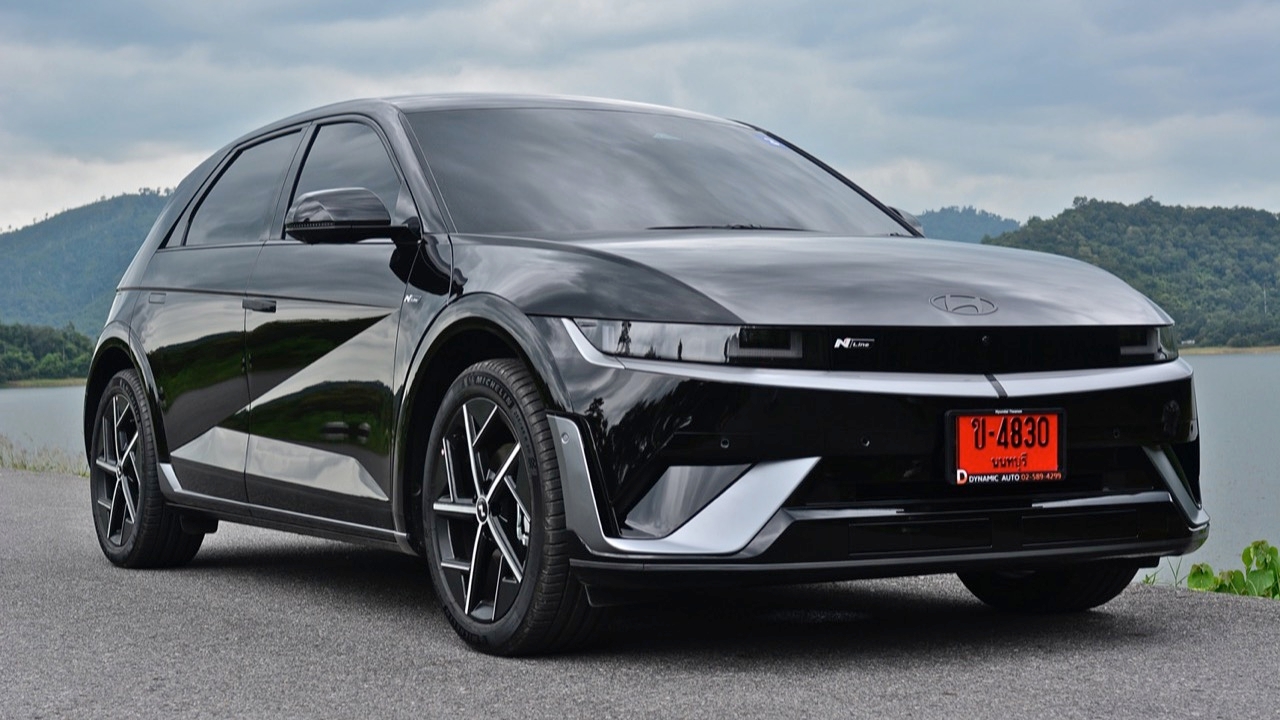
The Hyundai Ioniq 5 N Line is a differentiated electric vehicle variant, upgrading both exterior and interior trim to match the powerful Ioniq 5 N. This aims to boost sales. The Ioniq 5 is an intriguing new energy vehicle, but due to the lack of government tax relief for Korean cars, its initial price soared to 2 million baht. Subsequently, Hyundai began local assembly of the Ioniq 5 in Thailand using the special N Line trim, which offers a very spacious cabin and a powerful motor. It's an electric car well-suited for daily use, with nearly 500 kilometers of range and more space than competitors in its class.


Is the Ioniq 5 N Line Hyundai's first electric vehicle? No. The Korean brand has quietly produced quality EVs for years. The earlier teardrop-shaped Ioniq was sold as a fully electric vehicle. Before the Ioniq, global media praised the Hyundai Kona Electric quietly launched abroad. The Kona Electric, a small crossover, has a longer range than the Audi Q8 e-tron and Jaguar I-Pace. In Thailand, Hyundai officially launched the Kona Electric at the Bangkok International Motor Show in March 2019, as a completely built-up import (CBU).
The Hyundai Ioniq 5 N Line launches at 1,399,000 baht for the first 400 units.
After the first 400 units, units 401 to 600 are priced at 1,449,000 baht.
After 600 units are sold, the price will return to the regular rate of 1,699,000 baht.


Hyundai understands that Korean brands cannot rise in the EV market without applying past EV development lessons to attractive contemporary designs. Everyone was amazed by the Ioniq 5’s interior, making it one of the most desirable EVs you can buy for 1.3 to 1.4 million baht. It’s a vehicle you want from the first sight. Its range and features confirm it’s a smart purchase. The sharp, angular design makes the Ioniq 5 N Line one of the best-designed EVs. Launched in 2025 with new 20-inch alloy wheels and redesigned bumpers, Hyundai could not offer this price without local assembly. The Ioniq 5 is already a successful Korean global product. It has no fake grille, only light patterns subtly emerging from the front panel. The front lines look aggressive linking to futuristic square LED headlights. The side design is a challenging feat. The rear adorned with LED lights resembles sci-fi movie robots. This design excels aerodynamics, pedestrian safety, visibility, and aesthetics, blending a high-performance hatchback with Blade Runner-like elements.


The Ioniq 5 N Line appears similar in size to the Jaecoo 5 EV but its cabin is much more spacious. It’s a giant crossover, comparable to a Range Rover Evoque disguised as a family hatchback. It uses Hyundai’s E-GMP platform, shared with Kia and Genesis EVs from the small EV2 to the large EV9. Hyundai’s engineers fully exploited this by designing a higher seating position and a tall glass cabin, giving a roomy feel and comfortable urban driving.


The Ioniq 5 N Line’s hardware has been updated multiple times recently to advance functionality with modern features. It carries an 84 kWh lithium-ion battery (gross capacity) and a 168-horsepower rear motor, accelerating from 0 to 62 mph in 7.5 seconds, though it can be quicker. It achieves a 590 km WLTP range. Brand loyalists to Chinese EVs may hesitate, but its sharp looks and drive explain Hyundai’s confidence to position it as a premium model. In fact, the Ioniq 5 N Line feels more luxurious than the Tesla Model Y. It inspires new exterior and interior design options for the standard Ioniq 5 to achieve a distinct, non-basic EV look. The N Line trim is the latest choice. The large retro-styled hatchback body hides one of the most complete family electric cars available at this price — impressive for a Korean model.


The Ioniq 5 EV has been on sale for some time and has undergone a facelift. In media eyes, it remains one of the best-looking and standout EVs in the market. Remember, Hyundai’s strength is not just durable diesel vans; the Korean brand has produced EVs for over a decade. The first Thai batch of Ioniq 5 struggled due to price and fierce competition from Chinese EVs benefiting from import tax advantages. Yet, the large retro hatchback body hides one of the most fully equipped family EVs at 1.3 million baht. Though sales volume is modest, buyers are highly satisfied, overlooking the higher price compared to Chinese models. Nowadays, consumers increasingly prefer EVs that are appealing both as electric vehicles and in driving experience. Long-term satisfaction depends also on after-sales service, a weakness for Chinese brands but a strength for Korean ones.


The Hyundai Ioniq 5 N Line interior features motorsport-inspired trim from the Ioniq 5 N, including twin 12.3-inch screens arranged horizontally on the dashboard. The materials rival those of Chinese cars. Hyundai designers emphasize light tones, avoiding dark or overly sporty moods that might feel confining, combined with minimalistic, balanced design. The N Line steering wheel, shared with the high-performance model, includes many buttons that may seem cluttered initially, but after customization, it learns user preferences and displays sharp graphics. It’s easy and attractive to use, with quick-access buttons for disabling annoying alerts and proactive safety systems. The central touchscreen responds swiftly. Analog climate controls feature a dedicated touch panel for constant accessibility, better than hiding climate menus in submenus.


Regarding spaciousness, the interior is truly vast—almost colossal. The Ioniq 5 is built on an EV-specific platform with no engine compartment, allowing a long 3,000 mm wheelbase, the same as a BMW 7 Series. The rear cargo space is 520 liters, with a compartment below for charging cables. The rear-wheel-drive (RWD) model adds a 57-liter front trunk for cable storage, preventing damage from cargo. With a 3-meter wheelbase, the cabin is even roomier than a BMW 5 Series—this is before adjusting seat positions.


Owners can slide the center console, cleverly named the "Universal Island" by Hyundai. This sliding console and charging panel move forward or backward up to 140 mm, allowing rear passengers easier access to charging ports or creating extra legroom. Sliding it backward lets the driver step out conveniently through the passenger door, useful in tight parking spaces.
The Ioniq 5 N Line offers a unique driving feel in the EV world. Many hatchbacks try to imitate SUVs, but this car does the opposite. It provides a good driving position with clear forward and peripheral views, resembling a thick hatchback. The driver sits as high as in a van. Despite having 225 horsepower, it’s not a hot hatch. For excitement, one must look to the Ioniq 5 N with 641 horsepower and 650 Nm torque, rivaling the BMW M2. The N Line acts as a sporty family car with aggressive styling but less extreme performance than the true 5 N model.


The Ioniq 5 has some sportiness but not excessive. When cornering hard, the front end holds reasonably well but doesn’t feel thrilling. The suspension is tuned traditionally Korean — prioritizing soft absorption of road bumps over body roll control during turns, reminiscent of Hyundai’s large sedans. Michelin Pilot Sport EV tires sized 255/45R20 are the most expensive and high-performance tires in the EV segment, likely sourced from the Ioniq 5 N rather than the less powerful N Line.


It’s certainly fast but starts to lose steam beyond 140 km/h. At high speeds, the car handles wind buffeting well, with excellent noise insulation. No high-pitched motor whine disturbs the cabin; only normal wind and tire noise are audible. Its premium tires contribute to this quietness. Hyundai uses standard side mirrors, yet wind noise is well suppressed. The Ioniq 5 N’s quick electric steering is tuned for agility, but the N Line’s heavier body and less sporty nature keep pace closely.


At first glance, it may seem too ordinary, lacking excitement despite sporty trim. However, over time, you appreciate features like blind spot cameras that pop up on the digital display when signaling, alerting to hidden bicycles. The sound system performs well, making road trips enjoyable. The suspension lets the car glide smoothly like a premium German SUV without aggressive character. On uneven Rangsit–Ongkharak roads, it can feel a bit floaty when cresting bumps, but overall, the Ioniq 5 N Line is very comfortable for travel.


The claimed range is 590 kilometers; in tests, it achieved 490 kilometers. This is not revolutionary but reasonable. Aggressive acceleration consumes more battery than cruising at 90-100 km/h, an ideal speed for EVs. Unlike some Chinese EVs whose batteries drop drastically with each push, this model offers balanced consumption. Considering price and performance, it’s acceptable at 1.3 million baht for a distinctive, very cool car.


In summary, the car is easy to drive and offers a European-like feel rather than a Korean one. It’s relaxing on long trips due to its spacious cabin and solid, refined build quality. It includes full technology: smartphone connectivity, OTA updates, easy CarPlay integration, good audio, seats that recline like beach chairs, and an external power supply via V2L. Claimed range is 590 km, with real-world 490 km without battery-saving driving. No other 800-volt EV is cheaper. It maximizes cabin space efficiently. Downsides include price and limited popularity in Thailand, where the brand is mainly associated with vans, despite Hyundai’s superior offerings.
Key Highlights
The new 2026 IONIQ 5 N Line, locally assembled, embodies the "Never Ordinary" concept. It is a 100% electric vehicle building on the global success of the IONIQ 5 family, offering standout style, sporty design, 800-volt EV technology, and exclusive N Line identity.
The N Line design wraps the car in inspiration from Hyundai’s high-performance N family, bringing motorsport sportiness from track to road.
Equipped with high-voltage 800-volt technology, an 84 kWh lithium-ion battery, and a maximum range of 591 kilometers (NEDC).
Supports ultra-fast 350 kW charging, going from 10% to 80% battery in about 18 minutes.
Premium cabin features genuine leather seats with the N logo.
Comes with Hyundai SmartSense, a comprehensive intelligent safety system with 17 features.
BOSE Premium Sound System with External Amplifier and eight speakers.
The smart Hyundai Bluelink app debuts in Thailand with this model.
Exterior Design
The 2026 IONIQ 5 N Line shows a sportier, more stylish personality with exclusive N Line trims, including front and rear bumpers, side skirts, and a rear diffuser.
Parametric Pixel LED headlights and taillights reflect the IONIQ family’s futuristic identity and create a distinctive road presence.
20-inch alloy wheels designed exclusively for the N Line enhance sporty appearance and driving stability.
Vision Roof increases cabin openness and includes an electric sunshade.
Active Air Flap vents improve aerodynamic efficiency.
Pop-up door handles with sensors and power-operated tailgate featuring Smart Power Tailgate system.
Interior Design: The cabin blends sporty and stylish N Line elements with genuine leather seats bearing the N logo, a red-stitched N Line steering wheel, and dual 12.3-inch digital displays that provide comprehensive information connectivity.
Cabin & Comfort: The IONIQ 5’s highlight is its spaciousness due to a 3,000 mm wheelbase. Zero Gravity front seats with leg rests increase comfort during charging breaks. Front seats are electrically adjustable with heating, ventilation, and driver-specific memory. Maximum cargo space is 1,580 liters with rear seats folded. Dual-zone automatic climate control includes rear air vents.
Technology & Safety: Supports wireless Apple CarPlay and Android Auto. BOSE Premium Sound System with external amplifier and eight speakers. Five USB-C ports. Vehicle-to-Load (V2L) power output up to 3.6 kW. Regenerative braking adjustable via paddle shifters. Five driving modes: Eco, Sport, Normal, My Drive, Snow. Over-the-air (OTA) software updates. Hyundai Bluelink app, first launched in Thailand.
Hyundai SmartSense Safety System
The 2026 IONIQ 5 N Line includes 17 safety and driver assistance features, including Smart Cruise Control with Stop and Go.
Forward Collision-Avoidance Assist (FCA) provides automatic emergency braking warnings.
FCA with Junction Turning (FCA-JT) adds emergency braking at intersections.
Lane Keeping Assist (LKA) helps keep the vehicle in its lane.
Lane Following Assist (LFA) keeps the car centered in its lane.
Blind-spot Collision-Avoidance Assist (BCA) warns and steers when vehicles are in blind spots.
Rear Cross-Traffic Collision-Avoidance Assist (RCCA) warns and brakes automatically when reversing.
Reverse Parking Collision-Avoidance Assist (PCA-R) helps avoid collisions while parking backward.
Surround View Monitor (SVM) provides 360-degree camera views.
Parking Distance Warning (PDW) sensors front, side, and rear.
Blind-spot View Monitor (BVM) camera system for blind spots.
High Beam Assist (HBA) automatically adjusts high beams.
Safe Exit Warning (SEW) alerts when opening doors if vehicles approach from behind.
Driver Attention Warning (DAW) detects driver fatigue and alerts if the car ahead moves.
Leading Vehicle Departure Alert (LVDA) warns when the car in front moves.
Rear Occupant Alert (ROA) reminds to check rear passengers.
Manual Speed Limit Assist (MSLA) helps maintain set speed limits.