

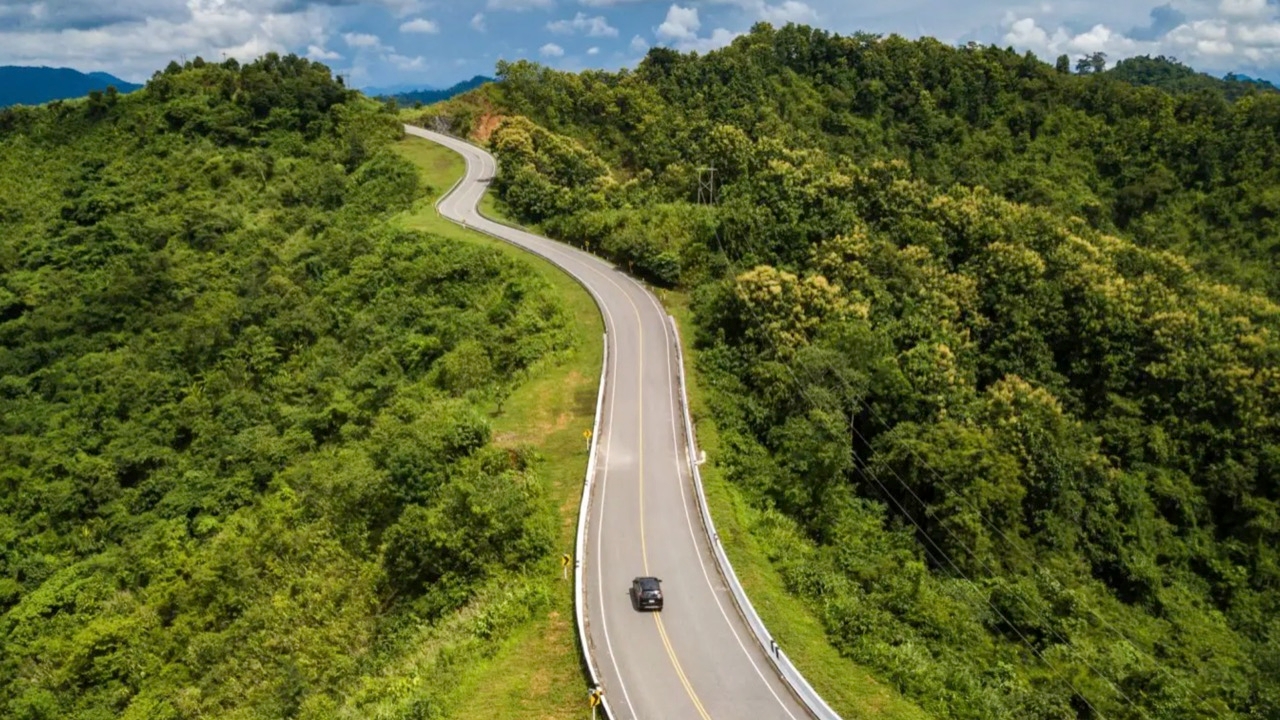
Experiencing nature on the mountains with cool, often cold air is a relaxing way to spend a holiday. Driving through mountain routes is one of Thailand's most popular winter activities. When the weather cools, at mountain peaks or tourist spots on hills and mountains in the North or Northeast, caution is necessary. These routes are not frequently traveled, especially steep ascents and descents filled with many twisting curves. Lack of familiarity with the route or being a new driver who has never driven on mountain roads before can be dangerous without proper driving knowledge.

1. Control your vehicle's speed
When driving downhill, controlling your vehicle's speed appropriately is crucial. Follow posted speed limits. When navigating curves on mountain roads, it is advised to keep away from the solid lane divider because larger vehicles may encroach into your lane at blind curves—those where the curve exit is not visible. Never increase speed while driving downhill. As you descend, speed can increase without gradual braking. Driving fast downhill combined with alternating left and right curves requires continuous braking. The vehicle's speed and weight strain the brakes, possibly causing brake fade or failure due to excessive brake system heat. When ascending and passing long curves, increase caution and reduce speed for safety. Most importantly, maintain steady accelerator control and avoid frequent heavy braking, which can overheat the brake pads and reduce braking effectiveness.

2. Use the appropriate gear
On steep routes, the vehicle may lack sufficient power to continue uphill, so shift to a lower gear depending on the slope. Recommended gears are first or second for manual transmissions, and D2, D3, S, or L for automatics. When descending steep slopes, never put the transmission in neutral or gear N to let the vehicle roll freely, as this causes excessive speed and loss of control. Use a low gear to help slow the vehicle.

3. Do not keep the brake pressed continuously while descending
As previously mentioned, continuous braking while driving downhill at speed causes the brake system to heat up, tires to work harder, and increases danger on roads mostly unsuitable for high speed. Continuous braking on steep descents causes the brake pads to repeatedly rub against the discs, raising system temperature beyond safe limits. This can burn the pads and discs, rendering them unusable. When descending, reduce speed, stay away from the solid lane divider, use low gear, and brake only when necessary. Never hold the brake pedal down continuously.

4. Be cautious of curves
Mountain roads are narrow and winding. It is not recommended to drive at high speed or tailgate closely. Besides being impolite, tailgating reduces braking distance. Maintain safe following distance, especially when driving a heavy 2.5-ton SUV, for safety. When entering sharp switchback curves, exercise extra caution. Faster vehicles should allow others to overtake by moving close to the shoulder, not by driving slowly and blocking the way. Use the horn or flash high beams once or twice to signal your intention to overtake. Never change lanes while turning.

5. Do not overtake
Mountain routes have many dizzying curves. If unfamiliar with the road or if your vehicle lacks power, do not attempt to overtake. The main risk is colliding with oncoming traffic. In the worst case, even if a head-on collision is avoided, swerving to avoid it could cause a vehicle to fall off the mountain—an accident that has occurred frequently.