

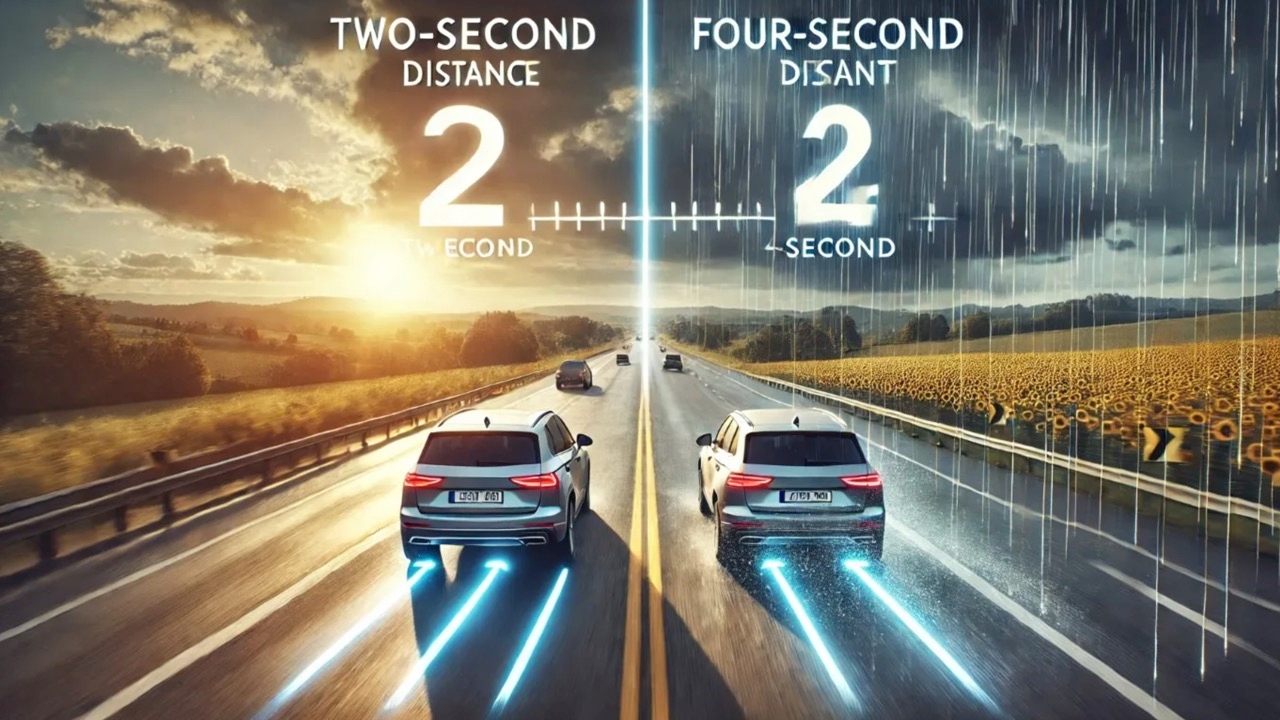
The main reasons for rear-end collisions are braking too late, tailgating too closely, or losing focus by staring at a screen trying to catch creatures in a game or talking on the phone while driving, which can distract you from braking properly and cause you to crash into the vehicle ahead. Additionally, if the brake lights of the car in front are broken, it can lead to even worse consequences.

Wet road surfaces during rain increase braking distances significantly, often causing surprise and late braking. This can result in the vehicle behind crashing heavily into you, leading to a chain collision causing damage to both the front and rear. At high speeds, such accidents can cause serious injuries or even fatalities, which have occurred many times.
A simple safety principle is to imagine if the car in front suddenly brakes hard, skids, or spins out in the middle of the road, or if an accident occurs just ahead scattering debris across the road—how would you respond? The key safety concept is not to tailgate but to leave enough distance so you can brake safely and in time during emergencies, avoiding rear-end collisions when braking hard. Driving on a highway is completely different from driving in the city.

The faster you drive, the more distance you must keep from the fast-moving vehicle ahead that you're following. After overtaking on the right, if the left lane is clear, you should move back into it. You should not linger in the right lane, which is intended for overtaking. Thinking you can stay in the right lane at your current speed is incorrect since more powerful vehicles can come up behind you at any time. Avoid driving alongside trucks or trailers; overtake them quickly and do not ride side by side with large-wheeled vehicles that could swerve at any moment. Driving slowly and lingering in the right lane is bad etiquette.

There is no fixed rule for safety distances, but on high-speed highways, you should maintain at least a two-second gap or about 30 meters. Always observe your surroundings—front, sides, and rear—by alternating between mirror checks and forward viewing. Look far ahead to anticipate and prepare for unexpected events, giving yourself time to avoid hazards. Drive at the legal speed limit or according to posted warning signs.

If the vehicle ahead is driving too slowly, maintaining a safe distance will slow you down as well. In this case, you should safely overtake after ensuring the road ahead is clear, there is no oncoming traffic, and you are not near a U-turn point. After overtaking, return to the legal speed and avoid lingering at slow speeds, which can cause you to unintentionally speed up. Also, yield to faster vehicles behind by allowing them to overtake safely; blocking their way increases risk and danger.

When you are driving slower than other vehicles, you should move aside to let faster vehicles pass. Do not assume they will find a way themselves, as this increases danger significantly. Signal left to indicate you are allowing overtaking. Such courtesy is rare in Thailand but is a major factor in the high accident rate, making Thai roads some of the most dangerous worldwide. This is not something to be proud of.

If you are being tailgated by a faster vehicle driving aggressively, such as a pick-up truck pushing hard and tailgating like a bully, it is best to let them pass rather than brake suddenly, which could increase risk. When you see an opportunity, move aside to let the reckless driver overtake safely. Driving without regard for others increases danger. If you do not yield when tailgated and an emergency braking occurs ahead, you will likely have to brake hard yourself and end up being rear-ended.