

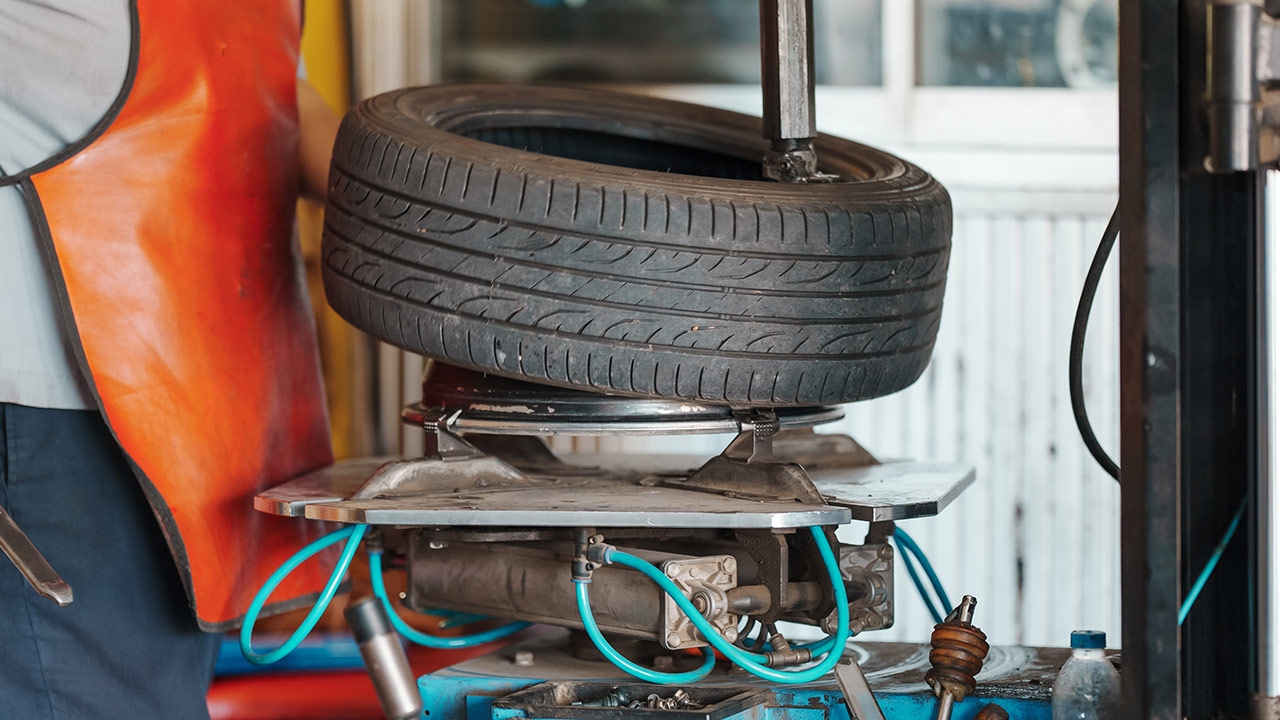
"Flat tires" are a common experience for nearly every driver, caused by nails, screws, metal debris, or sharp objects on the road. Many assume that simply finding a shop and patching the tire is enough. In reality, there are various patching methods, each with distinct advantages, limitations, and suitability. Choosing the wrong method can lead to recurring leaks or compromise driving safety.
Generally, the four common tire patching methods are plug patching, cold steam patching, hot steam patching, and mushroom patching.

Plug patching also known by some as "worm patching" is a repair method done without removing the tire from the rim. The technician removes the object causing the puncture, slightly enlarges the hole, then inserts a glue-coated fiber plug into the hole to seal it.
Its advantages are quick application, low cost, and suitability for immediate fixes, such as small nail punctures on the tread.
However, this method does not inspect internal tire damage, and the fiber plug may deteriorate or leak again, making it more suitable as a temporary fix rather than for long-term use, especially for vehicles traveling long distances or at high speeds.

Cold steam patching requires removing the tire from the rim. The technician cleans and roughens the puncture area, applies adhesive, and attaches a patch from the inside, pressing it firmly to bond with the tire.
The benefit is that the patch seals the hole more securely from the inside than plug patching. It also allows inspection of the tire's interior for tears, wire damage, or wear caused by driving on low pressure.
This method suits small punctures on the tread but demands careful surface preparation. Poor cleaning or uneven adhesive application can cause the patch to detach and leak again.

Hot steam patching is similar to cold patching but uses raw rubber combined with heat and pressure to fuse the repair material with the tire.
Its advantage is a durable, tightly bonded patch, ideal for damage needing stronger adhesion than cold patching. However, the technician must skillfully control temperature, as excessive heat or prolonged application can damage the tire's structure.
For modern tires, it is important to choose shops with proper equipment and experienced technicians, rather than deciding based solely on price or speed.
Mushroom patching uses a repair material shaped like a mushroom, where the stem is inserted through the puncture, and the cap seals the inside surface of the tire.
This method addresses damage in two ways: filling the puncture channel and sealing the inner surface, reducing the chance of water or moisture penetrating and damaging the tire's structural layers and wires.
Mushroom patching requires tire removal and careful inspection of the hole's size and angle, making it more time-consuming and costly than plug patching. However, it is considered a comprehensive repair method for nail punctures on the tread when done according to standards.
The safe area to patch is the central tread, which contacts the road and has a strong structure. The puncture must be within the size limits set by manufacturers and not caused by long tears.
Patching the sidewall, shoulder, or bead is not recommended because these areas flex constantly while driving and endure stresses from turning. Repairs here may not restore the tire's structural strength fully.
Additionally, you should replace tires immediately if you notice any of the following:

If the repair requires removing the tire from the rim, wheel balance should be checked and adjusted, especially if steering vibration, vehicle shaking at speed, or tire rotation has occurred. Repair materials and reassembly can alter balance.
After repair, tire pressure should be checked again within 1–2 days. If pressure drops abnormally, return to the technician to check for leaks. Avoid inflating and continuing to use the tire without identifying the cause.
For urgent repairs with punctures on the tread center, plug patching allows quick continuation of travel but the tire should be inspected internally as soon as possible.
For long-term use, methods requiring tire removal and internal inspection—especially mushroom patching—are preferred, as they seal both the puncture and inner surface more completely. The choice depends on the puncture's size, location, angle, and tire manufacturer recommendations.
However, not all flat tires can be safely repaired and reused. While replacing tires may be more costly, if damage occurs on the sidewall, internal structure, or if the tire is already worn, replacement is a safer option than risking a blowout. Tires are the only contact point between vehicle and road, and safety should never rely on unsuitable patches.