

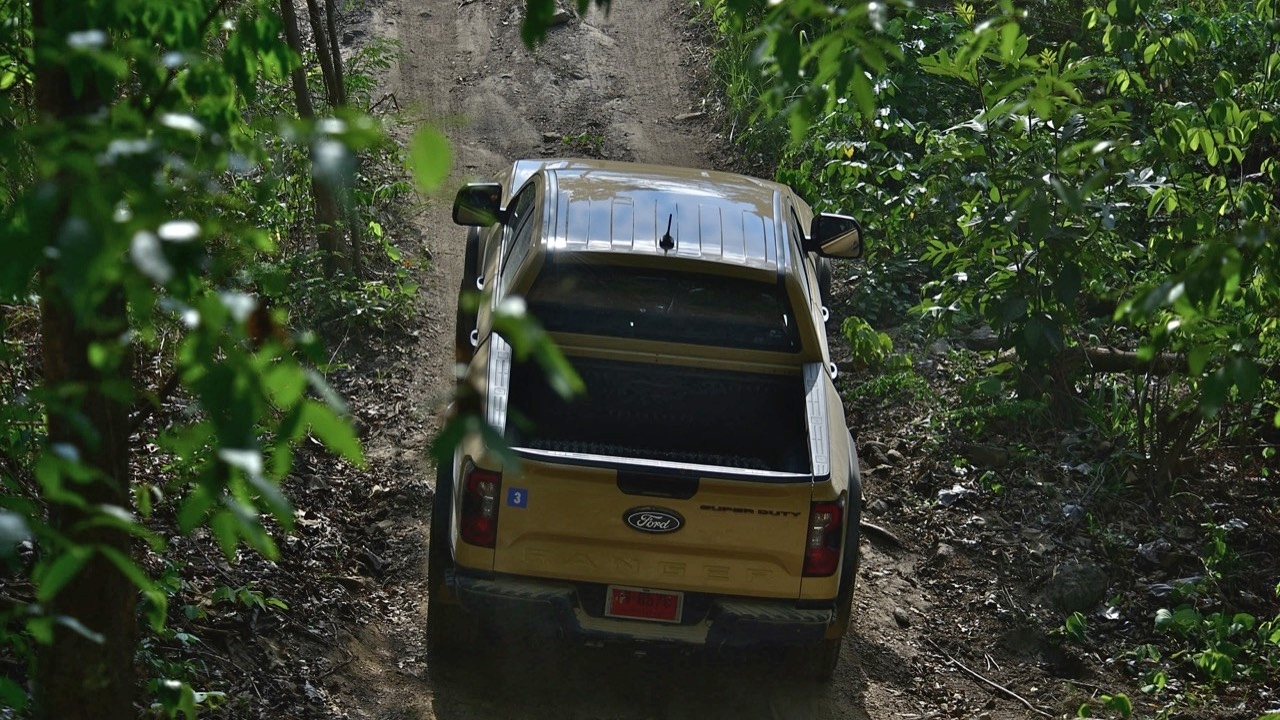
Driving up a 29-degree (approximately 55.4% gradient) steep slope like Khao Raberd (Khao Ang Kaew) is critically steep, exceeding the capabilities of most vehicles and drivers. Standard roads generally handle slopes only up to 10–15 degrees. There are many other easier, safer, and more scenic locations for content creation. Still, conquering such a steep route can bring a sense of pride. Drivers or riders without skill in handling steep slopes, insufficient vehicle power, or tires lacking adequate grip face extreme danger when reversing down.

The ascent and descent routes at Khao Raberd are intended exclusively for paragliding and air sports athletes. Generally, the public is not permitted access. Those wishing to go up must notify the responsible authorities. Many unauthorized entries have resulted in accidents, both during the day and at night. Some vehicles lost control near the cliff edge, became unrecoverable, and had to be abandoned. We strongly warn against testing vehicle capabilities here due to life-threatening risks.

Remember that vehicles climbing this slope require readiness in torque performance, physical condition, driving skills, and engineering limits. Many unforeseen variables come into play. On a 29-degree steep concrete road, weight shifts almost entirely to the rear wheels. Front-wheel-drive cars lose downforce on the front wheels, causing tire slip and loss of traction. Also, cooling limits are critical—Khao Raberd is hot all day, and rain makes the surface slippery. Engines and transmissions endure maximum continuous load; high RPMs cause rapid heat buildup in transmission fluid.
The Khao Raberd ascent, located at the Air Sports/Paragliding Field in Nong Yai District, Chonburi Province, has two main routes with vastly different characteristics and usage conditions.


The old route (original off-road path) is a natural trail with clay soil, deep ruts, and large holes. Rain makes it extremely muddy and slippery. It requires a fully equipped 4-wheel-drive (4x4) vehicle with specialized off-road gear. This route is deteriorating and used less. Recently, during a Ranger Super Duty test, the route proved unsuitable for lower-performance vehicles, especially in the rainy season. Getting stuck requires rescue by authorities and is strongly discouraged.
The new route is fully paved with concrete for convenience but has very steep sections, some reaching 20-29 degrees, with continuous sharp hairpin bends. It suits vehicles with high torque. However, in the rainy season, the concrete surface becomes slippery, increasing danger.
Travel precautions: When ascending, use 4-wheel drive (4H or 4L) or low gear to smoothly climb without spinning wheels. When descending, always use low gear (1st gear) to engage engine braking, apply brakes firmly in intervals, then release. Avoid continuous braking to prevent brake overheating and fade.
(Note: Currently, this area is managed by the subdistrict administrative organization and serves as an international-level air sports training and competition site. Extra caution is required due to narrow, steep roads without continuous lighting.)

Techniques for controlling the vehicle while climbing steep slopes with sharp hairpin turns.
Gear and accelerator selection: Use the lowest gear available—L, 1, or Mode M1—to lock the gear ratio for maximum continuous torque. Never allow the gear to shift up. Accelerate smoothly without sudden throttle inputs to avoid wheel spin and loss of tire traction. Maintain torque by modulating the accelerator to prevent engine speed from dropping and losing power.

Handling sharp hairpin turns on steep slopes.
Choose a wide line to reduce slope steepness. When no oncoming traffic or downhill vehicles are present, enter the turn from the outside and cut inside to reduce the vehicle's tilt and slope angle. Steer smoothly; narrow or abrupt steering on a slope increases wheel resistance, reducing traction and causing the vehicle to stall mid-turn.
How to survive emergencies.
If the vehicle loses power or stalls on a steep slope, firmly press the foot brake and engage the handbrake immediately. Shift to Park (or 1st gear for manuals) and do not release the brakes until composed. If unable to continue, carefully release the brake and reverse straight down. Never turn the steering wheel sharply across the slope, as the 29-degree angle greatly increases the risk of rollover.

Descending steep slopes.
For manual transmission vehicles, never use neutral or keep the clutch depressed. Use the lowest gear to enable engine braking to help slow the vehicle, combined with intermittent brake application. This prevents overheating and brake fade or boiling of brake fluid.
Climbing critically steep slopes over 20-25 degrees demands effective tire grip, torque, directional control, throttle use, gear selection, and vehicle weight transfer. Any deficiency leaves little room for error on Khao Raberd. The differences among front-wheel drive, rear-wheel drive, and four-wheel drive systems are as follows.
Front-wheel drive.
Weight transfer reduces traction and torque. When climbing steep slopes, most vehicle weight shifts to the rear wheels, drastically decreasing downward force on front wheels. Front wheels must provide both traction and steering, so they lose grip easily, causing wheel spin even with light acceleration. If front wheels slip, steering control is lost immediately, potentially stalling the vehicle mid-slope. Front-wheel drive is the least suitable for critical steep slopes, with high risk of power loss and inability to continue. Avoid slopes over 20 degrees with front-wheel drive.
Rear-wheel drive.
Weight shifting to rear wheels during climbs is advantageous, increasing downward force and grip on the driven rear wheels. This allows better traction and climbing ability than front-wheel drive. Front wheels only handle steering. However, excessive acceleration on slippery or loose surfaces can cause oversteer, with the rear end swinging out.

Four-wheel drive.
Power is distributed to all four wheels, sharing engine torque to avoid overloading any single wheel. It provides high stability. Even if front wheels lose some downforce due to weight transfer, rear wheels continue pushing the vehicle upward. Conversely, if rear wheels spin freely, front wheels can still pull the vehicle forward.
Four-wheel drive vehicles handle cornering on steep slopes firmly. Powertrain and traction control systems help maintain the vehicle's direction according to steering input. Four-wheel drive has advantages and safety when coping with critical 29-degree slopes.
Continuously Variable Transmission (CVT) automatic gearboxes focus on smoothness and fuel efficiency. However, continuous steep climbing exposes their limitations immediately.

Limitations of CVT on steep climbs.
CVT has non-continuous gear ratios and torque. It uses a metal belt running on variable pulleys. When facing steep slopes, the transmission control unit tries to adjust ratios to reduce engine RPM, causing torque drop, power loss, and sluggish acceleration. Transmission fluid temperature rises rapidly. Holding the throttle to climb creates huge friction between belt and pulleys, overheating the transmission fluid (CVTF), causing the system to enter Safety Mode and reduce power to protect the gearbox.
Belt slippage occurs when aggressive throttle inputs on slopes cause the metal belt to slip on pulleys, accelerating wear. Engine braking is weak on descents because CVT lacks fixed gears. Slowing the vehicle by engine braking is less effective than torque converter or dual-clutch transmissions, forcing greater reliance on foot brakes and risking brake overheating.
How to preserve CVT transmissions on steep climbs and descents.
Use low gear positions (L, S, M1-M2): override automatic mode to lock the transmission in low gear, maintaining fixed gear ratios and torque within optimal engine RPM. Accelerate smoothly without kickdowns; sudden throttle on slopes strains the transmission pump and belt. Apply gentle, steady throttle to keep engine speed stable.
Rest the vehicle when transmission fluid overheats: if a temperature warning appears or engine RPM is high but power is low, find a safe spot to stop. Let the engine idle in Park to cool the transmission fluid. Do not turn off the engine immediately.
Thanks to images from the page "Trip Every Journey".
Autolifethailandhttps://www.youtube.com/watch?v=lv1l4JraZfs