

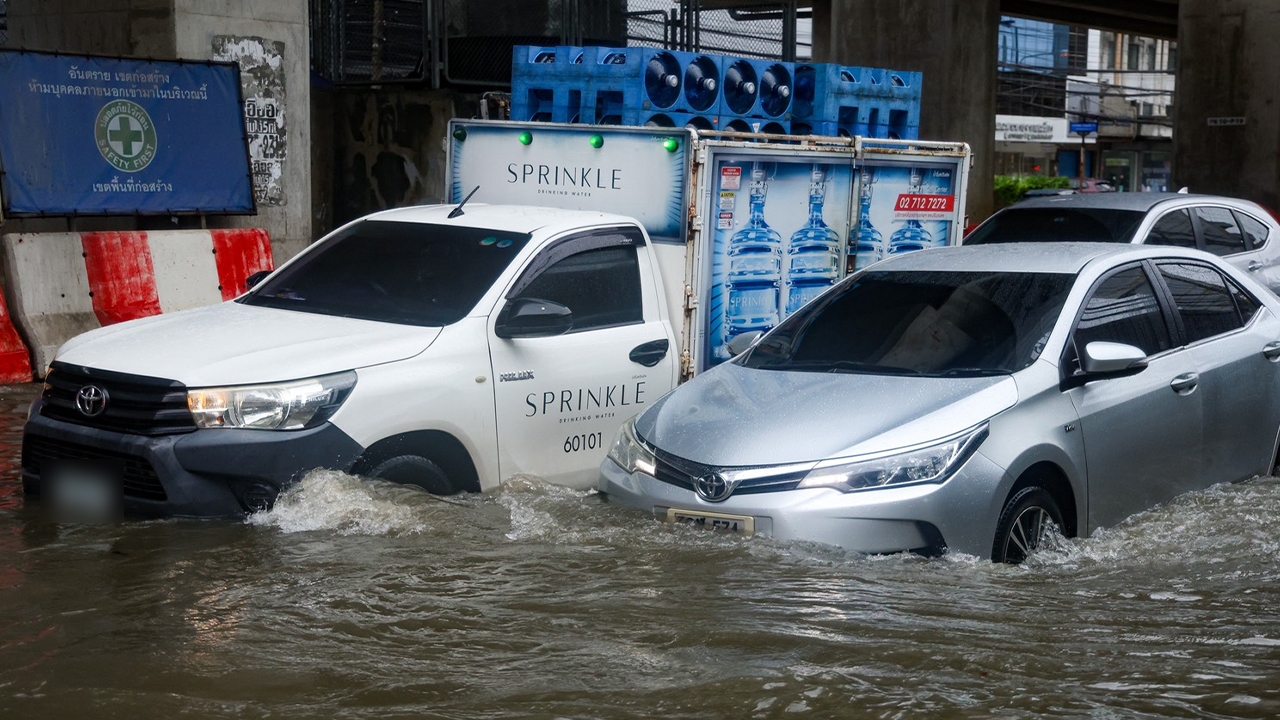
Heavy rain has turned roads into puddles, and many may think, "Step on the gas to get through quickly." However, driving fast through water can splash water higher and increase the chance of water entering the engine's air intake. If water enters the cylinders, the engine can sustain severe damage.
The safest option is to avoid flooded routes, especially where the road surface is not visible, the depth is unknown, or water levels are rising. Do not rely solely on the vehicle ahead, as the height and position of air intakes vary by model, according to RAC Drive.
If you assess that the water is only shallow and you must proceed, drive slowly and steadily, keep a safe distance from the car ahead, avoid sudden acceleration that creates waves, and do not stop in the water. If the vehicle starts to stall or the engine dies, stay calm, turn on hazard lights, and seek help.
Most importantly, if the vehicle stalls after going through water, do not attempt to restart it. If water has already entered the engine, restarting can cause more severe damage. Have the vehicle towed to a service center or garage and prioritize the safety of those inside the vehicle.

1. Shallow water where the road surface and edges are clearly visible. Drivers should slow down and watch for potholes. If the entire route's depth is unknown, choose an alternate path.
2. Water about 15 cm deep or reaching under a passenger car's chassis. Do not risk driving through, as this can cause loss of control and engine stalling, especially if water is flowing strongly or swirling.
3. Water near the passenger compartment floor or at the level specified in the vehicle manual. Do not attempt to drive through. Waves from oncoming traffic may be higher than estimated.
4. Water about 30 cm deep with strong flowing water forming waves. You should turn around or find another route, as water flowing at this level can sweep vehicles away.
5. Water covering the road so the surface is not visible, flowing strongly, or blocked by barriers. Do not wait to measure depth; simply consider it "Do Not Enter."
Some models specify water-wading capabilities, such as the Toyota Hilux Revo, which can handle water up to 70 centimeters deep with a ground clearance of 21.5 centimeters.
Meanwhile, certain Ford Ranger and Everest models in Thailand specify a maximum wading depth of 800 millimeters. Ford recommends driving at no more than 7 km/h and checking water depth and conditions before proceeding.
However, the 70–80 cm specification applies only to specific models and does not imply floodwater should be driven through, especially when water flows strongly, the road surface is unseen, or there may be hidden holes. Vehicle owners should always check their model and year manuals and turn back if the route cannot be assessed.
Before entering, ensure you can see the road line and are confident the water level is within your vehicle's limits. If unsure, find another route. When driving through confirmed shallow water, maintain a slow, steady speed, keep distance from the car ahead, and be cautious of waves caused by oncoming traffic that may rise above the original water level. Importantly, do not stop in the water.
If your vehicle stalls in water, do not attempt to restart it. First, assess the safety of the occupants, then contact assistance and have a mechanic inspect the vehicle, as water may have entered various systems.