

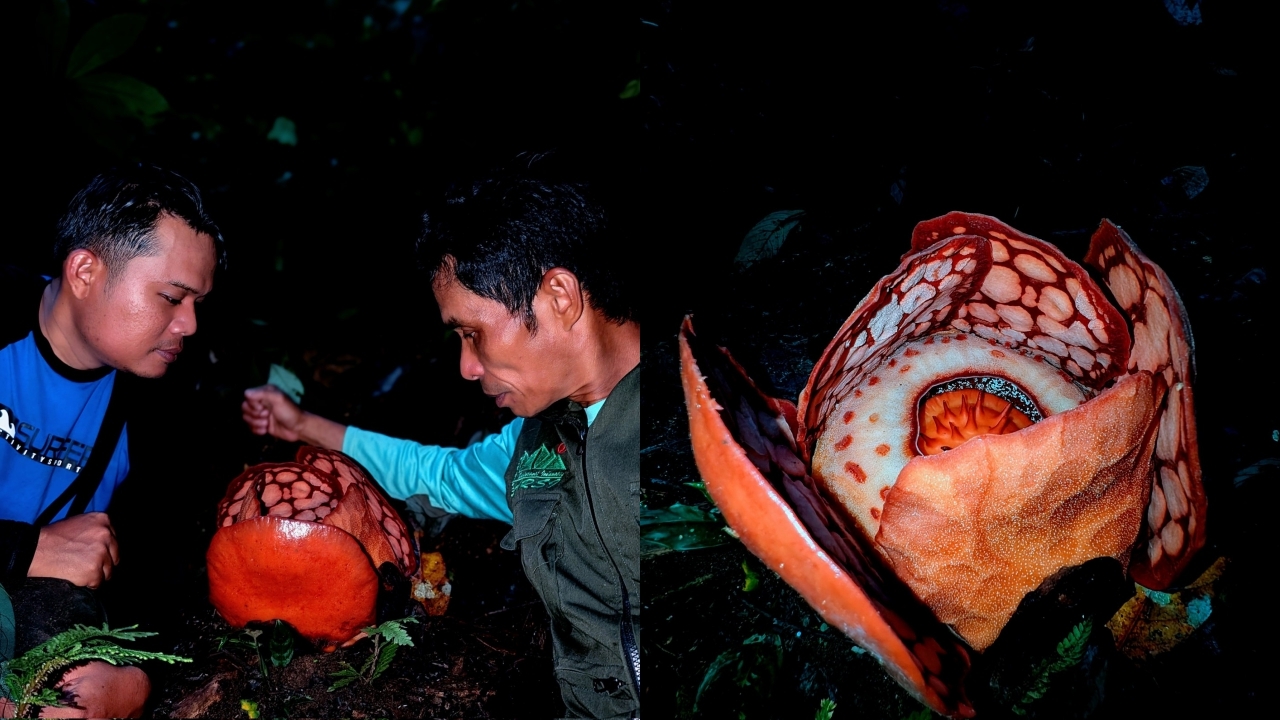
An Indonesian and international research team has confirmed the discovery of the rare Rafflesia hasseltii flower in a community-managed conservation area in West Sumatra after a 13-year search. This marks a major achievement for the project studying the genetic relationships of Rafflesia species across Southeast Asia using full genome sequencing technology.
The Indonesian National Research and Innovation Agency (BRIN), Bengkulu University, and a rare plant conservation community network jointly confirmed the discovery of Rafflesia hasseltii, one of Indonesia's rare flower species, through the research project "The First Regional Pan-Phylogeny for Rafflesia," which aims to study the genetic relationships of all Rafflesia species in Southeast Asia.
Indonesian botanist Sepcian Andriky and Chris Thorogood, deputy director of the University of Oxford Botanic Garden, spent nearly a full day trekking through dense Indonesian rainforest to locate this rare plant, unseen in the forest for over a decade. Upon finding it, Andriky knelt down and wept with joy, saying, "It has been a 13-year wait."
Joko Rido Witono, a researcher at BRIN's Center for Systematic and Evolutionary Biology, said on Monday, 24 Nov 2024 GMT+7, "This activity is part of our efforts to understand the genetic relationships among Rafflesia species in Southeast Asia and to support their conservation in their natural habitats."
Joko stated that this discovery underscores Indonesia's status as the country with the highest Rafflesia diversity in the world, on par with the Philippines. Currently, 16 giant parasitic Rafflesia species are recorded in Indonesia, with BRIN's research team successfully collecting samples from 13 species for DNA analysis.
He explained that since early 2024, the BRIN team has been responsible for collecting and analyzing samples within Indonesia, while other countries such as Malaysia and the Philippines conduct parallel research within their territories.
"We are confident that no genetic material will leave Indonesia. The entire research process is conducted legally with proper permits," Joko said, noting that the research is funded by the University of Oxford Botanic Garden and Nursery and BRIN's RIIM Expedition project.
The discovery of Rafflesia hasseltii marks the most significant moment of this research. The species was found during surveys in Bengkulu and West Sumatra, specifically in the West Sumatra region of Sijunjung. The research team documented the blooming of Rafflesia hasseltii in a community-managed conservation area overseen by a local forest management institute.
Joko emphasized the critical role of community-based conservation because many Rafflesia species are often found outside protected areas, even in community coffee and oil palm plantations. "Without proper education, human activities could threaten the survival of these Rafflesia plants," he warned.
Joko explained that this research uses Whole Genome Sequencing (WGS) to map the full genome of Rafflesia, potentially leading to the discovery of new species in the Indonesian archipelago. He said this approach differs from previous Rafflesia DNA studies, which only analyzed small gene fragments (500–1,500 base pairs).
However, the research faces significant challenges because Rafflesia is a fully parasitic plant and its flowers bloom for only a few days. Additionally, some species grow in remote, hard-to-access locations, requiring accurate information from local communities.
Joko also highlighted the importance of government and community support in conserving Rafflesia habitats. He said that upon completion of this work, the BRIN-coordinated research team will draft policy proposals to guide a national Rafflesia conservation strategy.