

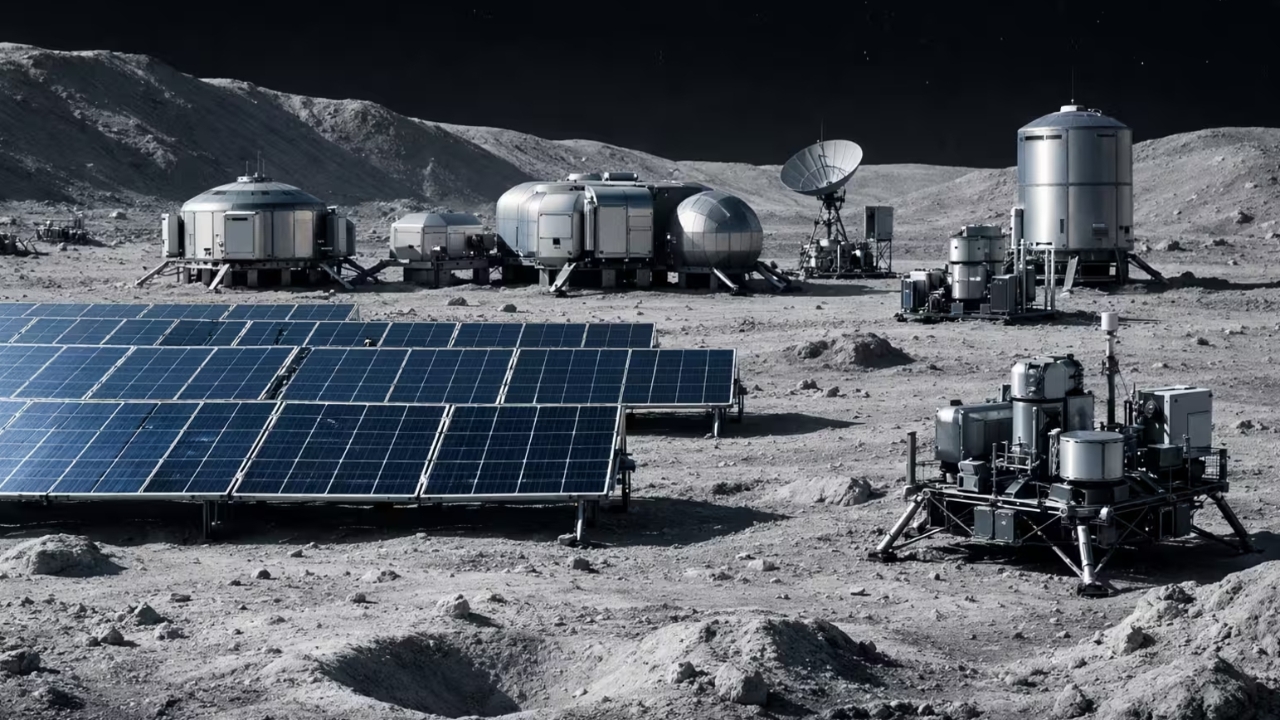
Russia has announced plans to develop a nuclear power plant on the Moon by 2036 to provide energy for lunar exploration projects and an international research station jointly operated with China, advancing long-term lunar missions amid competition among great powers.
Russian state space corporation Roscosmos stated that the goal is to supply electricity to surface exploration vehicles, rovers, observatories, and infrastructure for the joint Russian–Chinese research station, and it has signed a contract with aerospace company Lavochkin for construction.
Although the latest statement does not explicitly use the word "nuclear," Roscosmos clearly identifies Rosatom (Russia's state atomic energy corporation) and the Kurchatov Institute (the country's leading nuclear research institute) as the main participants, making it clear that the plant will use nuclear energy to power rovers, observation centers, and life support systems on the Moon.
Dmitry Rogozin, the current head of Roscosmos, confirmed that the primary goal is to install a nuclear power plant for sustainable lunar exploration, with plans to extend exploration to Venus, known as Earth's "twin planet."
This collaboration began with a memorandum of understanding (MOU) signed in 2021 and has continuously expanded. Most recently, in May, Russia and China signed a specific cooperation agreement to build a power plant on the Moon. The roadmap plans to deliver and install power plant components between 2033 and 2035, including five joint missions to transport modules to the lunar surface and install them, aiming to create a permanent 24-hour operational research station.
Since Yuri Gagarin became the first human in space in 1961, Russia has proudly maintained leadership in space. However, in recent decades it has fallen behind the U.S. and China, especially following the failure of the Luna-25 mission in August 2023, where the spacecraft crashed on the lunar surface, alongside the rise of SpaceX, led by Elon Musk, which has challenged Russia's dominance in space transport.
This announcement to build a nuclear power plant is viewed as a significant effort by Russia to upgrade from occasional exploration missions to establishing a long-term "scientific colony" on the Moon, located more than 384,400 kilometers from Earth.