

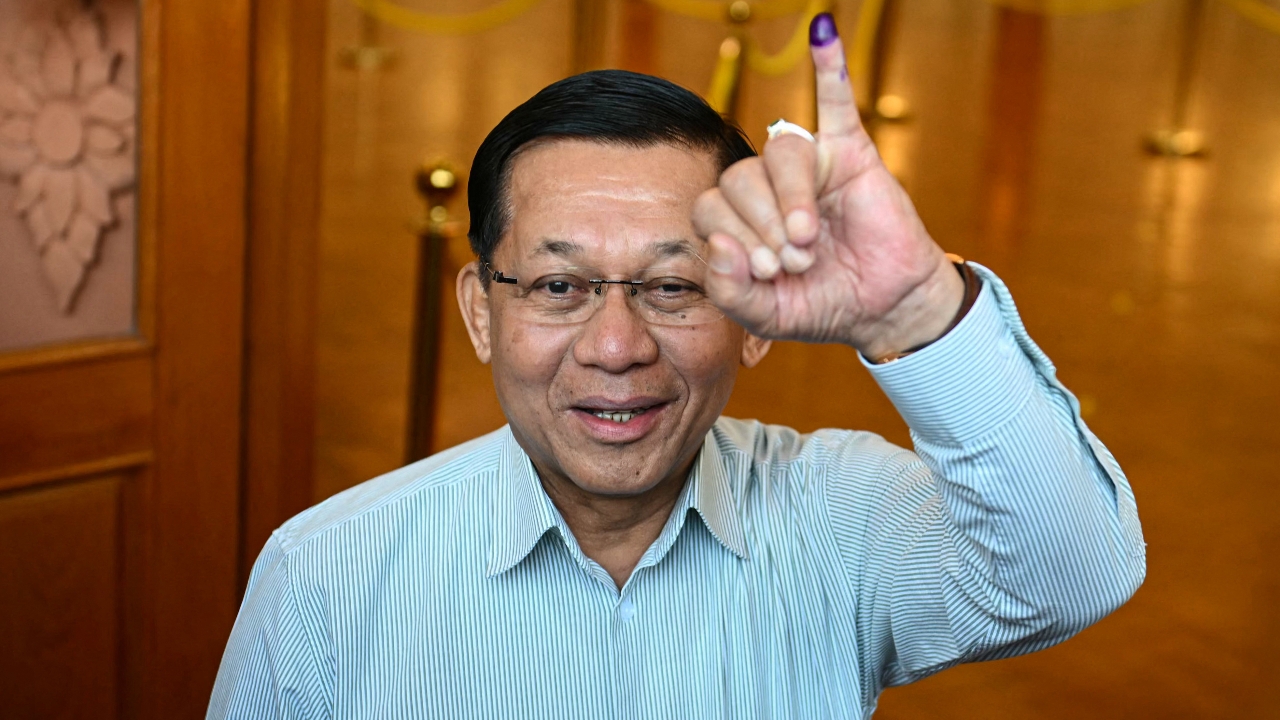
Senior General Min Aung Hlaing, leader of Myanmar's military government, went to vote at a polling station in Naypyidaw. He gave an interview asserting that this election would be "free and fair," despite heavy criticism from the international community. He stated that since the military is organizing the election, it cannot allow its reputation to be tarnished and emphasized that the goal is to restore a multi-party democratic system in the country.
The first round of the three-phase election began at 6:00 a.m. local time, covering constituencies in Yangon, Mandalay, and the capital, Naypyidaw, where Senior General Min Aung Hlaing cast his vote. He told reporters, "We guarantee this will be a free and fair election," adding, "The military is managing the election; we cannot allow our reputation to be damaged."
Despite strict security measures, reports emerged of bombings and attempts to disrupt voting at several locations. In Mandalay region, rockets were fired at residential homes in the early morning, injuring three people, one seriously. In Myawaddy, near the Thai border, multiple explosions occurred overnight Saturday, damaging over 10 houses. Reports indicate one child was killed and three others were seriously injured.
The military government has enforced new harsh laws punishing those who obstruct or oppose the election, including the death penalty. Recently, notable figures such as Mike Tee (film director), Jo Win Tut (actor), and Awn Dai (comedian) were sentenced to seven years in prison after criticizing films promoting the election.
Volker Türk, head of the United Nations Human Rights Office, stated, "There are no conditions conducive to the exercise of freedom of expression," while Myanmar citizens face pressure from all sides—both from the military government forcing them to vote and from opposition groups threatening to boycott the election.
This election is divided into three phases over the coming month, held in 274 towns out of 330 nationwide. The remaining areas were excluded due to unrest. A total of 57 parties are contesting, including the military-backed USDP, while over 40 parties have been dissolved, including Aung San Suu Kyi's NLD, which won landslide victories in 2015 and 2020.
Analysts view the multi-phase election as a tactic allowing the military government to adjust its strategy if early results are unfavorable. Meanwhile, some residents in Chin State expressed feelings that "the military cannot govern the country properly" and long for the democratic atmosphere before the coup.
Myanmar continues to face a severe humanitarian crisis caused by a civil war displacing millions, a collapsed economy, and the impact of a major earthquake in March. Western countries and ASEAN view this election as merely an attempt to legitimize the military's seizure of power.
,BBC