

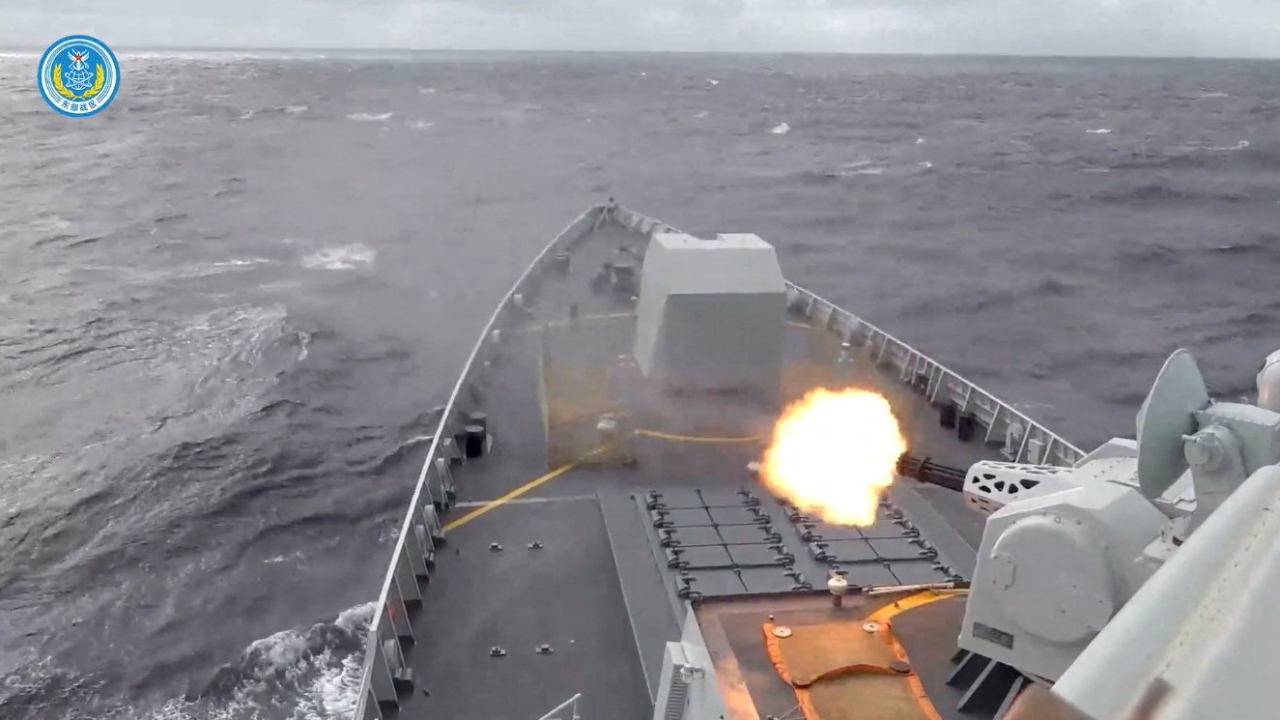
President Donald Trump said he is "not worried" about China's military exercises around Taiwan, viewing them as activities that have been conducted for over 20 years. Meanwhile, the Chinese military began a two-day drill simulating a blockade and seizure of key areas on the island in response to separatist trends and external interference. He also emphasized that he has a good relationship with President Xi Jinping.
U.S. President Donald Trump recently commented on China's large-scale military exercises around Taiwan, stating that he "does not feel worried" about the situation, even though the drills simulate a full blockade of the island.
"I have an excellent relationship with President Xi Jinping, and he hasn't told me anything about this. But of course, I have seen it," Trump told reporters, adding that the Chinese navy has been conducting drills in the area for over 20 years, so there is nothing he needs to worry about.
The two-day drills, which began on Monday (29 Dec), came just weeks after the U.S. announced one of its largest arms sales to Taiwan worth over 11 billion U.S. dollars (about 346 billion baht), including advanced rocket launchers and various types of missiles, which greatly displeased the Chinese government.
The Chinese military stated that the drills serve as a "warning" to separatist groups in Taiwan and external interference. On Tuesday, live-fire exercises lasted 10 hours across five locations around Taiwan, involving destroyers, frigates, and bombers to test coordination capabilities between the navy and air force.
Taiwan's Ministry of Defense reported spotting 130 Chinese warplanes circling the island on Tuesday morning, with over 90 crossing the "median line of the Taiwan Strait," an unofficial boundary in the strait. Additionally, more than 10 Chinese warships were observed, prompting Taiwan to order close military surveillance and prepare coastal missile systems for response.
Taiwanese President Tsai Ing-wen posted on social media criticizing China, saying that increasing military pressure is not the conduct expected of a responsible major power. She affirmed that Taiwan will not provoke conflict but will do everything possible to maintain national security.
Susan Shirk, former U.S. Deputy Assistant Secretary of State, analyzed that China's drills were aimed more at sending a message to Donald Trump than to the people of Taiwan, expressing displeasure over the arms sales. She also expressed concern that Trump might pursue a "transactional" political approach, potentially reducing military support for Taiwan in exchange for economic benefits or trade agreements with China in the future.
Meanwhile, Chinese Foreign Minister Wang Yi firmly stated that China must respond strongly to provocations from Taiwan's pro-independence groups and U.S. arms sales, reaffirming that "national reunification" is a historic mission China must accomplish.
. . . SourceBBC