

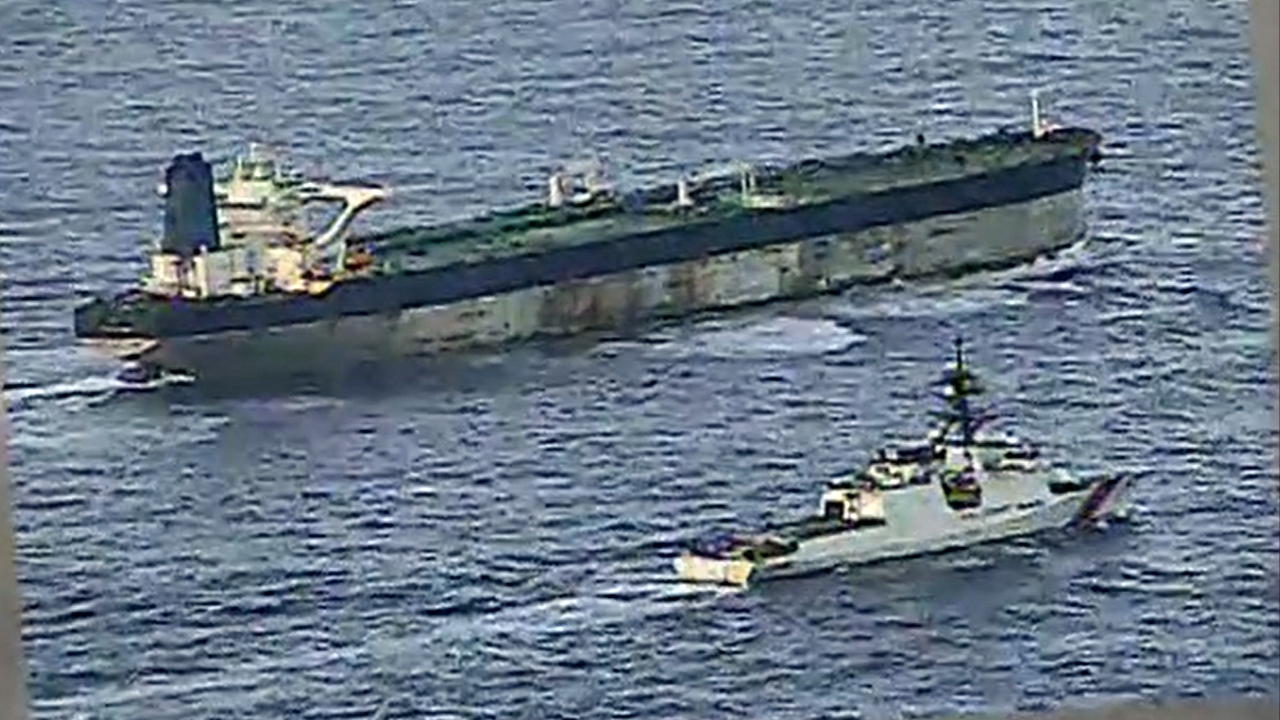
The US military launched an intense operation to chase and seize two 'ghost fleet' oil tankers in the North Atlantic Ocean and the Caribbean Sea. They successfully intercepted the Marinera, which had attempted to disguise itself under the Russian flag to evade capture for over two weeks, and the M Sophia, caught while illegally transporting Venezuelan oil to Asia. This incident represents a significant confrontation between the Trump administration and Russia amid the highest level of maritime blockades and warnings from Washington that its patience with the Kremlin over the Ukraine war and Venezuelan allies is running out.
The US military managed to seize two oil tankers closely linked to Venezuelan oil exports in a coordinated operation in the North Atlantic Ocean and the Caribbean Sea.
It began with the oil tanker Marinera, formerly known as Bella-1, seized in the North Atlantic between Iceland and the United Kingdom after a US naval pursuit lasting over two weeks. The US European Command stated the ship was seized due to violations of US sanctions and released images showing the tanker at a distance.
The operation heightened tensions because during the pursuit, the crew changed the ship’s name from Bella-1 to Marinera and reflagged it under Russia for protection. Reports indicated a Russian submarine was nearby in the area, though there was no direct confrontation. The UK Ministry of Defence confirmed it deployed reconnaissance aircraft and warships to support the US mission.
Meanwhile, the US Coast Guard intercepted another oil tanker linked to Venezuela in Latin American waters yesterday. The US Southern Command reported that the supertanker M Sophia, flying the Panamanian flag and under sanctions, was intercepted pre-dawn while operating in international waters of the Caribbean Sea. It was identified as a stateless vessel in the 'ghost fleet' involved in smuggling oil to evade sanctions, heading towards Asia, likely China, using stealth navigation by disabling tracking signals.
Russian naval forces were en route to escort the oil tanker Marinera when it was seized by US forces on Wednesday.
This incident marks a rare overt confrontation between the US and Russia during Donald Trump’s second presidential term, as the US leader pushes to end Russia’s war in Ukraine.
What happened?
The US imposed a maritime blockade on Venezuela in December as it sought to tighten control over President Nicolás Maduro before his unexpected arrest on 3 January. The ban on all sanctioned vessels entering or leaving Venezuelan ports significantly escalated tensions and threatened the country’s vital oil trade.
On 20 December, the US Coast Guard attempted to intercept the Bella-1 because it was flying an incorrect flag. This same vessel was sanctioned in July 2024 for allegedly transporting oil and generating revenue for Hezbollah. The ship had departed from Iran.
The ship refused boarding and escaped into international waters heading towards Europe.
The US Coast Guard pursued the ship for two weeks, even as US special forces were conducting a mission to capture Maduro, a strong Russian ally, and bring him to New York to face drug trafficking charges. On New Year’s Eve, Russia formally requested the US to cease the pursuit, according to The New York Times.
During the Atlantic crossing, the crew renamed Bella-1 to Marinera, re-registered it in the Russian ship registry, and painted the Russian flag on the hull.
Reports say Russia dispatched a submarine to escort the vessel on Tuesday, 6 January, but it appeared to be too late.
Before help arrived, the US caught up with the ship in waters between Iceland and the UK. Russian government-backed news outlet RT published what it claimed were deck images from Marinera showing American ships attempting a final interception.
The US European Command said the seizure supports Trump’s effort "to target sanctioned ships that threaten security and stability in the Western Hemisphere."
The UK Ministry of Defence stated it provided logistical support for the operation.
"This is a ship from Venezuela's secret fleet transporting sanctioned oil," White House spokesperson Caroline Leavitt told reporters Wednesday, adding that the seizure was court-authorized and the crew could face prosecution.
This is not the only oil tanker operating in Venezuelan waters that changed its flag to Russia’s in recent weeks. Russia’s reflagging of some vessels formerly part of the ghost fleet openly reveals their identities to Western observers.
Craig Kennedy, a researcher at Harvard University’s Davis Center for Russian and Eurasian Studies, said Russia’s registration of this vessel may be an attempt to gain leverage by circumventing the US oil blockade on Venezuela.
"Seizing a Russian-flagged ship on the high seas disrespects Russia's exclusive jurisdiction claims over that vessel," Kennedy said, adding Russia may have assumed the US would avoid boarding a Russian-flagged ship.
Kennedy added that Russia miscalculated how far Trump would go. Over the past weekend, US forces arrested Venezuelan President Nicolás Maduro and his wife, Cilia Flores, before dawn; both are now facing charges in New York.
"This is Russia’s attempt to use interference with the US blockade as leverage," Kennedy said, "and it backfired on Russia itself."
Other theories suggest something valuable may be on the vessel despite the absence of oil. The ship’s route between Iran and Venezuela is suspected to be used for illicit trade, including weapons.
To raise the stakes, Russia sent naval forces, including a submarine, to escort the tanker this week, according to The Wall Street Journal. The report emerged hours before US forces boarded the ship and Washington announced the seizure due to "violations of US sanctions."
How did Russia respond?
Russia’s response was relatively muted. The Russian Foreign Ministry said it was closely monitoring the situation and called for the Russian crew on board to be treated humanely and with dignity.
The Russian Ministry of Transport condemned the seizure as a violation of international maritime conventions. The ministry stated, "Under the 1982 UN Convention on the Law of the Sea, freedom of navigation applies in international waters, and no state has the right to use force against a properly registered vessel under another state's jurisdiction."
Notably, immediately after the incident, no Russian officials publicly commented, which is unusual as they typically quickly criticize US hostile actions.
One of the few to comment was Senator Andrey Klishas, who called the incident "an outright maritime robbery" in a post on his Telegram channel.
It appears that since Trump’s return to office in January, Putin has sought to reduce tensions with him.
Despite the historical tensions between the US and Russia, Putin acknowledged what he saw as Trump’s willingness to negotiate an end to the Ukraine war, beneficial to Russia, and emphasized cooperation over hostility between the two nations.
Independent analyst Konstantin Kalachev told Ostorozhno Media, "Trump is clearly frustrated that the Ukraine conflict remains unresolved, and the tanker seizure can be seen as a sign that his patience has limits."
However, White House spokesperson Leavitt said Trump has a "candid, honest, and very good" relationship with Putin when asked if the tanker seizure would escalate tensions with Russia.
SourcesThe Guardian/The Moscow Times