

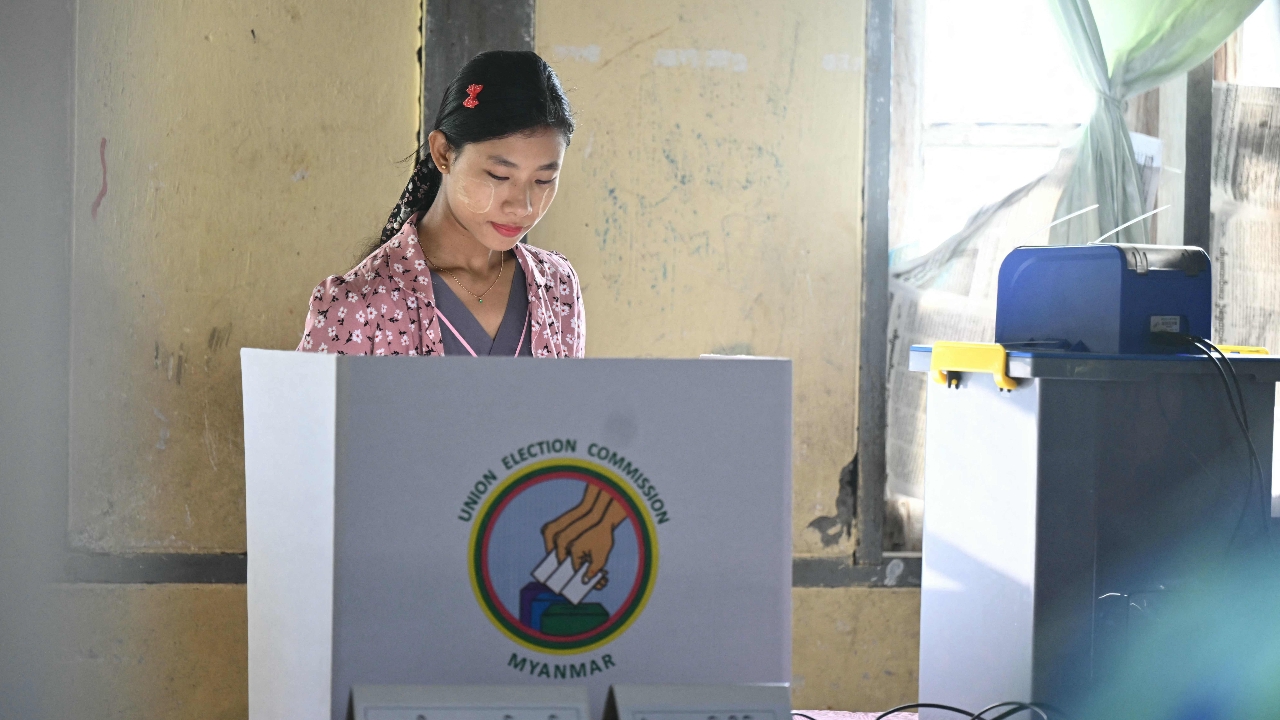
The USDP, the Myanmar military's proxy party, claims victory in the "Kawmoo" constituency, formerly represented by Aung San Suu Kyi, amid criticism that this election is merely a facade to perpetuate power.
The Union Solidarity and Development Party (USDP) claimed victory in the "Kawmoo" constituency, previously held by former democracy leader Aung San Suu Kyi, who remains detained by the military government. Both domestic and international critics argue the election is just a sham to extend the military junta's rule.
An unnamed USDP official disclosed that the party won the Kawmoo seat and claimed the USDP secured 15 out of 16 lower house seats in Yangon after the second round of voting last Sunday.
However, official vote counts or results have not been released, as the election commission, appointed by the military government, has yet to announce them. Analysts note that the election system was designed from the start to favor the military.
The election took place while Aung San Suu Kyi remains secretly detained, and the National League for Democracy (NLD), which previously won by a landslide, has been dissolved, leaving pro-democracy supporters feeling that the public has little genuine political choice.
The military government claims the month-long election, ending on 25 January, returns power to the people, but pro-democracy activists see it as a controlled, repressive process that suppresses dissent.
Tom Andrews, a United Nations human rights expert, said it is unsurprising that the military-backed party claims a landslide victory. He noted that the military designed the election to guarantee their proxy party’s win, reinforcing military dominance and creating an illusion of legitimacy amid ongoing violence.
Despite the election, the military-era constitution reserves at least 25 percent of parliamentary seats automatically for the military.
Since the 2021 coup, Myanmar has been in a civil war, and elections could not be held in many areas controlled by opposition groups that have established parallel governments challenging military authority.
The violence monitoring group ACLED estimates around 90,000 deaths from the conflict. On the first election day, 28 December, there were 52 violent incidents resulting in at least 68 deaths, marking the bloodiest day in months.
Meanwhile, over 330 people have faced legal charges for criticizing or opposing the election, and there are more than 22,000 political prisoners, including Aung San Suu Kyi, who remains detained.
Read more aboutMyanmar election