

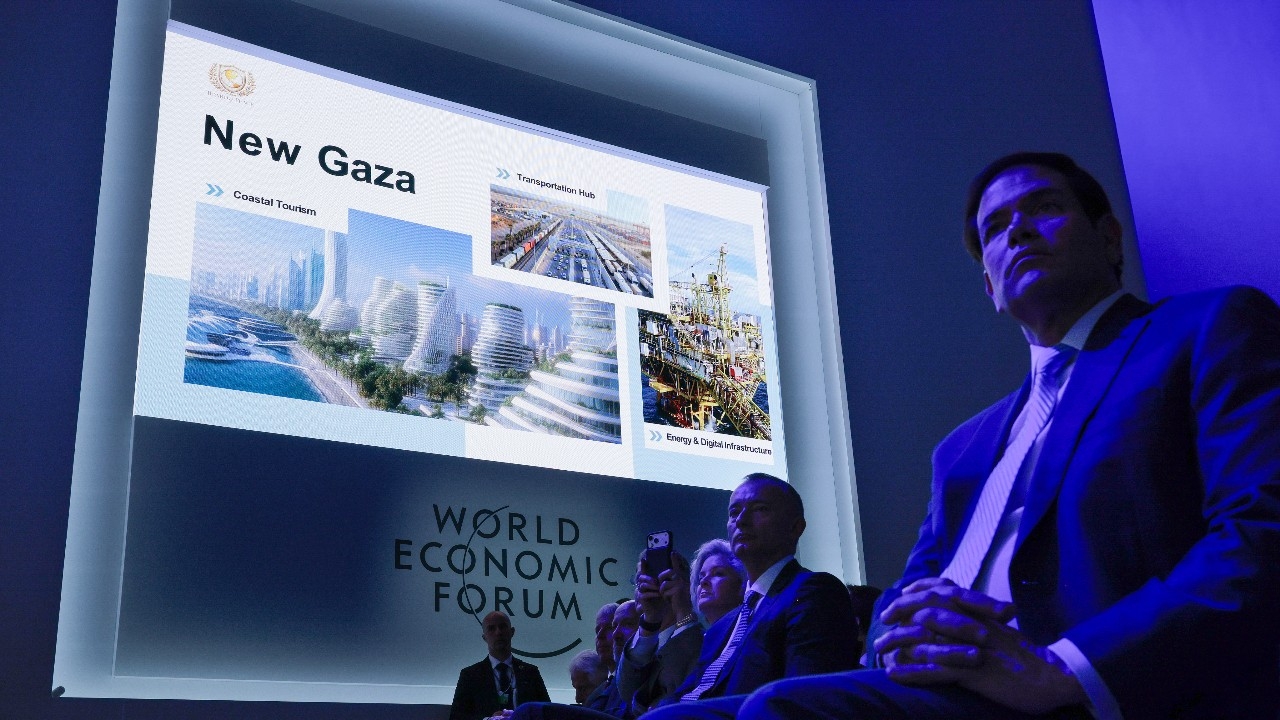
The United States revealed the "New Gaza" development plan to rebuild the Gaza Strip, which suffered severe damage from the war. Slides were presented showing numerous skyscrapers lined along the Mediterranean coast, a large housing project in the city of Rafah, and a phased development plan for a population of about 2.1 million people.
The U.S. government, led by President Donald Trump, officially launched the strategic "New Gaza" plan, aiming to fully rebuild the war-damaged Palestinian territory by focusing on luxury real estate development and establishing a new economic hub.
During the signing ceremony to establish the "Board of Peace" at the World Economic Forum in Davos, a model of a new city featuring skyscrapers along the Mediterranean coast and large housing projects in Rafah was unveiled to accommodate over 2.1 million residents.
President Trump said at the launch ceremony, "I am a real estate developer at heart, and everything depends on location. Look at this seaside position—it's beautiful real estate and will be something great for many people."
Jared Kushner, Trump’s son-in-law and a key figure in the ceasefire agreement, disclosed that despite over 60 million tons of debris needing removal, he is confident the city can be completed within 2 to 3 years. The master plan includes a coastal tourism zone with more than 180 high-rise buildings, the new city of Rafah featuring 100,000 permanent housing units, 200 schools, 75 medical centers, as well as a new airport and port near the Egyptian border, plus data centers and advanced manufacturing industries.
However, this massive investment plan comes with strict conditions. Trump issued an ultimatum to Hamas: "They must disarm. If they do not, it will be the end of them." Kushner added that Hamas has already signed a military reduction agreement, and the new technocratic Palestinian government (NCAG) will oversee the next phase.
Although the vision of "New Gaza" appears bright, the reality remains critical. According to United Nations data, nearly one million people still lack adequate housing, and 1.6 million face severe food insecurity. The ceasefire remains fragile, with ongoing Israeli attacks causing fatalities over the past three months.
A positive sign is the announcement by Ali Shaath, head of the NCAG committee, that the Rafah border crossing connecting to Egypt will reopen in both directions next week, symbolizing an end to Gaza's blockade in the foreseeable future.
Meanwhile, the U.S. is preparing to hold an international conference in Washington next week to invite global partners to contribute funding and allow private sector investment in the project that Trump once called the "Riviera of the Middle East."
.sourceBBC