

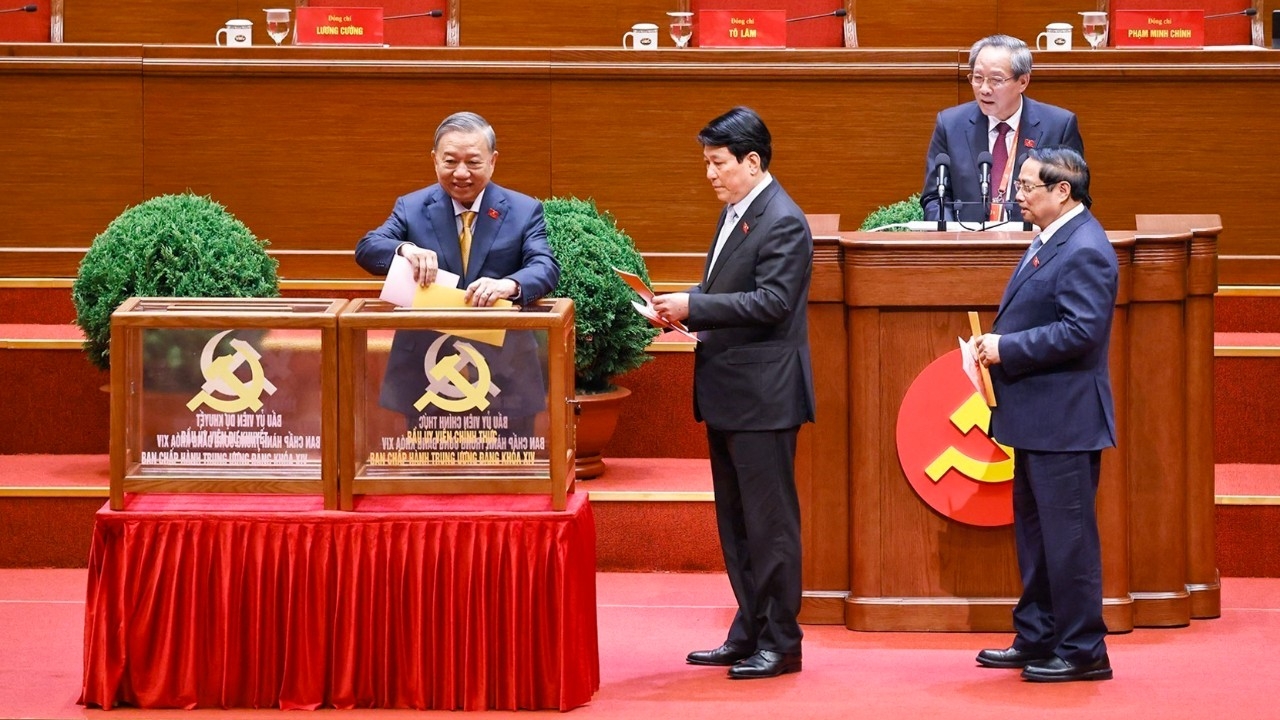
The Vietnamese Communist Party issued a statement confirming that the 180-member Central Committee unanimously voted to re-elect To Lam as General Secretary for another five years, officially maintaining his position as the country's supreme leader while advancing a major economic reform agenda to support the private sector and escape the middle-income trap.
The Communist Party's statement said the Central Committee "unanimously voted to elect Comrade To Lam to continue as General Secretary." National Assembly Chairman Vuong Dinh Hue stated that the party leader received all 180 votes from the total 180 members to continue in the top position.
There are two main factions vying for political power in Vietnam: the security faction supporting To Lam and a more conservative military faction. The party also announced the new 19-member Politburo, the party's highest decision-making body, which notably includes no members from the top four positions who traditionally represent the four pillars of Vietnam's centralized governance system aligned with the military.
The National Congress concluded earlier than the originally scheduled Sunday (25 Jan), which analysts interpret as a sign of solid consensus or possibly the suppression of opposition factions between To Lam's security group and the long-standing rival military faction.
Since assuming office 18 months ago following the death of Nguyen Phu Trong, To Lam has shifted the country's direction from focusing solely on anti-corruption to unprecedented large-scale structural reforms not seen in Vietnam for four decades. Key policies include cutting bureaucratic redundancies by reducing the number of provinces from 63 to just 34 and laying off more than 100,000 civil servants to improve efficiency.
Under "Resolution 68," To Lam has shaken Vietnam's socialist system by declaring the private sector as "the most important driving force of the national economy," elevating private companies to a status equal to state-owned enterprises, which have traditionally been the nation's backbone.
To Lam's main strategy is to support private companies known as "leading cranes" to compete globally by building 20 top private firms with international capabilities, following South Korea's "Chaebol" model that produced giants like Samsung and Hyundai.
The 2045 goal is to lead Vietnam to become a high-income country driven by technology and knowledge, shedding its image as merely a "low-cost manufacturing workshop" for foreign firms.
However, the plan has not been entirely smooth, as conservative factions within the party pushed through "Resolution 79" earlier this month reaffirming that state-owned enterprises—currently numbering 671 and accounting for 29% of GDP—must also remain "leading geese." This highlights ongoing policy struggles between state enterprises and private sector interests.
To Lam has warned that Vietnam must quickly upgrade its value chains, as the country currently relies too heavily on foreign technology and investment. "If a shirt's design, fabric, dye, and buttons all come from elsewhere, what do we gain? Perhaps only cheap labor wages and environmental pollution," he said.
His continued five-year tenure is seen as a new hope for Vietnam to overcome the "middle-income trap" that neighboring Southeast Asian countries like Thailand, Malaysia, and Indonesia are currently facing amid economic stagnation and aging populations.
/BBC