

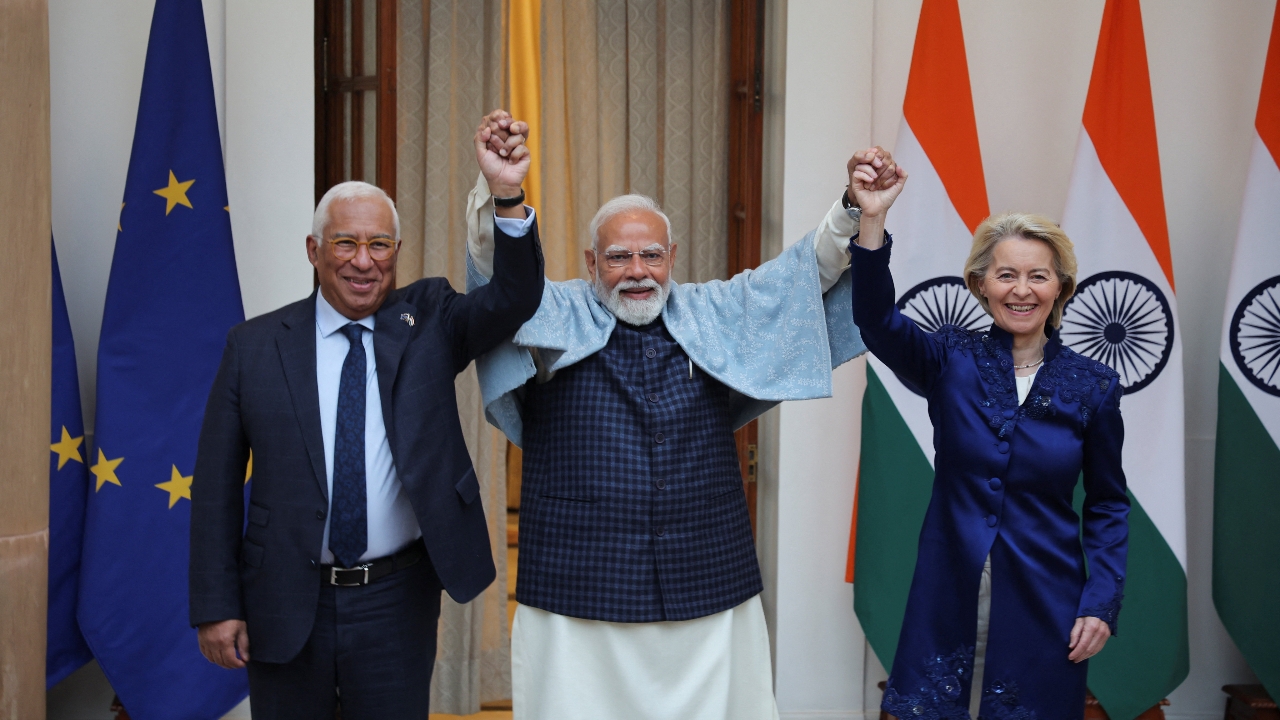
Prime Minister Narendra Modi announced the successful conclusion of a major free trade agreement (FTA) with the European Union after nearly two decades of prolonged negotiations. The agreement covers 25% of the global GDP and aims to reduce dependence on the United States, following tariff barriers imposed by Donald Trump. The deal opens the Indian market to European brand products, including cars and wine, in exchange for exports of textiles and pharmaceuticals.
Prime Minister Narendra Modi of India stated today (27 Jan) that India and the European Union (EU) have finalized a historic trade agreement, marking the opening of the world's most populous market to all 27 EU member countries after nearly 20 years of intermittent negotiations.
Prime Minister Modi described the agreement as the "mother of all agreements," covering 25%, or one quarter, of the global GDP and representing one third of global trade value. He said it will create enormous opportunities for India's 1.4 billion people and millions across Europe.
Prime Minister Modi and Ursula von der Leyen, President of the European Commission, are scheduled to officially announce the details together at the India-EU summit in New Delhi.
European Union data indicates that trade in goods between India and the EU reached 120 billion euros (approximately 4.43 trillion baht) in 2024, an increase of nearly 90% compared to the previous decade, along with services trade worth 60 billion euros (about 2.22 trillion baht).
In the fiscal year ending March 2025, the trade value between India and the EU was 136.5 billion U.S. dollars (around 4.24 trillion baht). Under this agreement, India plans to reduce trade barriers to allow easier entry of European products such as cars, wine, and food into its market. India will benefit from exports of textiles, pharmaceuticals, gems and jewelry, and leather goods. Additionally, both sides will sign cooperation agreements on security and facilitate the mobility of skilled workers, researchers, and students.
Sources close to the negotiations said the final discussions were intense, with outstanding issues such as the impact of the EU’s cross-border carbon tax measures on the steel industry.
This agreement is seen as a joint effort by India and the EU to reduce risks from dependence on the U.S., following former President Donald Trump's imposition of import tariffs on India as high as 50% and the collapse of India-U.S. trade relations last year.
Moreover, India is also trying to reduce dependence on Russian military equipment by expanding cooperation with new allies, while Europe is seeking alternatives to counter unpredictable U.S. tariffs and foreign policies.
Von der Leyen emphasized, "In a divided world, we have demonstrated that other viable paths exist." The International Monetary Fund predicts that India will rise to become the world's fourth-largest economy this year.
Next steps include a legal review process expected to take about 5-6 months before formal signing. Additionally, both parties plan to finalize agreements on seasonal labor mobility, students, researchers, high-skilled experts, and cooperation on security and defense. This marks a continued success for the EU following recent trade deals with Mercosur (South America), Indonesia, Mexico, and Switzerland.