

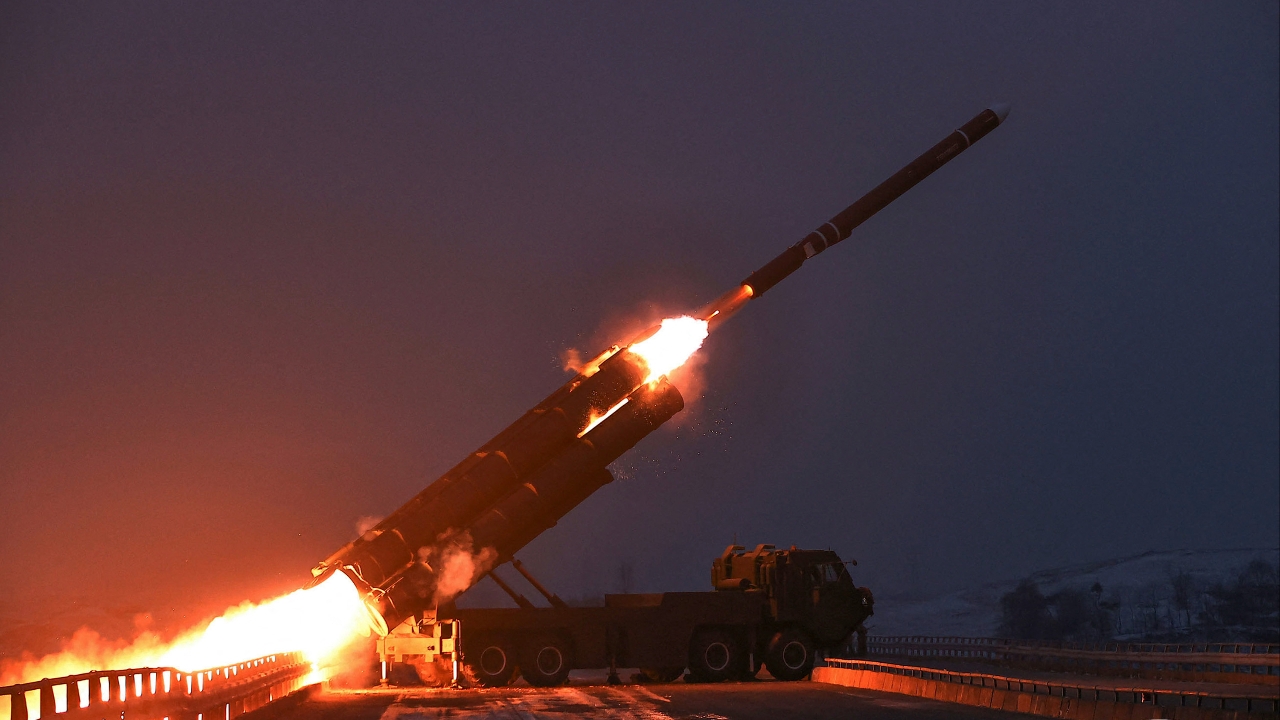
Japanese and South Korean officials reported that North Korea launched at least two guided missiles into the Sea of Japan just one day after a senior U.S. official visited Seoul. Analysts suggest this is a signal ahead of the upcoming major Workers' Party meeting and a response to the U.S. and South Korean alliance.
Japan's Coast Guard, citing the Ministry of Defense, stated that two guided missiles were detected being launched from North Korean territory. Meanwhile, Jiji Press reported that the missiles landed outside Japan's exclusive economic zone. South Korea's Joint Chiefs of Staff also reported detecting multiple missiles heading toward the East Sea.
This operation occurred just one day after Elbridge Colby, the third-highest-ranking official at the U.S. Department of Defense, visited Seoul and praised South Korea as an “exemplary ally,” a statement that displeased North Korea, which views U.S.-South Korea military cooperation as rehearsals for an invasion.
This weapons test took place at a critical time as North Korea prepares for its first major Workers' Party meeting in five years, scheduled within weeks. Supreme Leader Kim Jong Un has ordered the expansion and modernization of missile production lines.
Professor Yang Moo-jin, president of the University of North Korean Studies in Seoul, analyzed that this launch aims to raise tensions to tighten internal discipline and strengthen regime unity ahead of the party meeting. It is also a direct response to the Pentagon official's visit.
Analysts believe North Korea is not only developing weapons to threaten the U.S. and South Korea but also testing weapon performance ahead of exports to Russia, a key ally in the Ukraine war. Intelligence reports indicate North Korea has deployed thousands of troops to assist Russia in Ukraine.
Although former U.S. President Donald Trump met Kim Jong Un three times during his first term in attempts to reach a nuclear disarmament agreement, relations between the two countries have since stalled. Recently, Kim has ignored attempts for new talks and criticized North Korea's efforts to develop nuclear-powered submarines with the U.S. as a threat that must be met with appropriate retaliation.
,AFP