

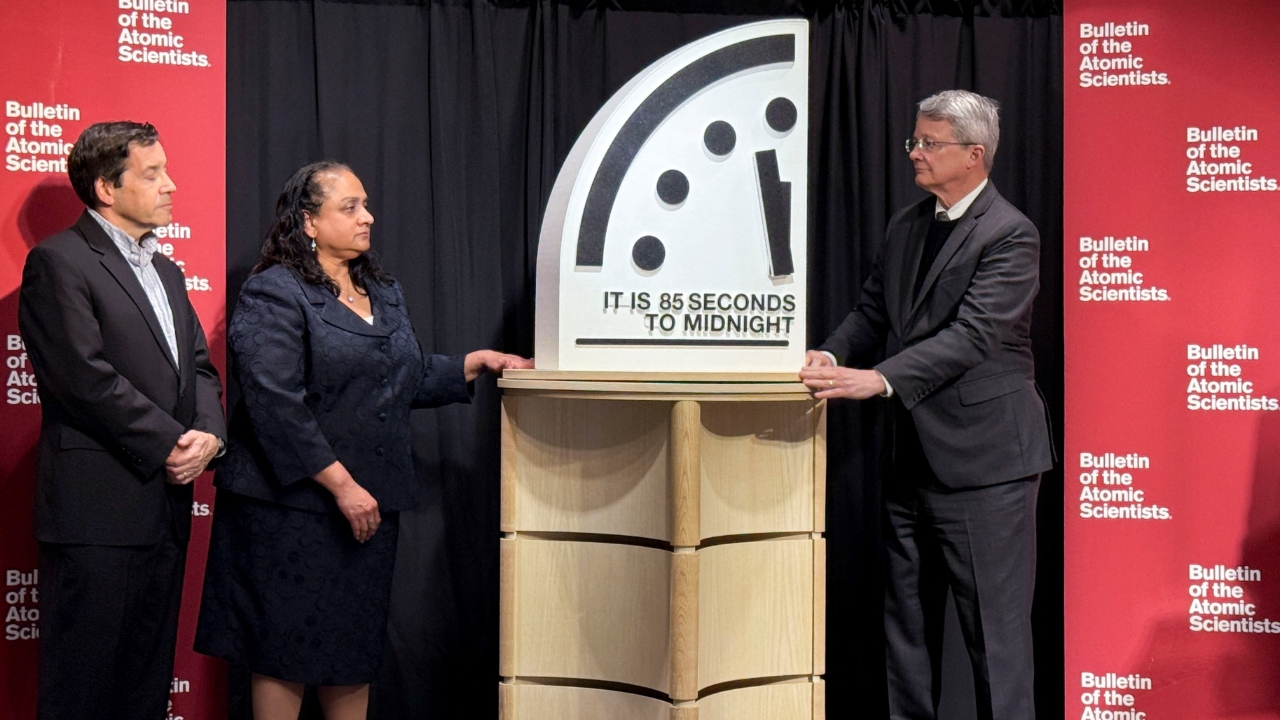
Scientists have adjusted the Doomsday Clock to just 85 seconds before midnight, marking the closest it has ever been due to international conflicts, climate conditions, and technologies like AI.
On 27 Jan 2026 GMT+7, scientists from The Bulletin of the Atomic Scientists (BAS), based in Washington, D.C., announced that the "Doomsday Clock" has been set at 85 seconds to midnight. Midnight symbolizes the moment when humanity can no longer survive on Earth. This 85-second setting is the closest to midnight since BAS created the Doomsday Clock in 1947 to symbolize how close humanity is to global destruction.
After remaining unchanged during 2023-2024, the clock's hands have moved closer to midnight for two consecutive years, reflecting insufficient progress in addressing global challenges such as nuclear risks, climate crisis, biological threats, and breakthroughs in "world-altering technology" like AI.
The scientists also noted that the spread of disinformation, misinformation, and conspiracy theories pose significant threats to humanity's survival.
“Humanity has not made enough progress in managing existential risks that endanger all of us,” said Alexandra Bell, BAS president and CEO, explaining the reasons behind this year's clock adjustment.
“The Doomsday Clock is a communication tool showing how close we are to self-inflicted global destruction. The risks from nuclear weapons, climate change, and disruptive technologies are all increasing. Every second counts, and our time is running out.”
“It is a hard truth to accept, but it is the reality we face,” Bell added.
Last year, BAS moved the clock to 89 seconds before midnight and warned that nations need to shift toward international cooperation and address the most critical existential threats.
“Instead of heeding this warning, major powers have become more aggressive, confrontational, and nationalistic,” said Dr. Daniel Holz, chair of BAS's Science and Security Board, during a briefing on Tuesday.
“Conflicts intensified in 2025, with multiple military operations involving nuclear-armed states. Additionally, the last treaty regulating nuclear arsenals between the U.S. and Russia is set to expire on 4 Feb 2026 GMT+7 — the first time in over half a century that nothing will prevent a potentially uncontrollable nuclear arms race.”
Dr. Holz also highlighted that severe dangers persist in the biological sciences, especially emerging fields like synthetic mirror life, despite repeated warnings from scientists worldwide.
“The international community lacks coordinated plans, and the world remains unprepared for bio-threats that could cause devastating damage.”
“The rapid growth and deployment of AI tools, combined with insufficient regulation, fuel the spread of false and misleading information, greatly undermining efforts to address these threats and worsening other impending disasters,” Dr. Holz stated.
Follow international news:https://www.thairath.co.th/news/foreign
Source:cnn