

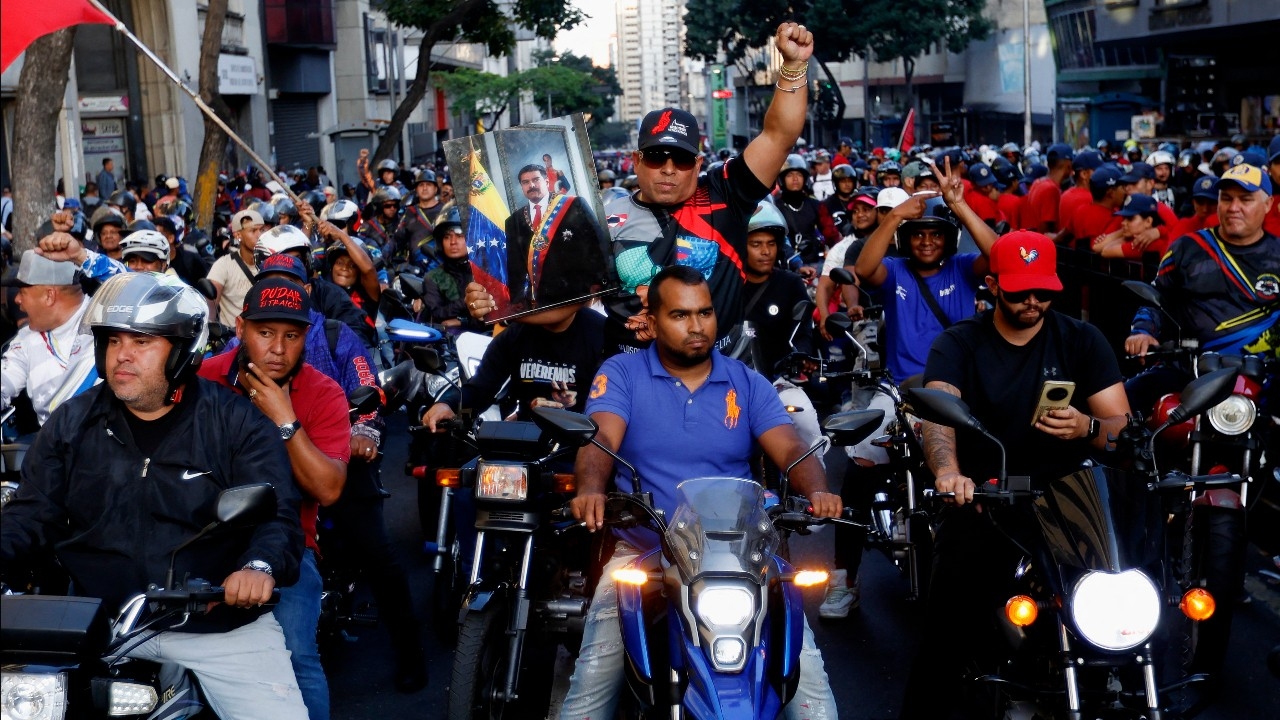
Thousands of Venezuelans gathered to protest in central Caracas, backing the government’s demand that the U.S. release former President Nicolás Maduro and his wife, who were detained and taken to a New York court last January.
Protesters marched through the streets of central Caracas, chanting “Venezuela needs Nicolás” on Tuesday (3 Feb), marking one full month since former President Nicolás Maduro was detained by U.S. military operations to face drug trafficking charges in a New York court.
Since then, Acting President Delcy Rodríguez has cautiously managed her role to maintain relations with the U.S. while preserving support from Venezuelans who want Maduro’s release.
This government-led protest drew thousands who marched hundreds of meters through central Caracas, blasting loud music and holding up pictures of Maduro and his wife, Cilia Flores, who is also detained by the U.S., as symbols of support.
“These people are not Americans,” said Nicolás Maduro Guerra, Maduro’s son and a member of parliament, addressing protesters many of whom wore red and waved Venezuelan flags, adding, “We have built a strong consciousness against imperialism.”
Protesters wore red because it is the color of the "Chavista" movement, named after the late socialist former President Hugo Chávez.
A representative of the demonstrators expressed confusion, sadness, and anger at the U.S. treatment of Venezuela, pledging support for Acting President Delcy Rodríguez’s decisions and affirming, "Sooner or later, the U.S. must release our president."
U.S. President Donald Trump said he is willing to work with Rodríguez, who served as vice president under Maduro, as long as she follows U.S. policies, especially allowing access to Venezuela’s vast oil reserves.
Under pressure, Rodríguez has begun releasing political prisoners and opened the state-owned petrochemical industry to private investment.
U.S. Deputy Ambassador Laura Dogu for Venezuelan Affairs arrived in Caracas on Saturday (31 Jan) to discuss restoring diplomatic ties cut off since 2019, after allegations that Maduro rigged his second presidential election.
On Tuesday (3 Feb), the U.S. delegation released a video outlining Dogu’s three-step plan to guide Venezuela through its crisis, culminating in “a friendly, stable, prosperous, and democratic Venezuela.” Rodríguez confirmed the talks, describing them as “straightforward conversations.”
That same day (3 Feb), hundreds of students and relatives of political prisoners marched in Caracas demanding approval of an amnesty law promised by Rodríguez, who said she is working “hard” to push the legislation “to enable the government to implement national policies amid extreme political violence.”
The law has yet to be considered by parliament, chaired by Rodríguez’s brother Jorge Rodríguez, a supporter of the Chavista movement and Maduro.
Opposition MP Stalin González expects the amnesty bill to be introduced for first debate on Thursday (5 Feb), adding, “I hope this amnesty will lead to reconciliation, peaceful coexistence, and democracy.”
Protesters shouted, “Freedom is in the streets and no one can stop it!” amid intense demonstrations, while the opposition called for new elections after Maduro leaves office.
Anti-government protests in Venezuela have been rare since the crackdown on demonstrations against the 2024 election results, which Maduro won; that crackdown led to over 2,000 arrests.
.source:France24
Read more about Venezuelahere