

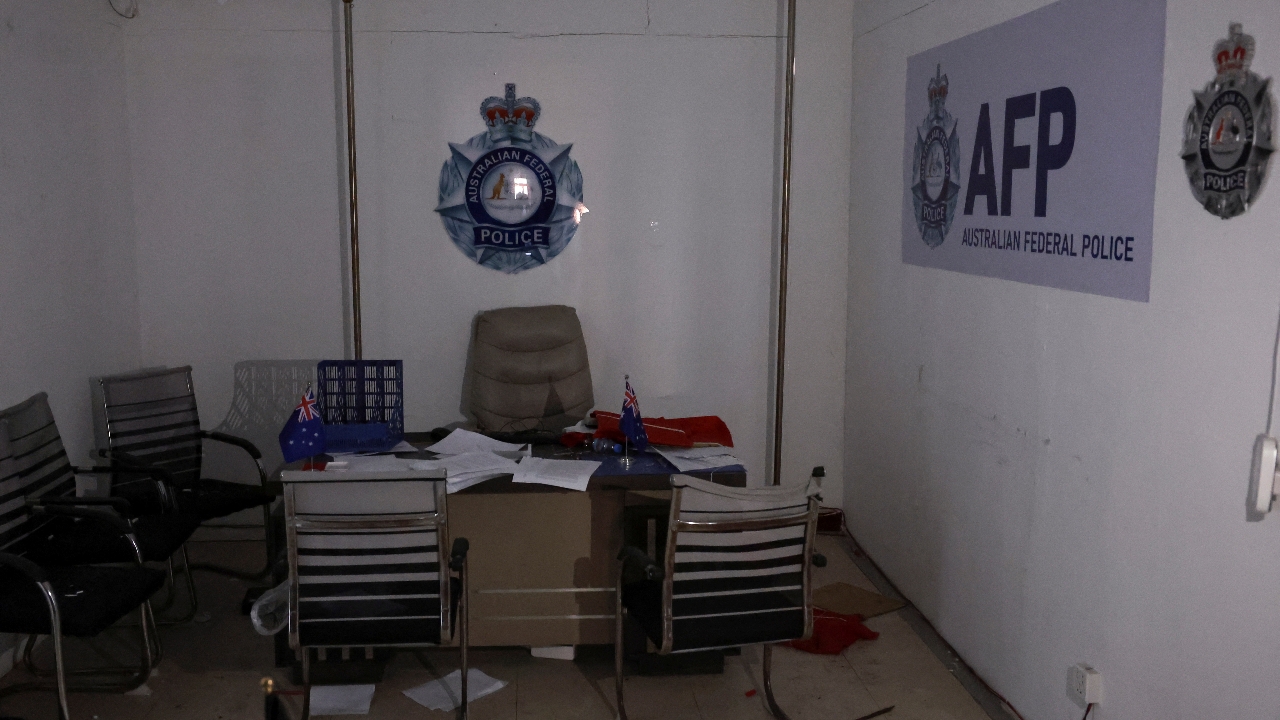
Reuters reporters visited an abandoned scam base in Cambodia, discovering numerous documents and staged scenes resembling a bank and police station intended to deceive victims, causing billions of dollars in global damages.
Reuters published many photographs of the abandoned scam base in Cambodia, where the building appears hastily deserted. Desks are cluttered with scattered documents, and several rooms are staged to look like Singapore and Australian police offices, as well as a room modeled after a Vietnamese bank.


Among the piles of documents were extensive personal information of victims, including a 73-year-old Japanese man’s phone number and bank balance, and an American woman who disclosed being a domestic violence victim. Additionally, romance scam scripts and impersonation dialogues for posing as government officials were found.
Reuters reported the abandoned complex, named Royal Hill, is near Or Samet town in Oddar Meanchey province—a known hotspot for human trafficking and online scams. This foreign news agency is the first to verify some of the documents’ authenticity.


One document was confirmed by contacting the Japanese man named in the files. He said he received a call late last year from someone claiming to be an electricity official threatening to cut power unless bank information was provided.
Although he did not transfer money, he inadvertently revealed several personal details and later realized this was a mistake.
Reuters could not confirm the true controller of the Royal Hill complex due to the difficulty in accessing land ownership records in Cambodia.
However, Chinese-language documents found on-site indicated that an anonymous manager leased space to multiple scam groups, naming a person called "Zhang" as a tenant, who did not respond to media inquiries.
The Cambodian government issued a statement claiming the building is a hotel and accused Thailand of forcibly seizing the area, while the Ministry of Interior spokesperson reaffirmed the government's commitment to crack down on scam centers and eliminate cybercrime by April.

In recent years, Southeast Asia has become a global hub for online scams, particularly in Cambodia, Laos, the Philippines, and lawless border areas between Thailand and Myanmar. These centers are often controlled by Chinese criminal networks and exploit human trafficking victims forced to work under harsh conditions.
The United States estimates that in 2024, Americans lost up to 10 billion U.S. dollars to scams originating from Southeast Asia.
Thai airstrikes in December, which the Thai military claimed targeted drone bases, along with Cambodian government crackdowns, have led to over 100,000 people fleeing scam operation centers nationwide.
Reuters also revealed another set of documents believed to be from the management zone, showing strict control measures such as riot control drills, military-style emergency plans, bans on outsiders approaching, prohibitions on food delivery services, enforced polite behavior, and bans on activities deemed illegal.
Financial documents showed that management charged scam groups several thousand dollars per month in rent, with some groups behind on payments.
Documents also contained cryptocurrency wallet information, which blockchain experts linked to high-risk services such as gambling and cash conversion.
A notebook entry dated October 2025 noted that on that day, the scammers received nothing but angry responses and encountered people who were aware of their tactics.
. Source:Reuters
Click to read more news aboutscammers