

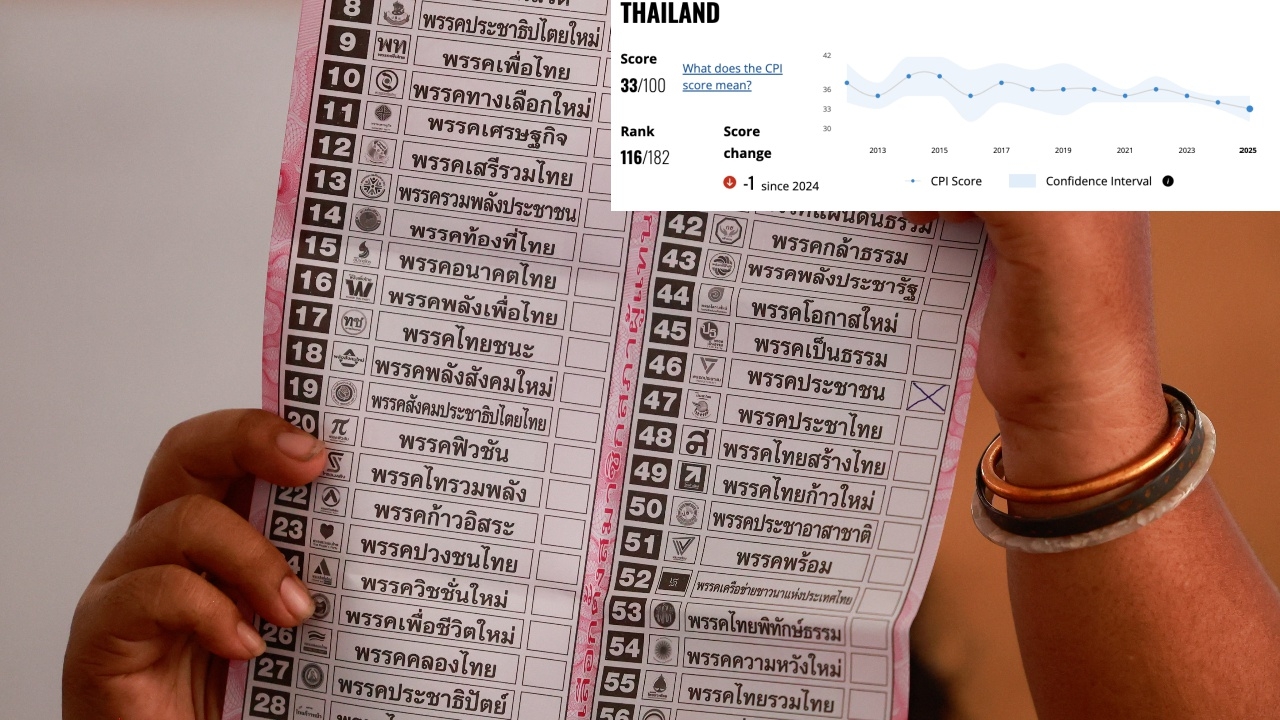
Thailand ranks 116th. After Transparency International (TI) released the 2025 Corruption Perceptions Index, it warned that the global corruption situation is "worrying," with the worldwide average dropping sharply to its lowest level in 10 years. It noted that the United States under Donald Trump's administration saw a steep decline in scores due to interference in the justice system and reduced independence of oversight agencies, while Denmark remained the world's most transparent country.
Transparency International (TI) released a report today (10 Feb) warning of worsening corruption in democracies worldwide, noting that the United States recorded its lowest-ever score in the ranking.Corruption Perceptions Index.For the year 2025.
TI, headquartered in Berlin, stated that the global average score on the Corruption Perceptions Index is 42 points, the lowest in over a decade, reflecting that most countries still cannot effectively control corruption. Among 180 countries surveyed, 122 scored below 50.
The index scores countries from 0 to 100, where 0 indicates very high corruption and 100 indicates very high transparency. Scores are based on expert and business executive assessments from sources such as the World Economic Forum and The Economist Intelligence Unit.
The report states that the United States scored only 64 points, ranking 29th, continuing a decline over more than ten years amid a deteriorating political environment since President Donald Trump resumed office earlier this year, with pressure applied to several independent institutions.
TI expressed concern over actions targeting independent voices and undermining judicial independence in the United States, including the investigation of Federal Reserve Chairman Jerome Powell after he resisted pressure to cut interest rates. TI also noted that delays and reduced enforcement of anti-bribery laws abroad, along with cuts to foreign aid budgets, have weakened global anti-corruption efforts.
The report highlights the United States as an example of declining effectiveness in fighting corruption in democracies, a trend also seen in the United Kingdom and France. Although these countries remain near the top of the rankings, corruption risks have increased due to weak checks and balances, legal loopholes, and insufficient enforcement.
TI further noted that many countries face pressures on democratic systems from political polarization and the influence of private money on state decision-making.

Thailand ranks 116th in the 2025 global corruption index, trailing Southeast Asian neighbors such as Singapore (3rd), Brunei (31st), Malaysia (54th), and Vietnam (81st). Indonesia and Laos share 109th place, while Cambodia ranks 163rd and Myanmar 169th out of 182 countries.
Within the European Union, Bulgaria and Hungary scored lowest with just 40 points. The report criticizes Hungarian Prime Minister Viktor Orbán's government for undermining the rule of law, civil liberties, and electoral integrity continuously for over a decade.
In Slovakia, which scored 48 points, TI noted that Prime Minister Robert Fico's government is weakening investigations into corruption and organized crime, especially those involving high-ranking officials.
Denmark remains the highest-scoring country for the eighth consecutive year with 89 points. Ukraine, which scored 36 points, is cited as a positive example; despite facing corruption criticisms during the war with Russia, ongoing case disclosures demonstrate the effectiveness of a new anti-corruption system.
The report also praises Ukraine's civil society movements over the past year for pressuring the government to withdraw attempts to reduce the independence of anti-corruption agencies, reflecting the vital role of civil society in continuously monitoring state power.
Source.AFP./Transparency International