

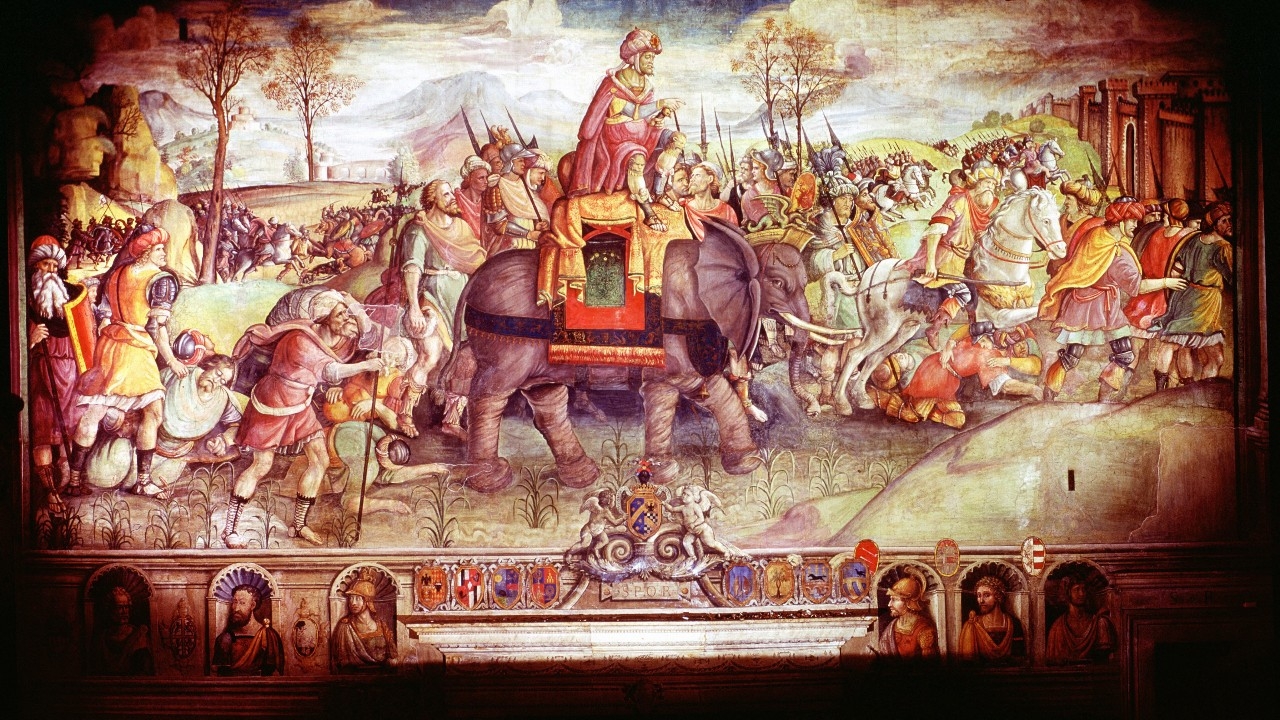
Archaeologists have excavated Iron Age elephant toe bones in southern Spain, which may represent the first "physical evidence" confirming the existence of the mighty war elephant army of Hannibal, the legendary Carthaginian general who led his forces across the Alps to invade Europe and challenge the Roman Empire over 2,000 years ago.
The discovery of elephant toe bone fragments by an archaeological team in southern Spain is becoming crucial evidence that may confirm the war elephant army once marched through ancient Europe. Scholars say this could be the first tangible proof linking to Hannibal, the great general of the Carthaginian empire.
Although paintings and historical records have long described Hannibal’s use of elephants in his wars against Rome, until now there has been no strong physical evidence supporting this theory. That changed with the excavation of bones at an Iron Age archaeological site near the city of Córdoba.
Scientists noted in the Journal of Archaeological Science: Reports that "excluding ivory, finding elephant skeletal remains in a European archaeological context is exceptionally rare."
Hannibal is regarded as one of the most successful military commanders of the classical era. He led the Carthaginian army (now Tunisia) into Europe to contest control of the Mediterranean. It is believed that in 218 BCE he led troops and animals across Spain and France to invade Italy, bringing 37 war elephants over the Alps during the Second Punic War.
The bones found in Spain are thought to belong to an elephant that died before reaching the Alps. Led by Professor Rafael M. Martínez Sánchez, the archaeological team found the bones beneath collapsed walls at the Colina de los Quemados site.

Researchers used carbon dating techniques to estimate the age of the 10-centimeter cubic bone fragment. The results suggest it dates to the period of the Second Punic War. They also compared the bone to modern elephants and Steppe Mammoths to identify the species.
During the 2020 excavation, the team also uncovered ancient artillery, coins, and pottery, important clues that the site was once a battlefield. "As large exotic land animals, these creatures were likely transported by ship," the researchers said. They added it is highly unlikely the bones were transported after death or used for decorative crafts since the bones lack aesthetic appeal.
Although it is difficult to determine the exact species of this elephant, scientists concluded in their report that "even if this bone does not represent the actual war elephant that crossed the Alps, it may be the 'first archaeological artifact' representing the animals used in the Punic Wars to contest Mediterranean dominance—a find long sought by modern European scholars."
. SourceBBC