

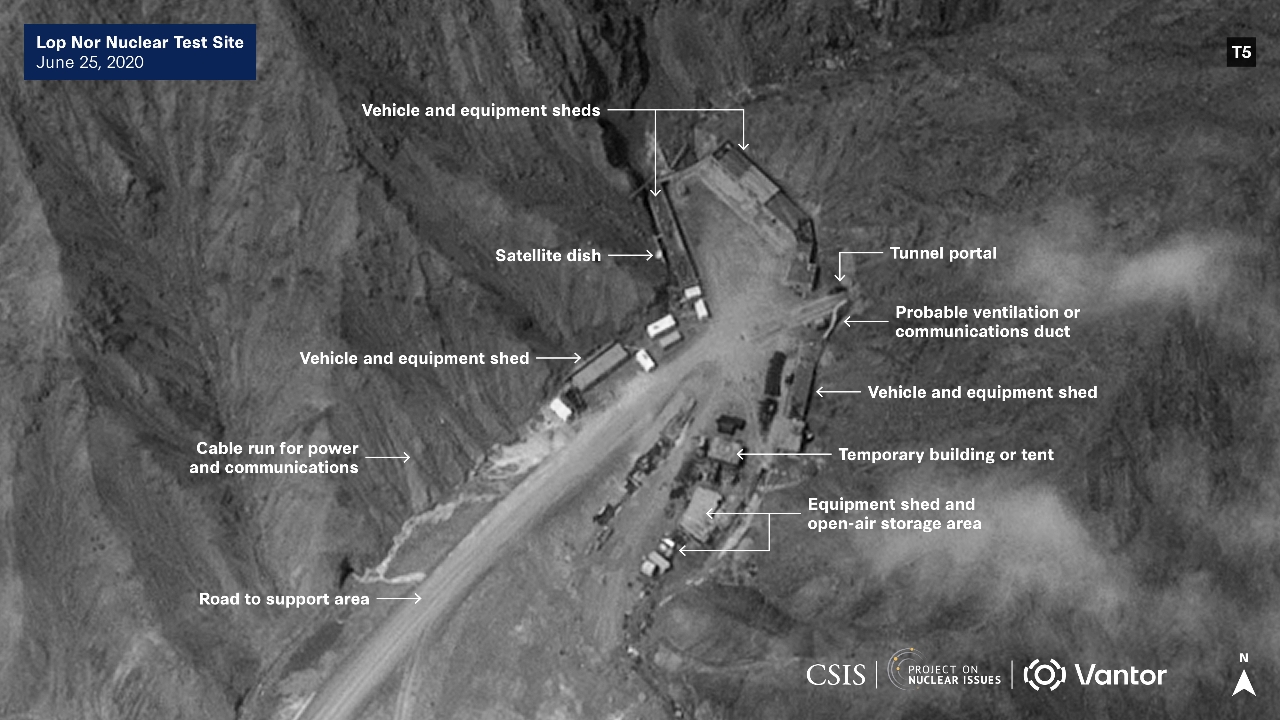
Senior US officials have revealed new details about a magnitude 2.75 tremor detected in Kazakhstan, approximately 720 kilometers from China's Lop Nor test site in the country's west, in June 2020. They stated that the characteristics of the event do not match a mining explosion or natural earthquake but resemble a nuclear test. China immediately denied the allegations, calling them baseless and a scheme to maintain US nuclear superpower status.
A senior US official disclosed new information possibly indicating that China secretly conducted an underground nuclear weapons test in June 2020. Christopher Yaw, US Assistant Secretary of State, said at a seminar at the Hudson Institute in Washington, D.C., that seismic monitoring stations in Kazakhstan detected a magnitude 2.75 tremor on 22 June 2020, about 720 kilometers from China’s Lop Nor test site in the west.
Yaw stated that further data analysis suggests it is highly unlikely the event was anything other than a single explosion, inconsistent with mining blasts or natural earthquakes. He emphasized that the characteristics align with a nuclear weapons test.
However, the Comprehensive Nuclear-Test-Ban Treaty Organization (CTBTO), responsible for detecting nuclear tests worldwide, said existing data is insufficient to confidently confirm the allegation.
The Chinese Embassy in Washington, D.C., issued a statement categorically denying the accusations. Spokesperson Liu Pengyu called the claims "completely unfounded" and described them as a US political attempt to justify resuming nuclear tests. He also accused the US of distorting the issue to maintain its nuclear power status.
China further urged the US to reaffirm its commitments as one of the five recognized nuclear-weapon states to refrain from testing and to take concrete actions to preserve global arms reduction and non-proliferation regimes.
Meanwhile, the CTBTO reported that seismic station PS23 in Kazakhstan detected two small tremors twelve seconds apart on the same day, but both were below the threshold needed to confirm a nuclear test. The organization’s detection system can reliably identify nuclear explosions with a yield equivalent to at least 500 tons of TNT.
Yaw also alleged that China may have employed a "decoupling" technique—detonating the device in a large underground cavity—to reduce seismic signals and evade international detection.
Both China and the US signed the Comprehensive Nuclear-Test-Ban Treaty in 1996 but have yet to ratify it. Nonetheless, under international law, both countries are obligated to respect the treaty’s provisions.
The US conducted its last underground nuclear test in 1992 and currently relies on a multi-billion-dollar program, including supercomputer simulations, to ensure the reliability of its nuclear warheads.
On the international political front, then-US President Donald Trump was pressing China to join negotiations with the US and Russia on a new nuclear arms control agreement to replace the expired New START treaty, raising concerns about a renewed arms race.
China has refused to participate in such talks, citing that its nuclear arsenal is significantly smaller than those of the US and Russia. However, the US Department of Defense states China currently has over 600 deployable nuclear warheads, with projections to exceed 1,000 by 2030, reflecting ongoing military expansion regionally and globally.