

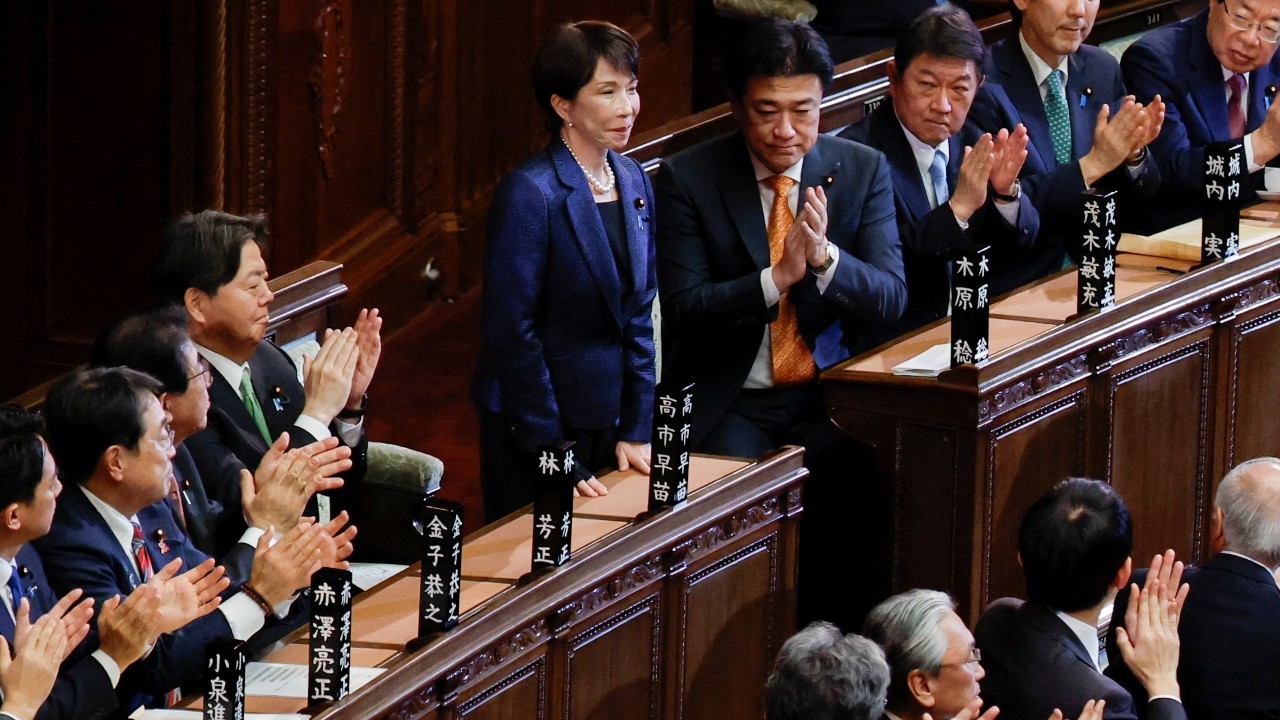
Japan’s House of Representatives officially elected Sanae Takaichi as Prime Minister just 10 days after the Liberal Democratic Party (LDP) won a landslide victory in the February 8 election. She is set to advance economic stimulus measures and suspend the consumption tax, while announcing the same cabinet lineup to maintain continuity in governance.
Following the general election on February 8, Japan’s parliament convened a special session and unanimously re-elected Sanae Takaichi as Prime Minister. In the House of Representatives, where the ruling party holds a majority, she received overwhelming support with 354 votes.
Although the ruling party is in the minority in the upper house, Takaichi won the decisive vote there as well with 125 votes to 65, defeating the opposition party leader decisively.
According to constitutional procedures, the previous cabinet resigned en masse before the session began to allow Takaichi to form a new government. However, no major changes in key positions are expected to preserve policy continuity. The main ministers will remain the same, including Toshimitsu Motegi as Foreign Minister, Satsuki Katayama as Finance Minister, and Shinjiro Koizumi as Defense Minister.
Within the LDP, it has been reported that Yasutoshi Nishimura, a former Industry Minister previously linked to an undisclosed funds scandal, may be appointed as head of the Election Strategy Headquarters.
Regarding parliamentary structure, the House of Representatives elected Ezuke Mori as Speaker and Keiichi Ishii as Deputy Speaker, both from the centrist Reform Alliance party.
Prime Minister Takaichi plans to hold a press conference this evening (18 Feb) to outline her expansionary fiscal policy, which she calls "responsible yet proactive." A key highlight is the plan to suspend consumption tax on food products for two years to help ease the cost of living for citizens.
The recent election marks a historic turning point as the LDP secured 316 of 465 seats in the lower house, an increase of 198 seats, making it the first party since World War II to hold an absolute majority.
This success followed Takaichi’s decision to dissolve parliament on January 23, capitalizing on soaring popularity to strengthen the coalition government between the LDP and the Japan Innovation Party (JIP), also known as Nippon Ishin, which increased its seats to 36.
While the government strengthened, the opposition Centrist Alliance suffered a heavy defeat, dropping to just 49 seats from 167. As a result, joint leaders resigned, appointing Junya Ogawa as the new leader to reform and renew the party with younger members.
Constitutionally, the lower house can override the upper house’s decisions with a two-thirds majority. The government remains a minority in the upper house after losing the July 2025 election during former Prime Minister Shigeru Ishiba’s tenure.
The special parliamentary session will continue until 17 July, with the urgent agenda of reviewing the preliminary budget for fiscal year 2026, which begins in April.
/sourceKYODO NEWS