

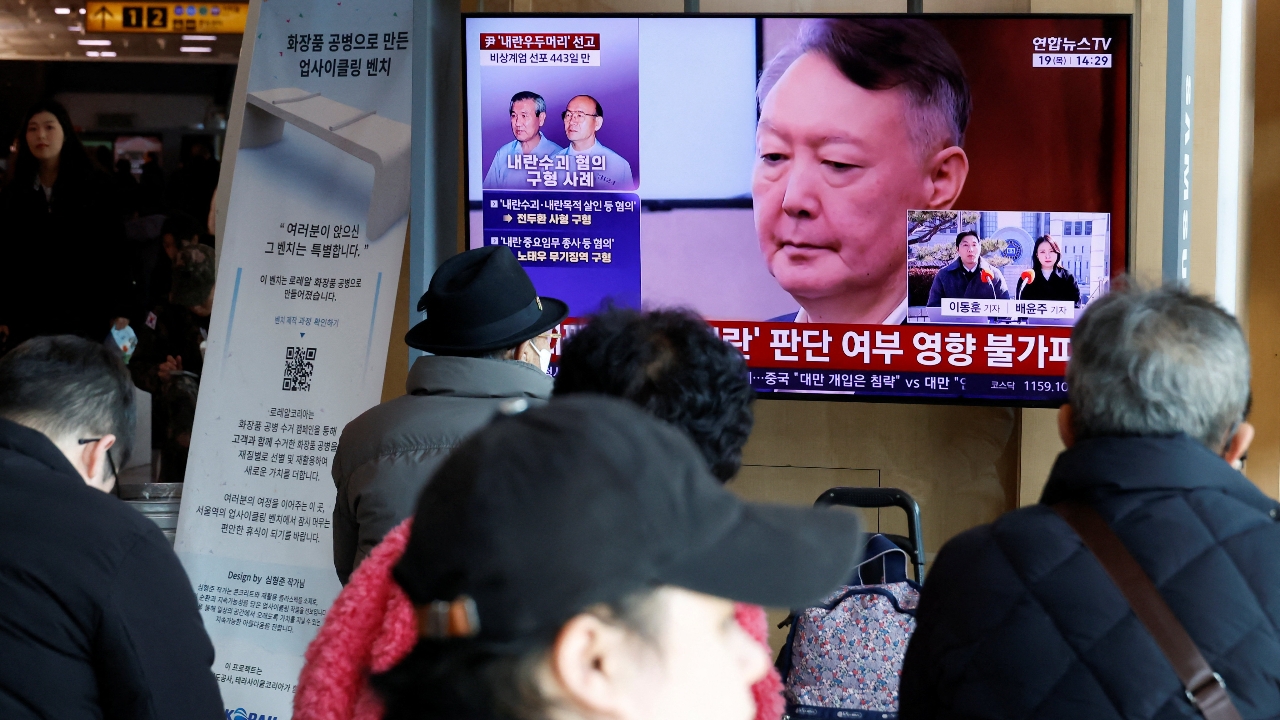
The Seoul Central Court found former South Korean President Yoon Suk-yeol guilty of rebellion and abuse of power related to the sudden declaration of martial law in December 2024.
Presiding Judge Ji Gwi-yeon stated in the ruling that Yoon's deployment of troops to the National Assembly building aimed to silence political opponents and deliberately paralyze parliamentary operations, causing significant harm to society and severely undermining the country's democratic foundations.
The judge said, "The court found no indication that the defendant felt remorse for these actions, and therefore sentenced him to life imprisonment."
During the reading of the verdict, Yoon Suk-yeol appeared calm and showed no signs of panic, in contrast to thousands of supporters gathered who sighed and shouted in despair, "Korea is collapsing," upon hearing the decision.
Previously, Yoon had argued that the martial law declaration was merely a 'symbol' intended to draw attention to alleged irregularities by the left-wing party, but the court dismissed this argument.
Under South Korean law, the punishments for rebellion are limited to life imprisonment or the death penalty. Yoon had already been sentenced to five years for lesser charges. Besides the former president, the court also sentenced several government and security officials involved as follows.
Former Defense Minister Kim Yong-hyun was sentenced to 30 years in prison.
Former Intelligence Commander Roh Sang-won was sentenced to 18 years in prison.
Former National Police Commissioner Cho Ji-ho was sentenced to 12 years in prison.
Former Seoul Metropolitan Police Commissioner Kim Bong-sik was sentenced to 10 years in prison.
Former head of the parliamentary security unit Mok Hyun-tae was sentenced to three years in prison.
The court stated that all defendants have the right to appeal within one week, and Yoon's case is likely to be escalated to the Supreme Court.
On the night of 3 December 2024, Yoon made a shocking late-night television appearance, warning of vague threats from North Korean influence and "anti-state forces," announcing the suspension of civilian government and the start of military rule.
Martial law was lifted six hours later after lawmakers rushed to the National Assembly to hold an emergency vote. Officials blocked the doors with office furniture to prevent armed troops from entering. The declaration sparked immediate protests, rattled the stock market, and caught key military allies such as the United States off guard.
Separately, Yoon's wife, Kim Gun-hee, was sentenced to 20 months in early January for unrelated bribery charges during her time as first lady.