

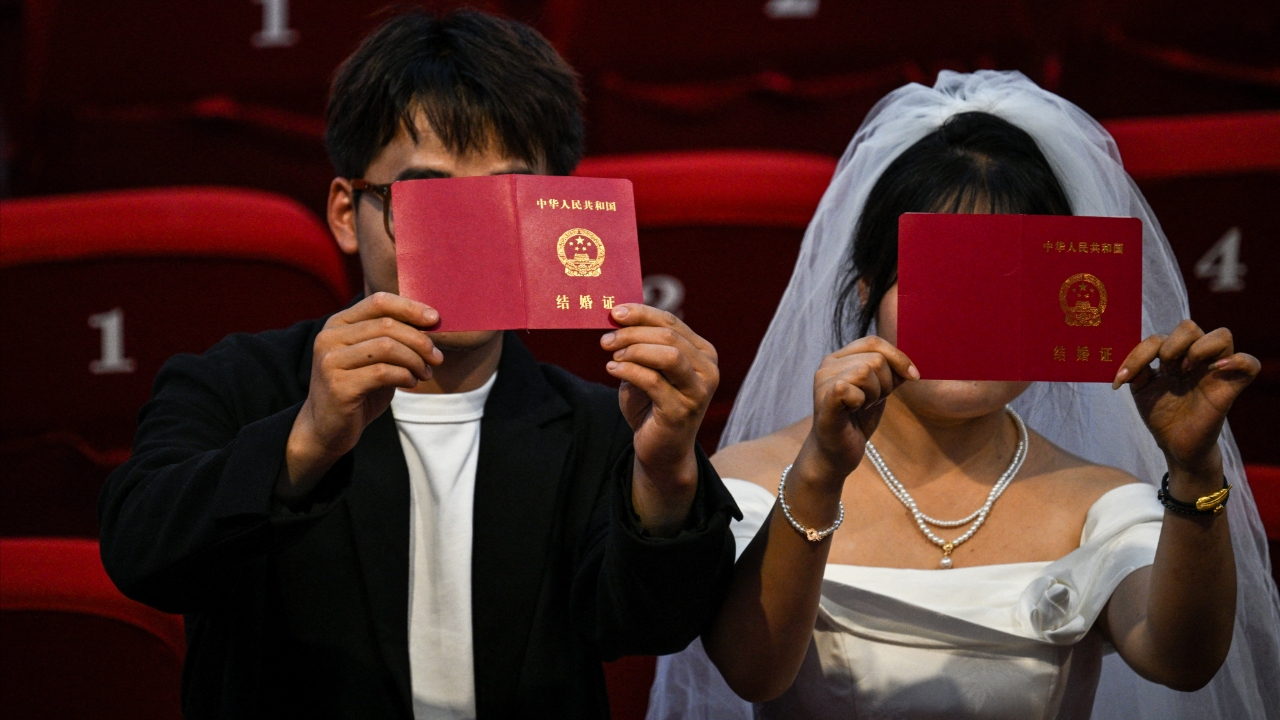
In 2025, more Chinese couples got married after nearly ten years of continuous decline, yet the birth rate dropped to a record low despite numerous government incentives.
Foreign news agencies reported on 19 Feb 2026 that China registered 6.76 million marriages in 2025, up about 10.8% from the previous year's record low.
However, this rise followed nearly a decade of declining marriage statistics, with last year's registrations amounting to only about half of the 12.25 million couples recorded in 2015.
Meanwhile, China's birth rate continued to fall, with only 7.92 million babies born in 2025—the lowest ever—pushing China rapidly toward an aging society.
An elderly Chinese citizen believes that younger generations have changed views on marriage, especially influenced by the one-child policy, which was implemented in 1970 to control population growth and officially ended in 2015.
He said, “Unlike us who grew up with siblings, we valued family bonds deeply from childhood through today.”
“But those born after the 1980s lack this kind of 'asset,' meaning sibling bonds. Men and women today tend to be highly individualistic, which may explain why marriage has become more complex.”
The rise in marriage registrations may be linked to government incentives introduced continuously, including from May 2025 allowing couples to register marriages anywhere nationwide, ending decades-old rules requiring registration only in one partner’s hometown.
Additionally, some provinces offer benefits such as marriage leave for up to one month and cash subsidies.
However, experts say more time and data are needed to determine whether the marriage registration recovery will be sustainable.
They noted the increase might reflect postponed weddings due to the COVID-19 crisis or delays from 2024, which was considered an unlucky year according to the Chinese calendar.
“We must be very cautious about viewing this increase as a major change or treating these (marriage promotion) policies as a magic solution,” said Stuart Gietel-Basten, Professor of Social Science and Public Policy at the Hong Kong University of Science and Technology (HKUST).
There remain fundamental pressures discouraging singles from marrying, such as unemployment and long working hours, which have barely changed over recent years.
“What changes marriage rates is everything in society,” Gietel-Basten said. “It’s about how you start your life—work, housing, living costs, expectations about children, career advancement, and caring for your parents. It’s a much bigger system we need to consider.”
Follow international news:https://www.thairath.co.th/news/foreign
Source:cna