

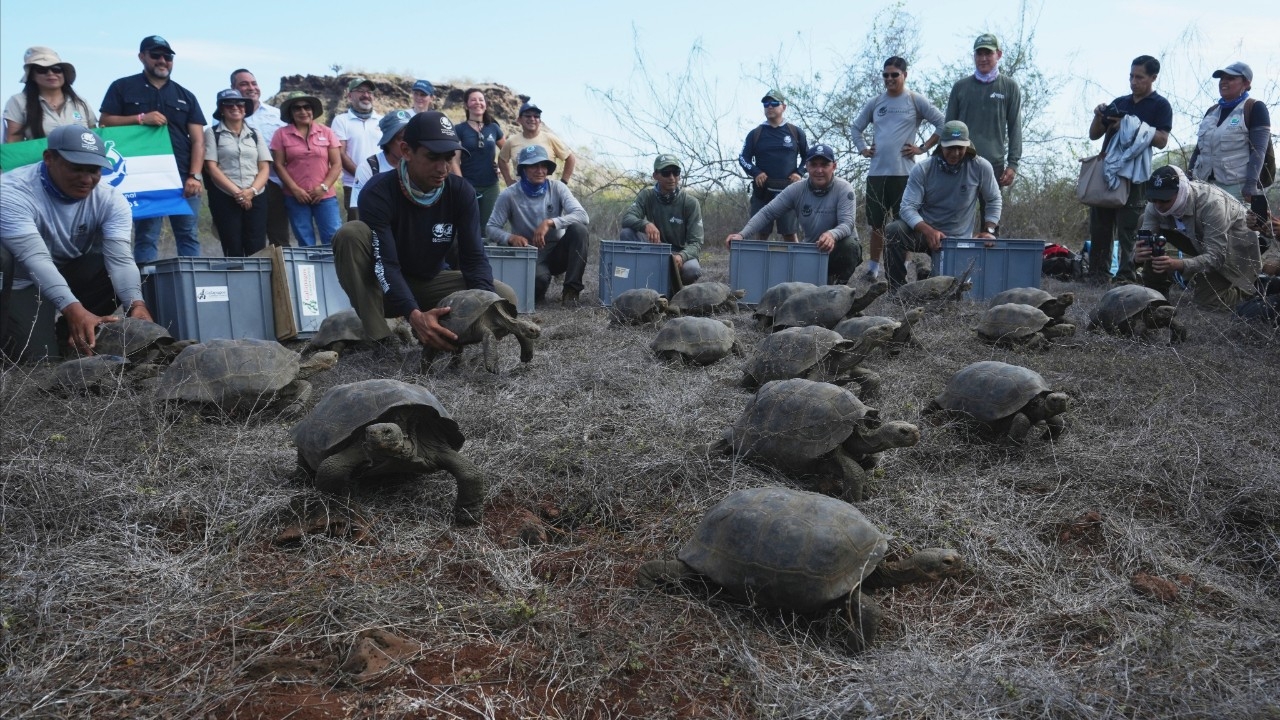
Giant tortoises, extinct on Floreana Island in the Galápagos for over 180 years, have been returned to the island after scientists spent nearly 10 years breeding them back.
Foreign news agencies reported on 21 Feb 2026 that giant tortoises are once again roaming Floreana Island in the Galápagos for the first time in over 180 years, following successful efforts by scientists to restore the species.
The release of 158 captive-bred juvenile giant tortoises onto the island is part of Floreana Island's ecological restoration project, led by the Galápagos National Park director, which conservationists have praised as a "highly significant milestone."

This reintroduction results from a "back-breeding" program started in 2017 after scientists found tortoises with ancestral Floreana giant tortoise lineage on nearby Isabela Island.
The island's original species, Chelonoidis niger niger, went extinct in the 1840s due to sailors capturing thousands of tortoises as food supplies for long voyages.
"The restoration of Floreana Island has reached a highly significant milestone with the release this week of 158 captive-bred giant tortoises back into the wild," the Galápagos Conservation Trust (GCT) said in a statement on Friday (20 Feb).
"This long-awaited moment brings hope not only for Floreana's future but also for ecosystem restoration efforts on islands worldwide," the statement added.

Dr. Jane Jones, CEO of GCT, described this moment as truly exciting, calling it proof of two decades of successful collaboration among scientists, charities, and local communities.
The conservation project gained traction after scientists discovered tortoises with Floreana ancestry near Wolf Volcano on Isabela Island in 2008. They selected 23 hybrid tortoises genetically closest to the extinct subspecies and began breeding them in controlled environments on Santa Cruz Island.
By 2025, over 600 hatchlings had been born, with several hundred now mature enough to survive in the wild.
The GCT describes these giant tortoises as "ecosystem engineers," emphasizing their crucial role in restoring degraded habitats due to their behaviors that help reshape natural landscapes.
Follow international news:https://www.thairath.co.th/news/foreign
Source:bbc