

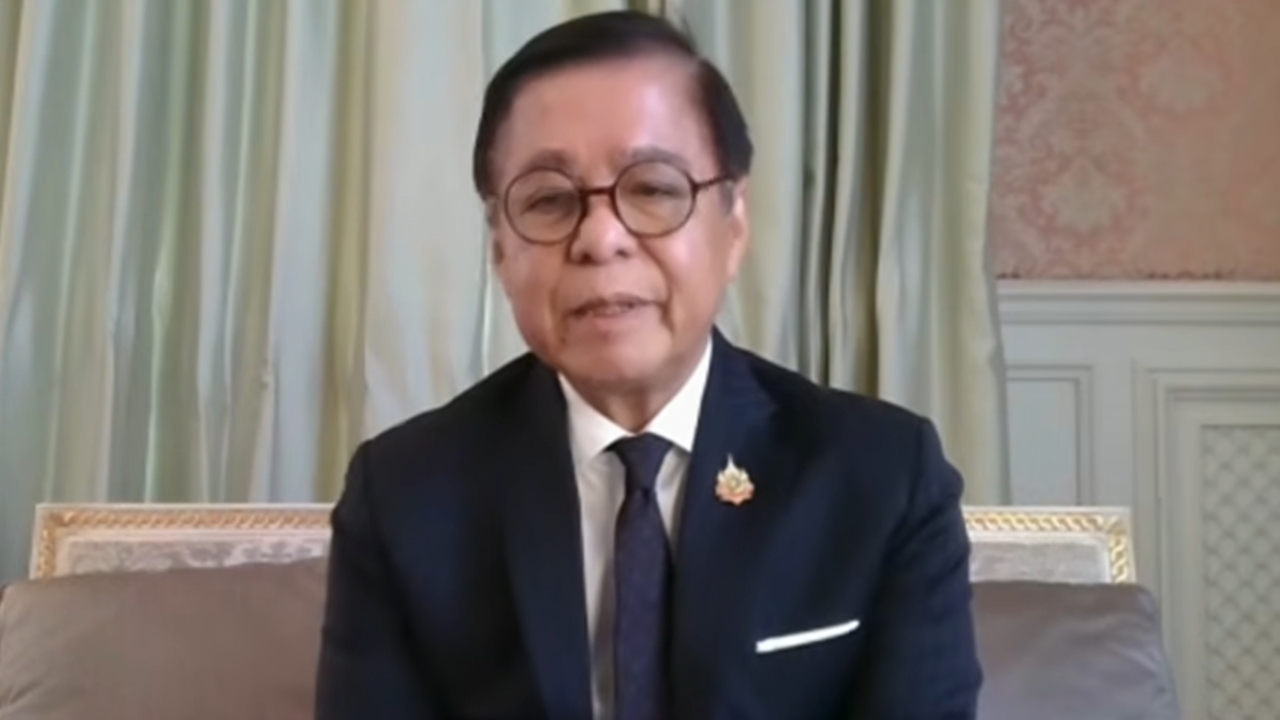
Sihasak Puangketkaew, Thailand's Minister of Foreign Affairs, gave an interview to France 24 during his official visit to France, responding to Hun Manet's claim that Thailand placed containers beyond the border.
Mr. Sihasak Puangketkaew, Thailand's Minister of Foreign Affairs, answered all questions from France 24 during his official trip to France, countering various distorted accusations previously made by Hun Manet in foreign media interviews.
The host asked about the situation between Thailand and Cambodia, noting that although a ceasefire agreement is still in place, the border situation remains unstable. Furthermore, Cambodian Prime Minister Hun Manet recently claimed that Thailand continues to encroach not only on border areas but also deep into Cambodian territory beyond areas Thailand previously claimed. The host requested Thailand's clarification on this allegation.
Mr. Sihasak explained that the fact is Thailand and Cambodia have agreed on a ceasefire framework, but the real situation remains very fragile. He believes that at this time, confidence-building must continue, with forces from both sides remaining in their positions, followed by joint efforts toward a future agreement on the border line between the two countries. Hun Manet may have overlooked the fact that, before the conflict, there was clear encroachment by Cambodia into Thai territory.
Mr. Sihasak said it is necessary to view the facts comprehensively, and the current reality is that efforts must focus on avoiding escalation, provocations, misinformation, and distortion, and maintaining calm so relations can move forward. Thailand believes that ultimately, all neighboring countries must coexist peacefully and prosper together, which is our goal, he affirmed.
The host also mentioned the issue where Cambodian Prime Minister said Thai soldiers placed containers and barbed wire in areas Thailand previously acknowledged as Cambodian land, asking if Mr. Sihasak's statement about both countries agreeing to a ceasefire and maintaining positions implies acceptance that Thai soldiers are currently in Cambodian territory and will not withdraw.
Mr. Sihasak responded clearly that he disagrees with that claim, explaining the areas where Thailand placed barbed wire or containers are within Thai sovereignty. These areas have long been encroached upon by Cambodia, dating back to Cambodia's conflict when Thailand opened its borders to accept about 400,000 Cambodian refugees. After the conflict ended and peace was restored, many Cambodian villages refused to return to their own land. Therefore, the claim that Thailand is encroaching beyond its border is completely incorrect.
The host also asked about the promise made by Prime Minister Anutin Charnvirakul before the election not to open the border and about plans to build a border wall between the two countries, questioning whether these plans would still proceed.
Mr. Sihasak answered that Thailand must take necessary steps to protect its sovereignty and territorial integrity, possibly including preventive measures to avoid Cambodian encroachment. However, all of this largely depends on Cambodia's stance—whether they genuinely seek peace with Thailand or continue on a path of conflict. This is Cambodia's decision; they are the ones turning this into an international issue and continuing to make false claims even after the ceasefire. He believes both sides should exercise restraint, avoid provocations, and move relations forward, but Cambodia's current claims represent a regression rather than progress in the relationship.
The host asked if the Thai Foreign Minister has communicated with Cambodia's Foreign Minister or if there have been discussions between the two countries' leaders. Mr. Sihasak replied that he has communicated and contacted Cambodia's Foreign Minister via WhatsApp, which he considers very important to avoid misunderstandings and situations that could spark conflict.
"I talk to Cambodia periodically, and at present, Thailand has just held elections and is in the process of forming a new government. Regarding issues Cambodia wants to discuss, I think we must wait until Thailand’s new government is established, which I have already informed Cambodia," he said.
In the meantime, both sides should strive to maintain peace and avoid situations that might lead to further conflict, as additional conflict would lead to greater losses, which he believes would not benefit either country.
The host also asked about maritime disputes, where Cambodia accused the Thai navy of seizing a Cambodian fishing boat with three crew members in Cambodian waters, inquiring about the actual situation. Mr. Sihasak clarified that Thailand must act if Cambodian fishing boats encroach into Thai waters, denying Cambodia’s claim that the area is Cambodian territory.
He countered that this tactic is commonly used by Cambodia to pressure Thailand and portray Thailand as the aggressor, which is not true. Thailand takes pride in its long-standing sovereignty, being the only Southeast Asian country never colonized, and adhering to diplomatic paths. Thailand has had to deal with Cambodia repeatedly involving international parties, which Cambodia should avoid if it wants to maintain good relations.
The host also asked about Mr. Sihasak’s meeting with Myanmar’s Foreign Minister and hopes to reintegrate Myanmar into ASEAN, despite Myanmar not fulfilling conditions such as ending fighting and comprehensive negotiations.
Mr. Sihasak noted that Myanmar has held elections, although imperfect, which may serve as a political transition within the country. He emphasized that Thailand does not recognize Myanmar’s elections but calls on Myanmar to move forward post-election through dialogue and reconciliation, hoping to initiate a peace process.
"This is the message Thailand wants to send—not that we are endorsing the elections, far from it. But the elections have happened, and that is a reality. So, as you know, what we are doing is calling on them: if they want to reengage, Myanmar must also demonstrate willingness to do so," he said.
"This is not a one-sided initiative; it requires cooperation from both sides. They must continue negotiations, reconciliation, and build a sustainable peace process. As a neighboring country, Thailand desires lasting peace in Myanmar, which is in our interest. We must work hard; we cannot just say we hope for peace and expect it to happen. We are actively working for peace and security."
Source:France 24
Click to read news aboutCambodia