

The prolonged conflict in South Sudan has caused numerous injuries and deaths, with hundreds of thousands of civilians displaced, while the humanitarian crisis worsens amid shortages of medicine, food, and shelter.
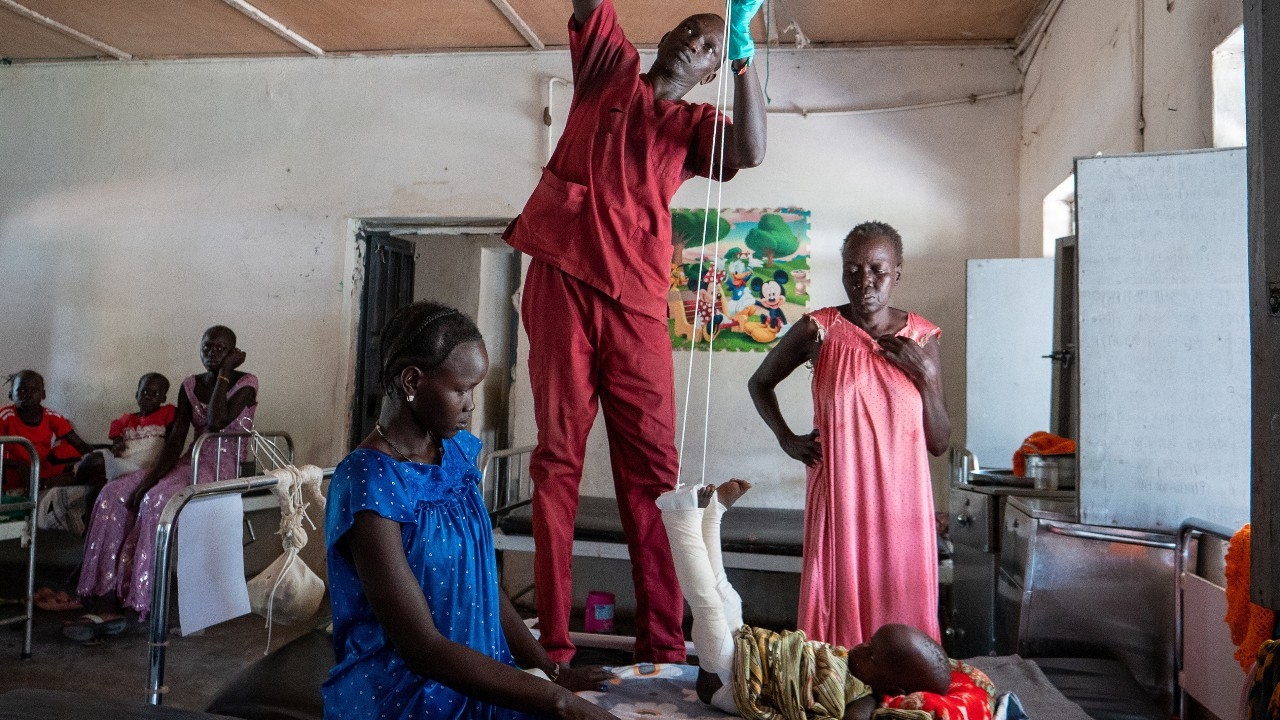
Nyayual Chuol, grandmother of an 18-month-old boy, carried her grandson to a hospital in the South Sudanese town of Akobo, located 130 kilometers from her village, to treat a gunshot wound on his leg, which she said was caused by government forces.
Upon arrival at the hospital, the resident physiotherapist treated the boy as two displaced persons, Nyayual Chuol and Kool Gatyen Pajock, watched.
A new clash in Jonglei State between the government military force known as the South Sudan People’s Defense Forces and the Sudan People’s Liberation Movement In Opposition has displaced 280,000 people in just two months.
This fighting has shaken the fragile peace established in 2018 after a five-year civil war in South Sudan.
In 2020, South Sudan formed a power-sharing government, appointing opposition leader Riek Machar as first vice president and Salva Kiir as president; however, Kiir later placed Machar under house arrest following violence that erupted in March.
By September, Machar and seven opposition members were charged with rebellion due to alleged involvement in attacks against government forces.
The conflict escalated in December when opposition forces captured government outposts in Jonglei State, prompting government counterattacks with bombings and ground assaults in January, despite peace agreements, resulting in heavy civilian casualties and displacement.
Nyankhiay Gatluak Jock, 28, one of 42,000 displaced persons living in a UN peacekeeping-protected camp in Akobo, fled her home village of Walgak after government forces attacked in early February. She stated that, for her, the peace agreement had ended, as the government forces would not kill civilians if it were still in effect.
After government forces bombed a hospital run by Doctors Without Borders on 3 February, Nyaphan Nyang Lual traveled to Akobo with her husband, daughter, and one-month-old granddaughter; en route, her husband was shot, and armed youth abducted her daughter.
Lual arrived in Akobo with her infant granddaughter Bhan Tut Mut but received no food assistance, while the baby suffered from diarrhea, causing Lual great anxiety.
Humanitarian services have not been spared from attacks. The United Nations Office for the Coordination of Humanitarian Affairs (OCHA) reported that 13 health facilities in Jonglei State were looted, some destroyed, and incidents of sexual violence have been reported in multiple areas.
Government budget cuts and increased restrictions on humanitarian organizations have led to shortages of resources including food and medical supplies. Nile Hope officials in South Sudan reported being unable to provide essential aid such as food, medicine, or shelter to displaced persons.

Tom Fletcher, UN Deputy Secretary-General for Humanitarian Affairs and Emergency Relief Coordinator, visited Akobo on 21 February to assess conflict-affected areas in South Sudan and called on the Security Council and regional powers to find ways to end the violence and conflict.
Thousands of displaced women and children at the camps welcomed Fletcher, though they remain uncertain about their safety and future prospects.
Some held handwritten signs reading “They kill everyone” to convey the dire situation.

Source:AP