

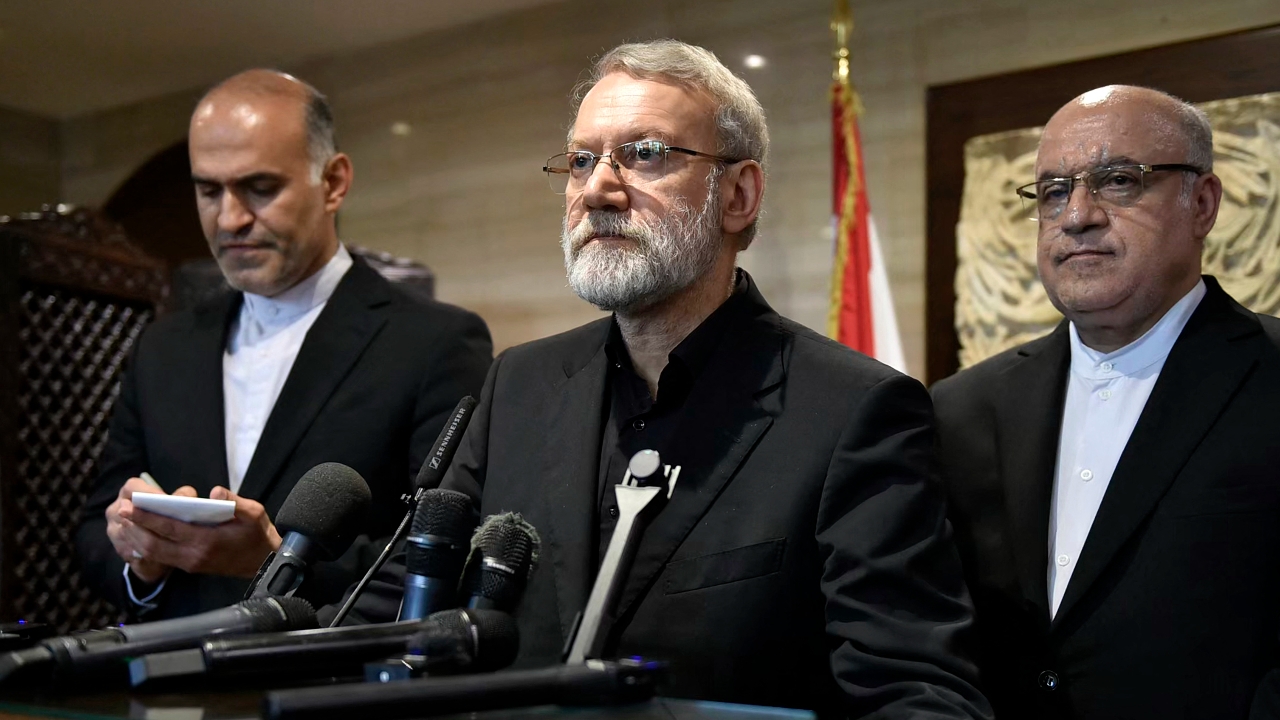
Ali Larijani, Secretary of Iran's Supreme National Security Council, responded to media reports claiming that Iran had contacted the United States through intermediaries to request resumption of negotiations. He said in a post on the X website that Iran "will not negotiate with the United States," emphasizing that Iranian forces "were not the ones who initiated aggression."
Larijani stated that U.S. President Donald Trump "has thrown the region into chaos with his misguided hopes," and is now concerned about further American military casualties. He added, "Through his mistaken actions, he transformed his own slogan 'America First' into 'Israel First' and sacrificed American soldiers in pursuit of Israel's power."
Larijani, a key advisor to Iran's Supreme Leader Ayatollah Ali Khamenei, reiterated that Iranian forces "did not initiate aggression first."
Ali Larijani, former speaker of the parliament and close associate of Ayatollah Ali Khamenei, returned to the center of power as Secretary of the Supreme National Security Council (SNSC) in August. He was assigned crucial tasks ranging from nuclear negotiations and strengthening regional ties to managing domestic protest groups.
On Sunday (1 Mar), Larijani announced on national television the establishment of an "Interim Leadership Council" to govern the country. He condemned the U.S. and Israel for attempting to plunder and undermine Iran's unity. He also warned separatist groups that any attempts to exploit the current situation would face the harshest retaliation. Reports confirmed that Major General Abdolrahim Mousavi, Iran's top military commander, died in the latest attack.
Larijani is recognized for effectively bridging various political factions in Iran. He recently traveled to Oman last month to prepare for indirect nuclear talks with the United States amid increased U.S. military presence in the Middle East.
Regarding nuclear policy, Larijani told Omani media, "This issue can be resolved" if the U.S. concern is to prevent Iran from acquiring nuclear weapons, which is a matter open to mutual agreement. However, he likened European proposals to abandon the nuclear program to exchanging "pearls for candy," reflecting his unwillingness to sacrifice the nation's core interests.
Despite his diplomatic image, Larijani was sanctioned by the U.S. government in January for allegedly orchestrating the violent suppression of anti-government protesters. The U.S. Treasury Department identified him as one of the first leaders to call for forceful action against civilians on Khamenei's orders, resulting in numerous deaths during the most severe protests since the 1979 revolution.
Another key role Larijani plays is as a liaison with allied powers. He frequently traveled to Russia to meet President Vladimir Putin to counterbalance pressure from Donald Trump. Additionally, he spearheaded the push for the 25-year cooperation agreement with China in 2021, asserting that Iran's nuclear program could not be destroyed because "once you discover the technology, no one can steal it."
Larijani was born in Najaf, Iraq, into a prominent Iranian religious leadership family. He holds a doctorate in philosophy and has siblings in high-ranking positions in the judiciary and foreign ministry. Despite being disqualified by the Guardian Council from running in the 2021 and 2024 presidential elections due to lifestyle and family foreign ties issues, his daughter was recently dismissed from a U.S. medical faculty position following heavy protests.
Amid the power vacuum following Khamenei's death, Larijani's role as a coordinator among various power factions within Iran's political system is closely watched as a key factor that may determine the country's direction during one of its most sensitive turning points in contemporary history.