

Where does the Strait of Hormuz deliver oil to, and which countries would be hardest hit if the strait is closed due to the Middle East crisis? With limited alternative routes and rising energy demand.
The cooperation between the United States and Israel in attacking Iran sparked a swift retaliatory response from Iran, leading analysts to warn of a sharp rise in global oil prices. Although Iran has not officially declared the strait closed, the Islamic Revolutionary Guard Corps broadcast a warning to ships in the area prohibiting entry into the "Strait of Hormuz." This strait is one of the world's most important shipping routes, handling both energy exports and imports, with about 30% of the world's seaborne crude oil transported through it.
Where do oil and natural gas go after passing through the Strait of Hormuz?
The U.S. Energy Information Administration (EIA) estimates that in 2024, about 84% of crude oil and condensate, as well as over 83% of LNG, transit the Strait of Hormuz. The main destinations are China, India, Japan, and South Korea, which together account for 69% of crude oil imports through the strait last year. The manufacturing, transportation, and power generation sectors in these countries heavily rely on energy products from the Persian Gulf region for their operations.
Who is affected?
Closing the Strait of Hormuz would severely impact the aforementioned Asian countries, which are major buyers, with China being the largest importer—accounting for 90% of Iran's oil exports to the global market. Disruption in oil transportation could increase fuel costs in China's manufacturing and export sectors.
It would also affect the sellers, namely the Arab Gulf countries whose economies largely depend on massive energy exports. For example, Saudi Arabia exports about 6 million barrels per day of crude oil through the Strait of Hormuz, the highest volume compared to other countries in the region.
Similarly, Iran exports approximately 1.7 million barrels per day, generating oil export revenues of around 67 billion U.S. dollars in the fiscal year ending March 2025. This is Iran's highest oil revenue in a decade, according to estimates from the Central Bank of Iran.
Disruptions in energy transport through the Strait of Hormuz would broadly impact the global economy by raising fuel and manufacturing costs. If crude oil prices surge to 100 dollars per barrel and remain there long enough, global inflation could rise by 0.6-0.7%, pushing natural gas prices higher as well. This scenario might lead major central banks worldwide to slow down monetary easing policies.
Closure of the Strait of Hormuz would instantly remove about one-fifth of the world's traded oil supply. Oil prices would not only rise but spike sharply due to panic.
However, Iranian official media stated that the final decision to close the strait must come from the Supreme National Security Council and be approved by the government.
Meanwhile, energy traders remain on high alert amid the situation. A senior crude oil analyst at Kpler noted that since the conflict began on Saturday, 28 February, the volume of vessels transiting the Strait of Hormuz has noticeably decreased.
Geography of the Strait of Hormuz
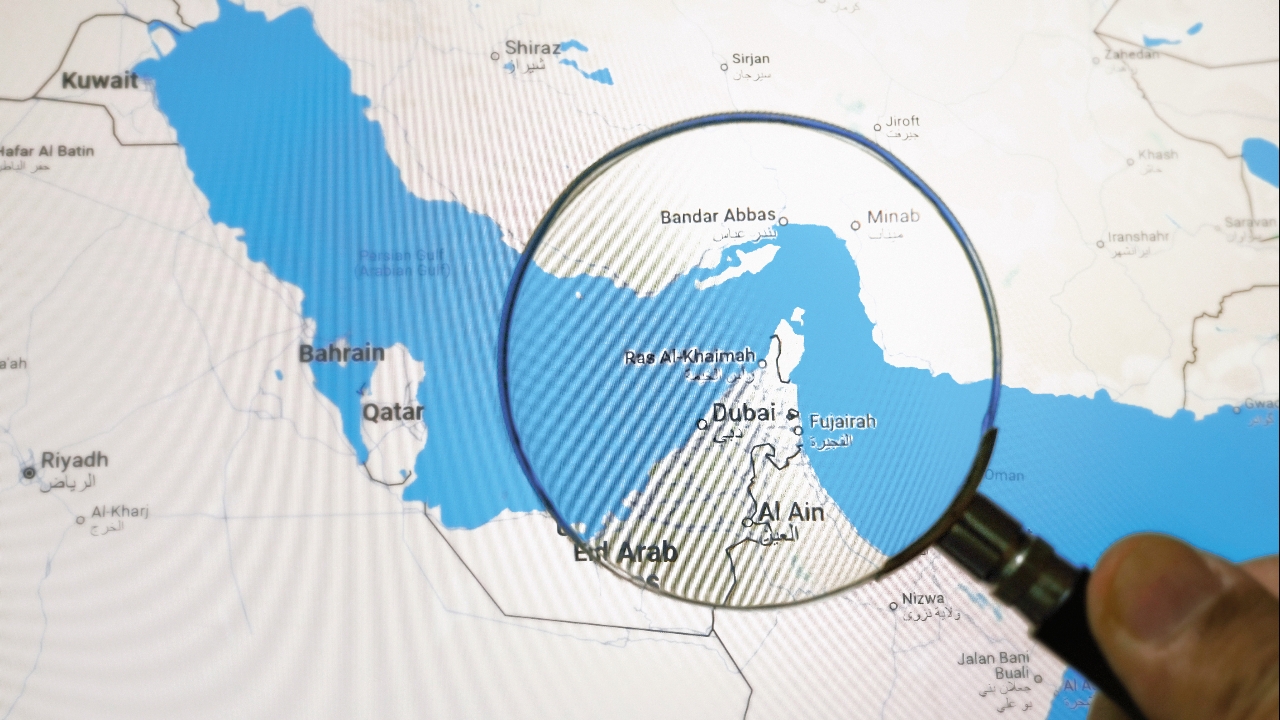
The Strait of Hormuz lies between the Persian Gulf (Arabian Gulf) and the Gulf of Oman, connecting to the Arabian Sea. Its northern shore borders southern Iran, while its southern shore borders the eastern coasts of the United Arab Emirates and Oman.
The narrowest point of the Strait of Hormuz is only 33 kilometers (21 miles) wide, with shipping lanes just 3 kilometers (2 miles) wide on each side. This narrowness makes the area highly vulnerable to attacks. Despite its limited width, the strait can accommodate the world's largest crude oil tankers and serves as the main route for major Middle Eastern oil and gas exporters to ship energy products to global markets.
Currently, the number of ships anchored on both sides—in the Gulf of Oman and the Persian Gulf—is increasing sharply. Shipping data shows at least 150 oil and gas tankers are anchored outside the Strait of Hormuz, as shipowners worry about navigation safety following Iran's threat to close the strait.
On Sunday, 1 March, reports emerged of an attack on oil tankers off the coast of Oman, signaling an escalation of the conflict with targets shifting from military infrastructure to energy assets.
Can alternate routes compensate for a blockade?
The ongoing threats to close the Strait of Hormuz over recent years have pushed Gulf oil exporters to develop alternative export routes.
Saudi Arabia has activated the East–West pipeline, stretching over 1,200 kilometers, capable of transporting up to 5 million barrels of crude oil per day. In 2019, Saudi Arabia temporarily repurposed a natural gas pipeline to transport crude oil.
The United Arab Emirates has connected oil fields via a pipeline with a capacity of 1.5 million barrels per day to the port of Fujairah on the Gulf of Oman. Similarly, Iran opened the Goreh–Jask oil pipeline in July 2021 to transport crude oil directly to the Gulf of Oman; it currently has a capacity of about 350,000 barrels per day.
However, the U.S. Energy Information Administration (EIA) estimates these alternate routes can collectively handle only about 3.5 million barrels per day, roughly 15% of the crude oil volume currently transported through the Strait of Hormuz.
Read more aboutInternational news