

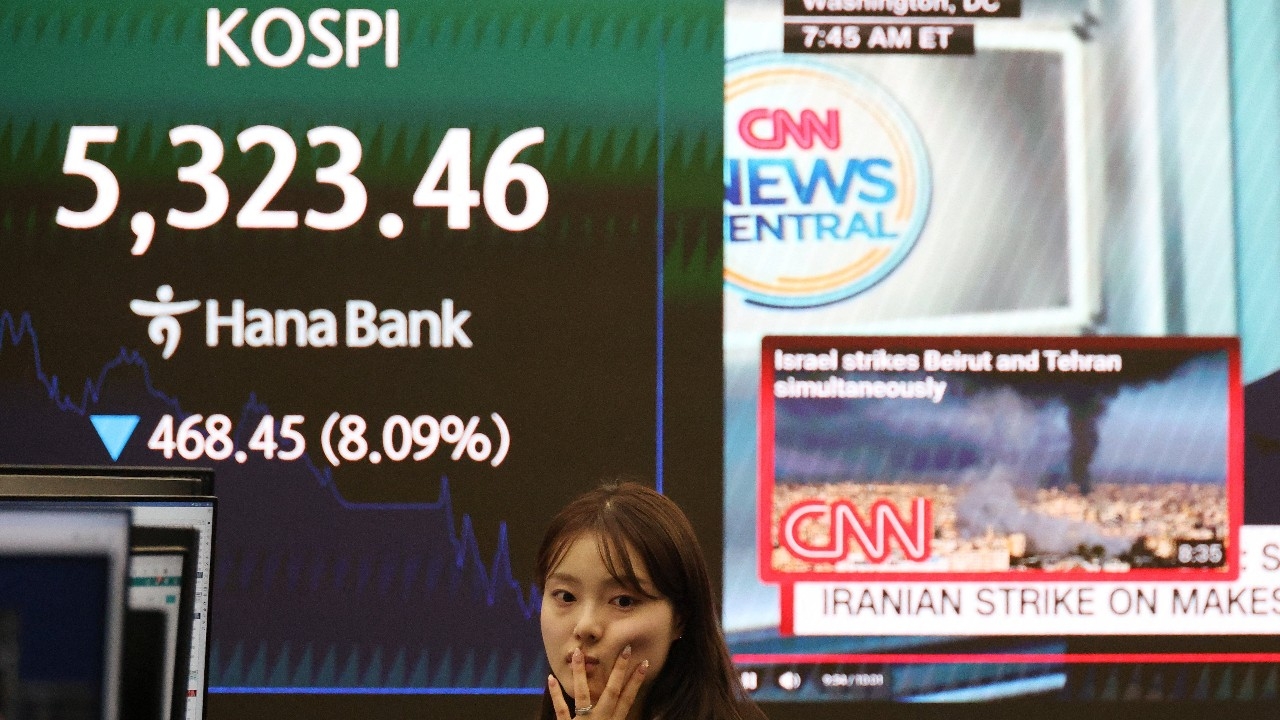
The Middle East conflict has caused major stock indexes in Asia to plunge sharply, including in Japan, Singapore, Hong Kong, and South Korea, which has had to implement temporary trading suspension measures due to the impact.
South Korea’s stock exchange announced a temporary trading halt today (4 Mar) after its key indexes sharply declined amid rising tensions in the Middle East.
The Kospi index plunged 12% today, worsening the heavy sell-off that began yesterday. The Middle East conflict severely undermined investor confidence, prompting South Korea’s stock exchange to impose a trading halt after both the Kospi and Kosdaq indexes fell more than 8% during morning trading, with the Kospi eventually dropping over 12%.
Previously, on Tuesday (3 Mar), the index had dropped 7.2%, marking its worst decline since August 2024, as investors withdrew from a market that had surged earlier, driven by enthusiasm for artificial intelligence (AI) stocks.
South Korea is the world’s fourth-largest crude oil importer, relying almost entirely on energy imports, with about 70% of its oil imports coming from the Middle East region.
On the currency front, the South Korean won weakened past the psychological threshold of 1,500 won per dollar for the first time in 17 years, prompting the Bank of Korea (BOK) to issue a statement immediately after markets opened. The central bank said it will closely monitor whether the won’s exchange rate and bond yields are deviating excessively from domestic fundamentals, even considering external factors, and reaffirmed its commitment to counter herd-like behavior in the market.
The situation also impacted the broader Asian markets, with Japan’s Nikkei index falling 3.5% to a one-month low due to risk asset sell-offs, while the Topix index dropped 3.7%. Hong Kong’s stock market declined 3%, and Singapore’s Straits Times index fell 2.4% by local noon. Strategists at IwaiCosmo Securities noted that investors shifted to selling indexes that had previously performed well, such as Nikkei and Kospi, to quickly secure profits amid risk.
In energy markets, WTI crude oil prices surged 12% to over $75 per barrel since the attacks began last Friday, while Brent crude rose more than 13%, staying above $82. Despite U.S. President Donald Trump’s promise that the Navy would protect oil tankers passing through the Strait of Hormuz to ease concerns, Iranian attacks on neighboring countries and the closure of some oil fields continue to exert enormous pressure on Asia’s energy-import-dependent economies.
:CNA
Read more on the Middle East warhere