

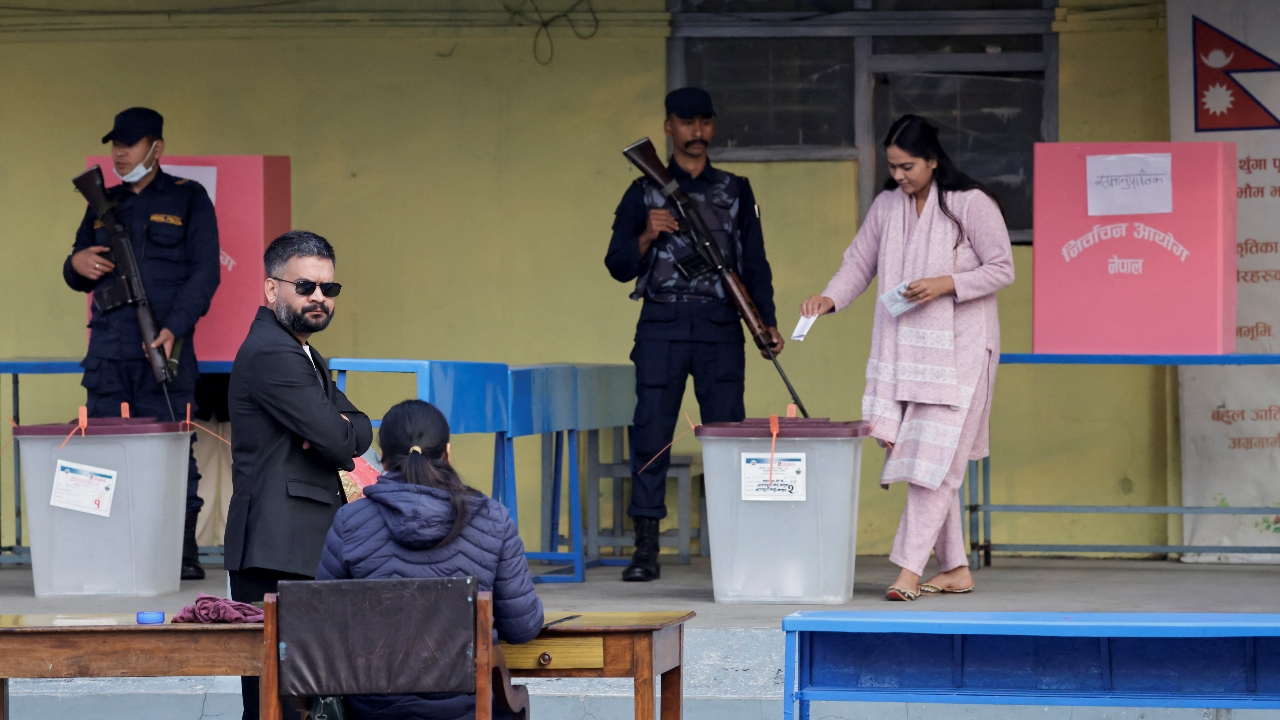
Nearly 19 million Nepalese went out to vote for a new House of Representatives amid tight security following major anti-corruption protests that toppled the previous government six months ago. Attention is focused on the clash between long-standing veteran politicians and the new "Gen Z" generation seeking to bring innovation and change to the country.
Nepalese began lining up to vote from early dawn today (5 Mar) across Kathmandu and remote areas. This election is highly significant as it will select the new government to replace the caretaker administration after the mass uprising in September 2025, which resulted in at least 77 deaths and the burning of several government buildings.
Acting Prime Minister Susila Karki cast her vote, thanking the public and urging for a peaceful election, stating, "Every vote will determine the nation's future," amid heavy deployment of military and police forces ensuring security.
This election features a contest among three distinctly different power blocs, including former leftist Prime Minister KP Sharma Oli, who was ousted last year and is attempting to regain power.
Balendra Shah, 35, a former rapper and Kathmandu mayor from the Rastriya Swatantra Party (RSP), has become a symbol of the new generation's power, along with Gagan Thapa, 49, the new leader of the Nepali Congress, the country's oldest political party, who has vowed to end the era of the 'old guard' politicians.
A key focus is Constituency No. 5 in Japa, a direct battleground between KP Sharma Oli and Balendra Shah. Locals express that the sacrifices of the younger generation during the protests must lead to transparent, corruption-free governance and meaningful change.
Nepal has had to use helicopters to transport election materials to remote mountainous areas, including regions near Mount Everest's summit.
More than 3,400 candidates are competing for 165 seats in the House of Representatives through constituency voting, plus 110 seats via proportional representation, out of a total of 275 seats. The Election Commission expects preliminary results within 24 hours, though proportional representation tallies may take longer. Analysts predict no party will gain an outright majority, leading to likely lengthy negotiations to form a coalition government.
,AFP