

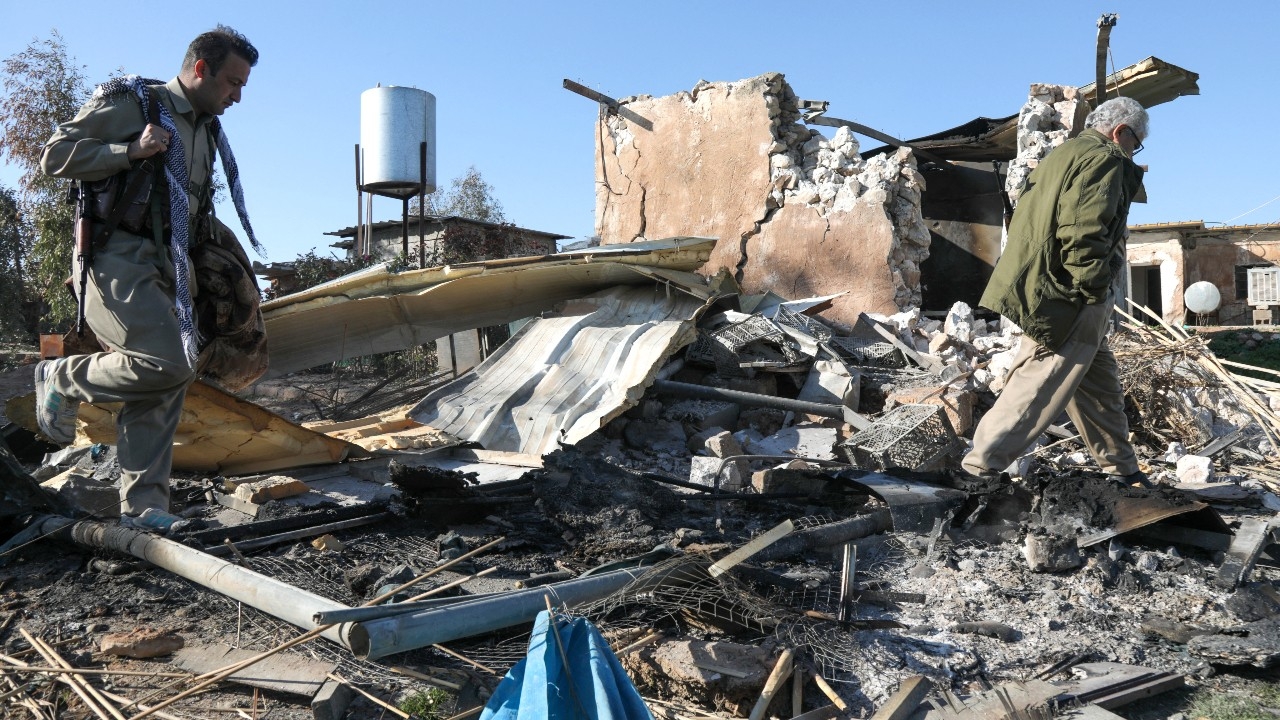
Iran launched attacks on bases of Iran-affiliated Kurdish armed groups in Iraq's Kurdistan region, using both missiles and drones, amid rising tensions fueled by reports that the United States may support Kurdish groups in fighting Iran.
The Iranian military revealed it struck the headquarters of Iran-affiliated Kurdish armed groups in northern Iraq's Kurdistan region, stating that three missiles were fired at Kurdish groups opposing the Islamic Revolution in Iraq, according to Iranian state media reports.
These attacks occurred amid escalating regional tensions following reports that U.S. President Donald Trump might seek to involve Kurdish armed groups in the fight against Iran, while U.S. and Israeli operations against Iran continue.
Sources confirmed that Iran's attacks on Tuesday and Wednesday resulted in at least one death and three injuries. One base was hit by a long-range missile around 11:00 a.m. local time, wounding four Kurdish Peshmerga fighters, with one later dying.
The targeted base sustained heavy damage; one building was destroyed and collapsed, with concrete and metal debris scattered widely, along with a large crater from the missile explosion.
Meanwhile, another base belonging to the Kurdistan Democratic Party of Iran (KDPI) was attacked by two drones on Tuesday, injuring at least one civilian.
A senior KDPI political leader said he believes the Kurds may soon play a role in Iran's internal conflict but did not specify a timeline, and declined to comment on reports that President Trump had contacted group leaders recently.
Separately, the Iran-backed Kataeb Hezbollah militia in Iraq announced that a senior commander died in an airstrike in southern Iraq recently. The deceased, Ali Hussein Al-Freiji, had been a member of the group for over 20 years.
Insiders said the attack occurred near the group's main base in southern Iraq, killing at least three fighters. One source accused the strike of being a joint operation by Israel and the United States.
The Jurf Al-Nasr base of Kataeb Hezbollah was the first target in Iraq reportedly hit by strikes attributed to U.S. and Israeli forces before expanding to other locations. Since the conflict began, at least 15 militia fighters have been killed.
Although Iraq, recovering from years of unrest, insists it does not want to be drawn into the U.S.-Iran conflict, it continues to be affected, as it has long been a battleground for influence between the two powers.
Several Iran-backed armed groups in Iraq, known collectively as the "Islamic Resistance in Iraq," including Kataeb Hezbollah, claim to have continuously launched drone attacks on U.S. bases in Iraq.
Recently, these groups have warned European countries against joining the conflict, threatening to target their forces and bases in Iraq and the region if they become involved.
Earlier, Iraqi state media reported that security forces seized two rockets and a launcher in southern Basra province, which were prepared for attacks on neighboring countries.
The Kurds, numbering approximately 25–35 million, inhabit mountainous regions spanning Turkey, Iraq, Syria, Iran, and Armenia. They are the fourth largest ethnic group in the Middle East but have never had their own nation-state.
In Iran, with a population of about 84 million, Kurds constitute roughly 10% of the population, mostly Sunni Muslims living in the country's northwest.
Amnesty International has reported that Kurds in Iran face long-standing discrimination in social, political, cultural, and economic rights, while Kurdish opposition groups exiled in Iraq's Kurdistan region continue to push for independence or autonomy, clashing periodically with Iranian security forces over the years.
.sourceBBC