

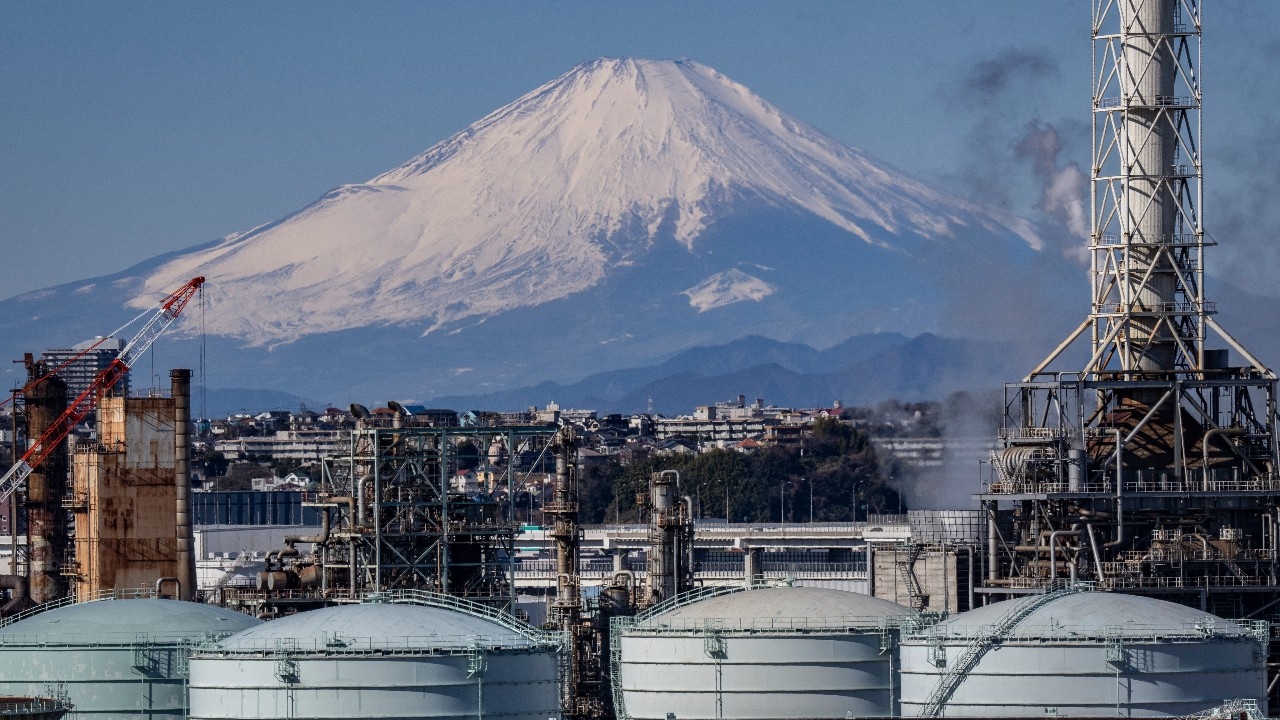
The Japanese government announced it has begun releasing oil from its strategic petroleum reserves after the International Energy Agency (IEA) approved member countries to release stockpiles to ease soaring energy prices caused by the Middle East war. The government also confirmed it has no plans to send Self-Defense Forces naval units to assist the U.S. in protecting shipping lanes.
The Japanese government officially declared through the Royal Gazette that it has initiated the process of reducing the country's oil reserves. This action responds to the International Energy Agency's (IEA) resolution on 11 March aimed at mitigating the impact of rising oil prices caused by the Middle East conflict.
Government spokesman Minoru Kihara stated that Japan will release private sector oil reserves equal to 15 days of domestic consumption. Meanwhile, Ryose Akazawa, Minister of Economy, Trade and Industry, added that the initial release will focus on private sector stockpiles before tapping into government reserves.
Japan is among the countries with the largest oil reserves globally, holding over 400 million barrels as of December. This amount suffices for domestic consumption for up to 254 days.
The IEA reported that members worldwide agreed to release a combined total of 271.7 million barrels of oil, marking the largest coordinated response to date. The plan specifies that member countries in Asia and Oceania will start releasing oil immediately, while those in the Americas and Europe will commence by late March.
On the security front, the Japanese government made a clear stance in response to U.S. President Donald Trump's request for allies, including Japan, to send warships to escort oil tankers in the Strait of Hormuz after Iran closed the shipping route in retaliation against the U.S. and Israel.
Defense Minister Shinjiro Koizumi told parliament, "Under the current situation, we have not considered any maritime security operations." This aligns with Prime Minister Sanae Takaichi's statement that she has not received an official request from President Trump and emphasized that any decision must prioritize Japan's interests and domestic legal frameworks. She acknowledged that deploying Self-Defense Forces abroad is "very difficult legally" due to the 1947 pacifist constitution.
Japan, the world’s fourth-largest economy, remains highly vulnerable in energy security because it depends on Middle East oil imports for 95% of its supply, with over 70% transported through the Strait of Hormuz.
Iran's closure of the Strait of Hormuz directly threatens Japan's energy security, prompting the government to accelerate releasing oil reserves to maintain economic stability while avoiding international military conflict.
,AFP