

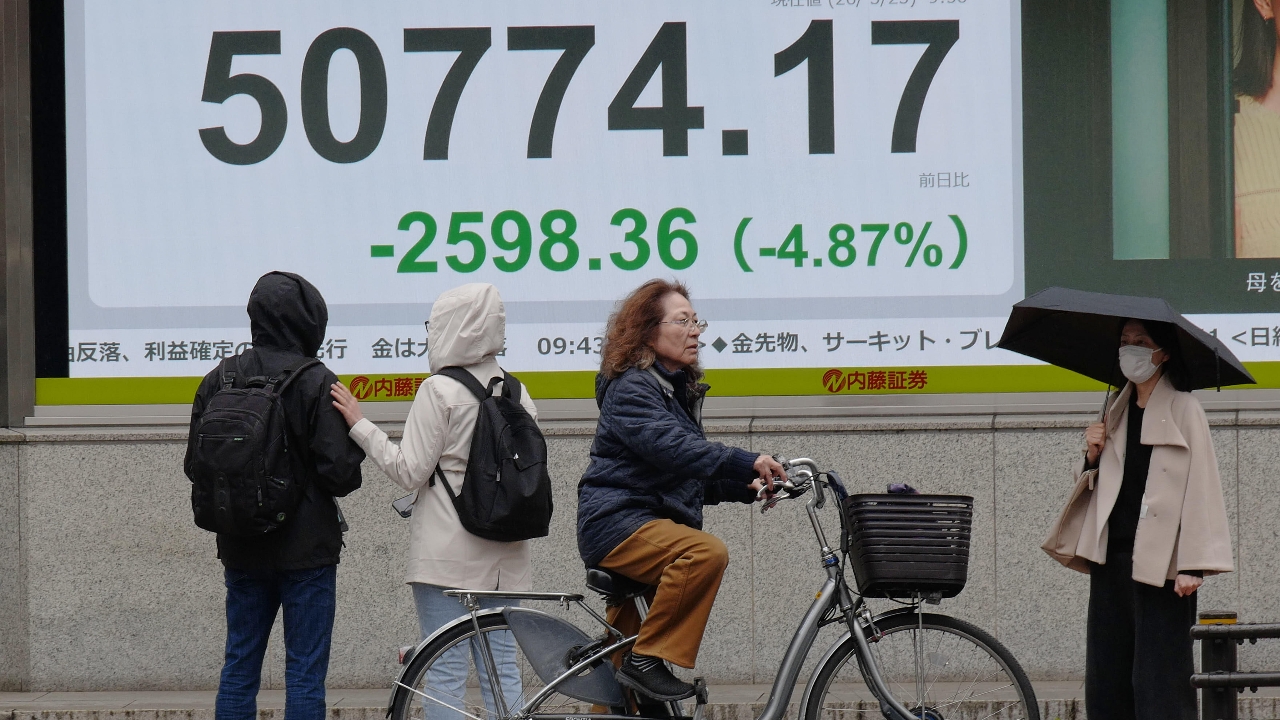
Asian stock markets opened sharply lower after President Donald Trump issued an ultimatum to Iran to reopen the Strait of Hormuz within 48 hours. If Iran does not comply, the U.S. will strike power plants throughout the country. In response, Iran threatened to destroy infrastructure across the entire region.
Tensions in the Middle East have continued to escalate, entering the fourth week of conflict. This has caused major Asian stock markets to plunge heavily at this morning’s opening (23 March). Japan’s Nikkei 225 index dropped over 3.4%, South Korea’s Kospi fell nearly 5%, while Hong Kong and Taiwan markets both declined by more than 2%.
The latest trigger came after U.S. President Donald Trump posted online late Saturday night (21 March) at 23:44 GMT, or Sunday 06:44 Thailand time, demanding Iran fully reopen the Strait of Hormuz for navigation within 48 hours. Otherwise, the U.S. military would launch strikes to destroy power plants across Iran, starting with the largest facility. This threat was a response to Iran’s missile attacks on the Israeli cities of Dimona and Arad.
Iran’s Parliament Speaker Mohammad Bagher Ghalibaf immediately retaliated, warning that if the U.S. attacks Iranian power plants, Iran would destroy energy and freshwater infrastructure throughout the region in turn.
Iran has been blocking the Strait of Hormuz, one of the world's most vital oil shipping routes, since 28 February following attacks by the U.S. and Israel. Normally, this strait handles about 20% of global crude oil and liquefied natural gas (LNG) trade. The blockade has rapidly driven up global fuel prices.
Fatih Birol, Executive Director of the International Energy Agency (IEA), said during a press briefing in Canberra, Australia, that the world is facing the worst energy crisis in decades—worse than the 1970s oil crisis and more severe than the impact of Russia’s 2022 invasion of Ukraine.
Global oil prices remain high, with Brent crude trading around 112 U.S. dollars (approximately 3,700 baht) per barrel. U.S. crude prices have risen 0.2% to about 98.57 U.S. dollars (around 3,250 baht) per barrel.
Japan and South Korea are among the hardest hit in the region, as both countries heavily rely on oil and natural gas imports passing through the Strait of Hormuz. Prolonged warfare, escalating conflicts, and threats of infrastructure attacks from both the U.S. and Iran will severely impact the economic systems and manufacturing sectors across Asia, making such effects unavoidable.
:BBC
Read more aboutMiddle East War