

Dutch archaeologists are urgently conducting DNA tests on a skeleton uncovered beneath the altar of a church in Maastricht after evidence suggested it could be the remains of Charles de Batz de Castelmore, known as d'Artagnan, the French musketeer who died in the 1673 war, reinforcing the legend that the musketeer was a real historical figure.
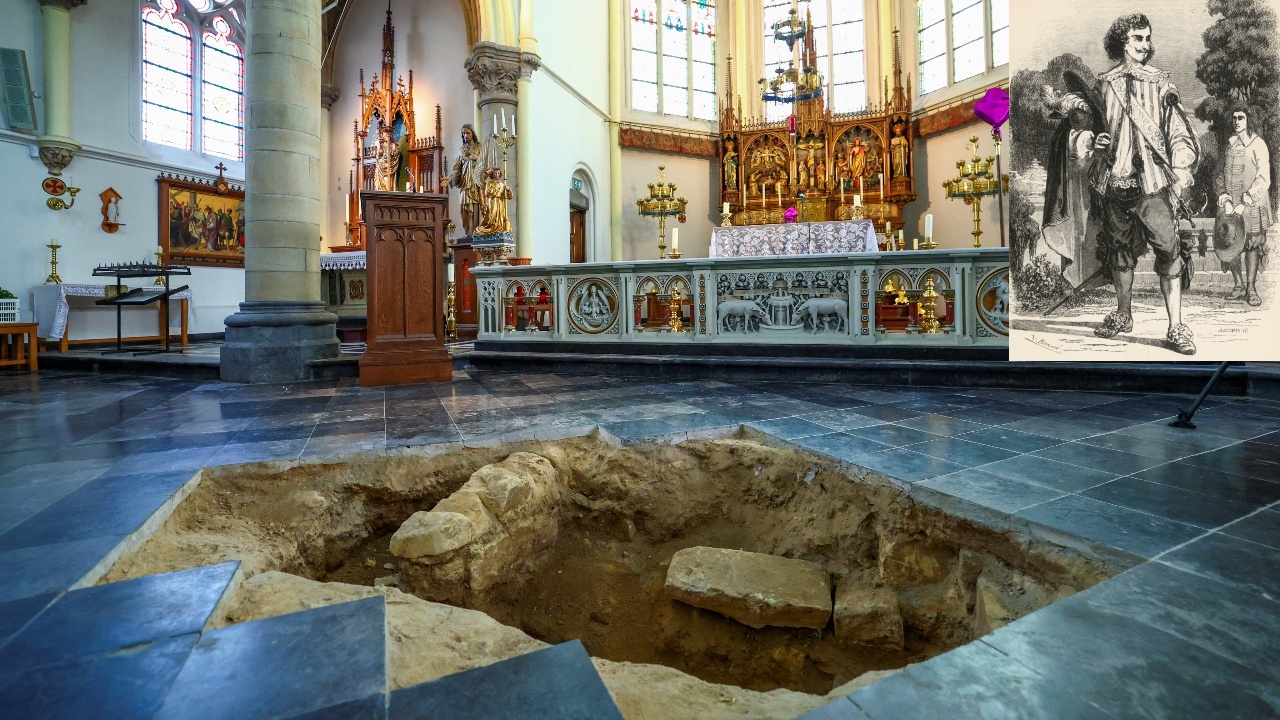
Church officials and archaeologists revealed the discovery of human skeleton remains believed to possibly belong to d'Artagnan (Charles de Batz de Castelmore), the famous French musketeer, found in front of the altar at St. Peter and Paul Church in Maastricht, the Netherlands.
This discovery occurred by chance after part of the church floor collapsed in February, leading workers to uncover a grave beneath the tiles. This prompted an investigation to verify the individual's identity through DNA testing of the jawbone, to be compared with living descendants.
Although the name d'Artagnan is widely known worldwide from Alexandre Dumas's 1844 novel The Three Musketeers, he was in fact a real historical figure who served as captain-secretary of the musketeers under King Louis XIV of France.
d'Artagnan died in battle during the siege of Maastricht in the Franco-Dutch War on 25 June 1673 after being shot in the neck by a musket ball. At that time, transporting his body back to Paris during the hot summer was extremely difficult.
Archaeologist Wim Dijkman noted several clues supporting this theory, including the burial location near the French army camp. Additionally, coins dated 1660 and lead musket ball fragments were found near the grave, along with a letter indicating d'Artagnan was buried in a sacred area. Being buried beneath the altar is considered the most hallowed spot.
Jos Valk, a church canon, said, "Considering all the evidence together, it seems very likely, but of course we must await definitive DNA confirmation." If confirmed, this would end a more than 350-year-long search for the musketeer's grave.