

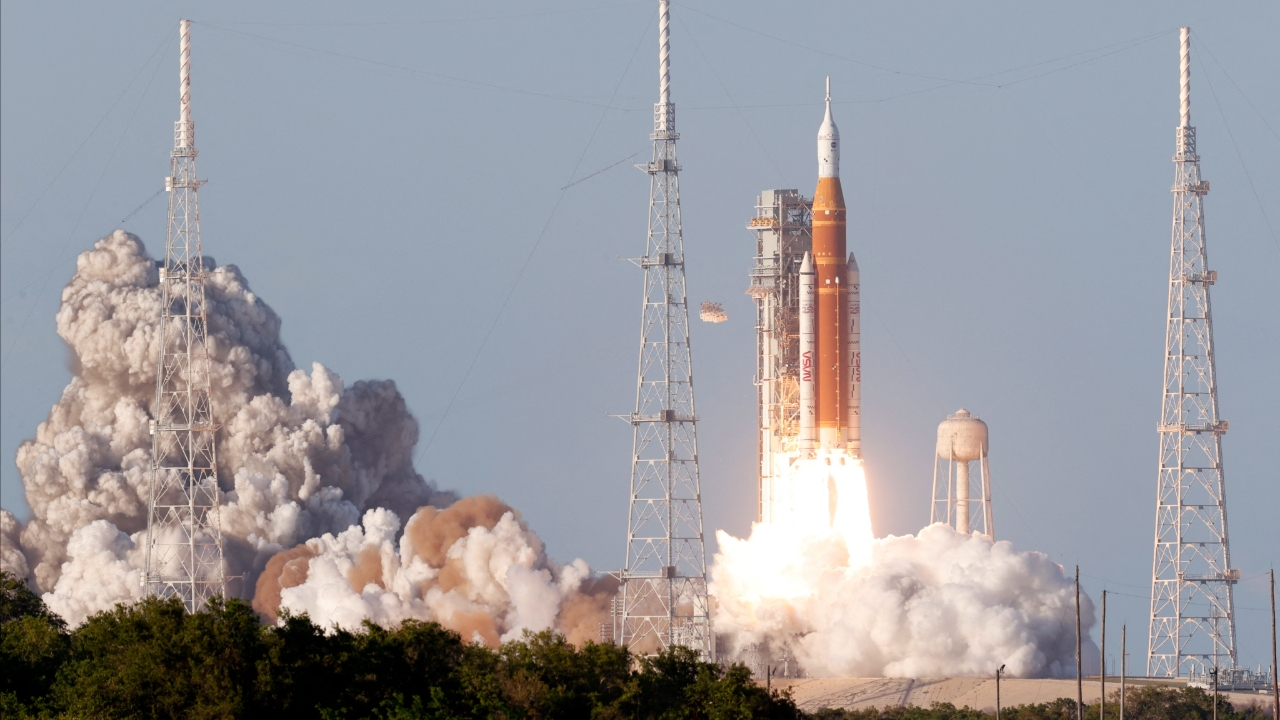
The Artemis 2 mission has departed Earth to take astronauts on a lunar orbit for the first time in over 50 years, laying the groundwork for the next mission to send humans to walk on the moon again.
NASA’s SLS rocket launched from the Kennedy Space Center at Cape Canaveral, Florida, at 18:24 local time, carrying the Orion spacecraft and the four-member Artemis 2 crew on their first lunar orbit in more than five decades.
The four astronauts consist of three NASA pilots—Reid Wiseman, Victor Glover, and Christina Koch—and one from the Canadian Space Agency (CSA), Jeremy Hansen.
The primary goal of the approximately 10-day Artemis 2 mission is to test the performance and safety of the Orion spacecraft before commencing Artemis 3, planned to return astronauts to the lunar surface.
After the SLS rocket ascends, it will jettison its booster fuel tanks. Then the Orion spacecraft and the Interim Cryogenic Propulsion Stage (ICPS) will separate from the main rocket core and continue their journey in Earth orbit.
While orbiting Earth, Orion will switch to manual control mode, allowing the crew to test navigation and flight path controls. Additionally, deep space GPS and communication systems will be tested.
If all systems function normally, Orion will ignite its engine to generate the thrust needed to escape Earth’s orbit and head toward the moon, a journey taking about four days to reach the lunar far side, orbiting approximately 370,000 km from Earth.
The astronauts will then test radiation shielding and emergency procedures before the final phase, with Orion returning to Earth over another four days and splashing down in the Pacific Ocean.
If successful, Artemis 3 could occur in 2027 (assuming the spacecraft is ready). NASA aims to return to the moon to establish a sustainable base by building a surface outpost and an orbital space station, hoping to achieve this before China, which plans to send astronauts to the moon by 2030.
Follow international news:https://www.thairath.co.th/news/foreign
Source:CNN