

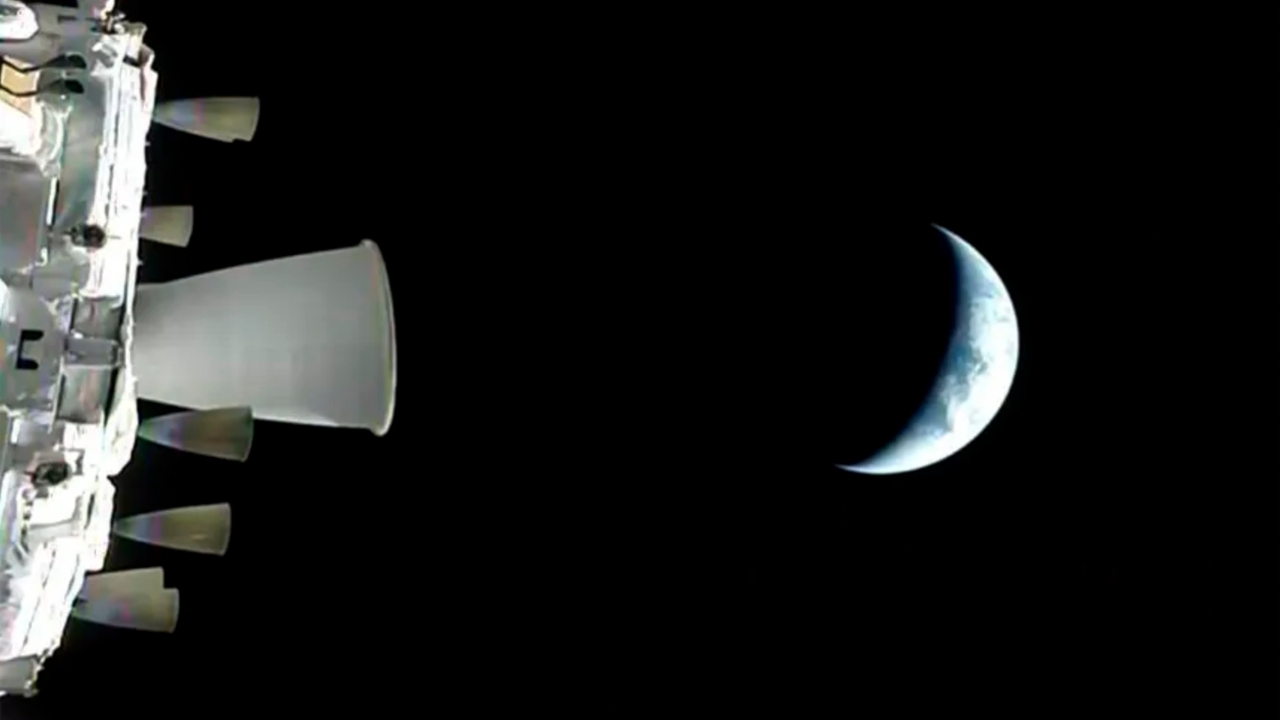
Astronauts on the Artemis 2 mission ignited the engine to propel the Orion capsule spacecraft out of Earth's orbit, fully embarking on a journey toward the Moon. This is the first time in 50 years that humans have traveled beyond Earth's boundary.
On Thursday, the mission control center in Houston confirmed that the Orion capsule ignited its engine for nearly six minutes to accelerate beyond Earth's gravitational pull, heading toward the Moon with tremendous thrust—comparable to accelerating a car from a standstill to highway speed in under three seconds.
After spending 25 hours adjusting in Earth's orbit, three American astronauts and one Canadian aboard the Orion capsule received the critical ignition signal, known as Translunar Injection, to accelerate beyond Earth's gravity, aiming for a nearly 400,000-kilometer journey.
This engine ignition marks the first time in half a century since the Apollo 17 mission in 1972. NASA confirmed that all proceeded according to plan. Next, the Orion spacecraft will take the astronauts around the far side of the Moon to capture surface images from angles never seen before with the naked eye before looping back to Earth. This marks the beginning of establishing a permanent base on the Moon in the future.
Jeremy Hansen, one of the astronauts on this mission, excitedly reported, “Humanity has once again demonstrated what we are capable of.” The astronauts are currently on a "Free-return trajectory," which uses the Moon's gravity to sling the spacecraft back to Earth without fuel propulsion in case of emergency.
Before the critical engine ignition, the four astronauts—Reid Wiseman, Victor Glover, Christina Koch, and Jeremy Hansen—spent the initial time in space checking systems and resolving minor issues, such as communication and malfunctioning toilet systems. They also began their daily routine with 30 minutes of exercise to prevent muscle and bone loss in microgravity.
Artemis 2 is not just a 10-day lunar orbit mission but also sets new records by sending the first female astronaut (Christina Koch), the first Black astronaut (Victor Glover), and the first non-American astronaut (Canadian Jeremy Hansen) around the Moon. If successful, they will become the humans who have traveled farthest from Earth in history—over 400,000 kilometers—paving the way for a lunar surface landing in 2028 and establishing a permanent base to support deeper space exploration.
This mission is also closely watched in terms of international politics amid competition with China, which aims to land humans on the Moon by 2030, as well as pressure from the U.S. administration to achieve success before 2029. However, some experts continue to monitor technological and budgetary challenges, as NASA heavily relies on private sector technology for future missions.
/sourceAP